🎯 Summary of Content:
The “Safety First” manual for securing land and villas: From Due Diligence to Title Transfer.
🎯 Quick Answer: Learning how to buy property in Bali safely typically involves a process of 2 to 8 weeks for straightforward transactions (though complex cases involving title disputes or inheritance can extend to several months). For foreign investors, the safest route is establishing a PT PMA (Foreign-Owned Company) to secure a Hak Pakai (Right to Use) or HGB (Right to Build) title. The process requires a strict sequence: 1) Sign an MOU to lock the price, 2) Conduct Due Diligence (Zoning Verification), 3) Sign the SPA (Sales Purchase Agreement) with a notary, and 4) Finalize the AJB (Deed of Sale) for title transfer. Skipping the zoning check (Pink vs. Green zone) is the #1 cause of failed investments.
👤 Written by: Rasmus Holst Founder & CEO of Coco Development Group. Reviewed by: Head of Legal & Compliance at COCO Development Group
Last updated: 19 January 2026
ℹ️ Transparency: Let’s be real about our bias. COCO Development Group is a property developer; we build and sell investment resorts in Bali. We write these guides because we believe educated investors make the best clients. However, the “Safety First” protocols outlined below are not sales fluff, they are the exact operational standards we use to protect our own capital. We share this roadmap to ensure you can navigate the market safely, whether you choose to invest with us or someone else.
Overview: The Acquisition Timeline
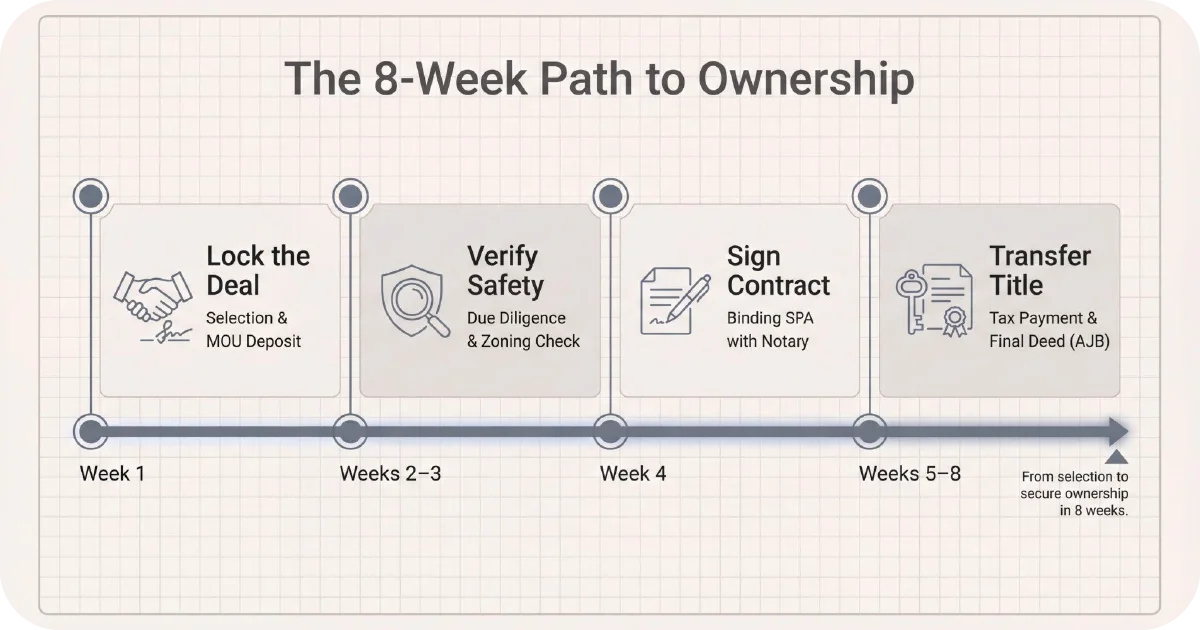
- Week 1: Property Selection & MOU (Deposit)
- Week 2-3: Due Diligence (Zoning & Legal Checks)
- Week 4: Signing the SPA (Binding Contract)
- Week 5-8: Tax Payments & Final Title Transfer (AJB)
Phase 1: The Prerequisites (Before You Buy)
This step-by-step manual is the practical execution chapter of our broader Buy Property in Bali While that main guide covers the “What” and “Why” of the market, this article focuses exclusively on the How.
Before looking at Bali properties, you must define your “Legal Vehicle.” Foreigners cannot own “Freehold” (Hak Milik) property personally. Attempting to use a local nominee to bypass this is illegal. For a full analysis of the laws, read our guide on Can foreigners buy property in Bali – pending
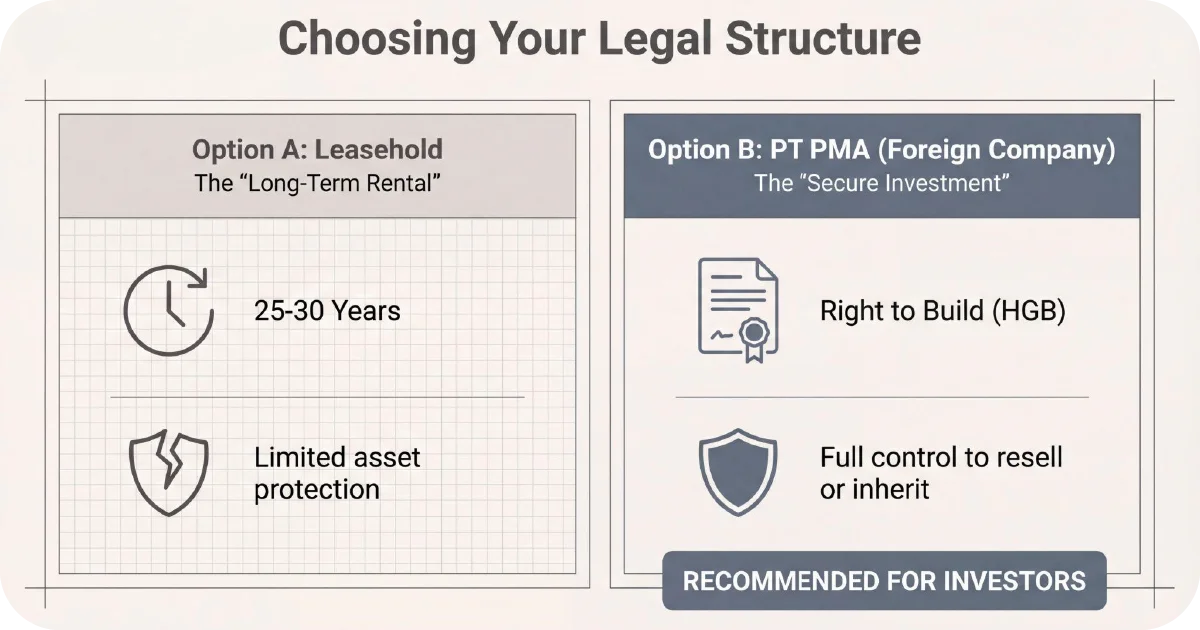
To acquire property safely in 2026, you generally have two options:
- The Leasehold Method: A long-term rental (25-30 years). Fast, but offers less control/asset protection.
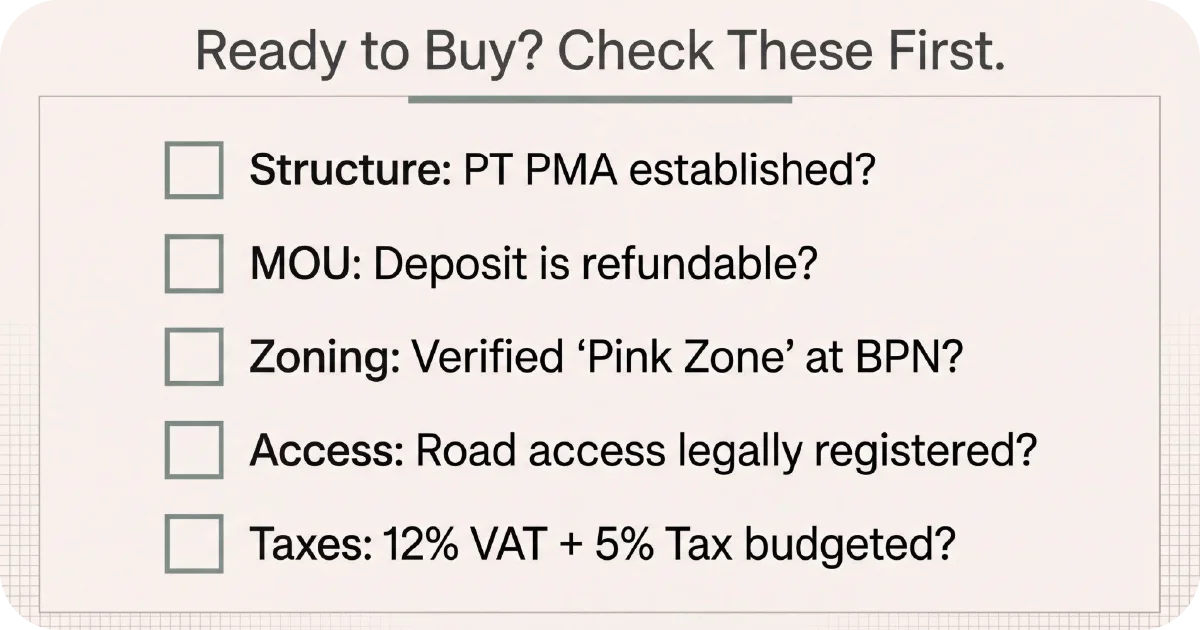
- The PT PMA Method (Recommended): You set up a Foreign-Owned Company. This company holds the title (Hak Pakai or HGB), giving you full legal control and the ability to resell or inherit the asset securely.
Do not guess on your company structure. For a complete breakdown of costs, visa benefits, and the specific differences between these titles, read our Bali Investor Guide 2026: Visas, Taxes & Legal Setup. This article focuses strictly on the buying process.
Phase 2: The 6-Step Acquisition Process
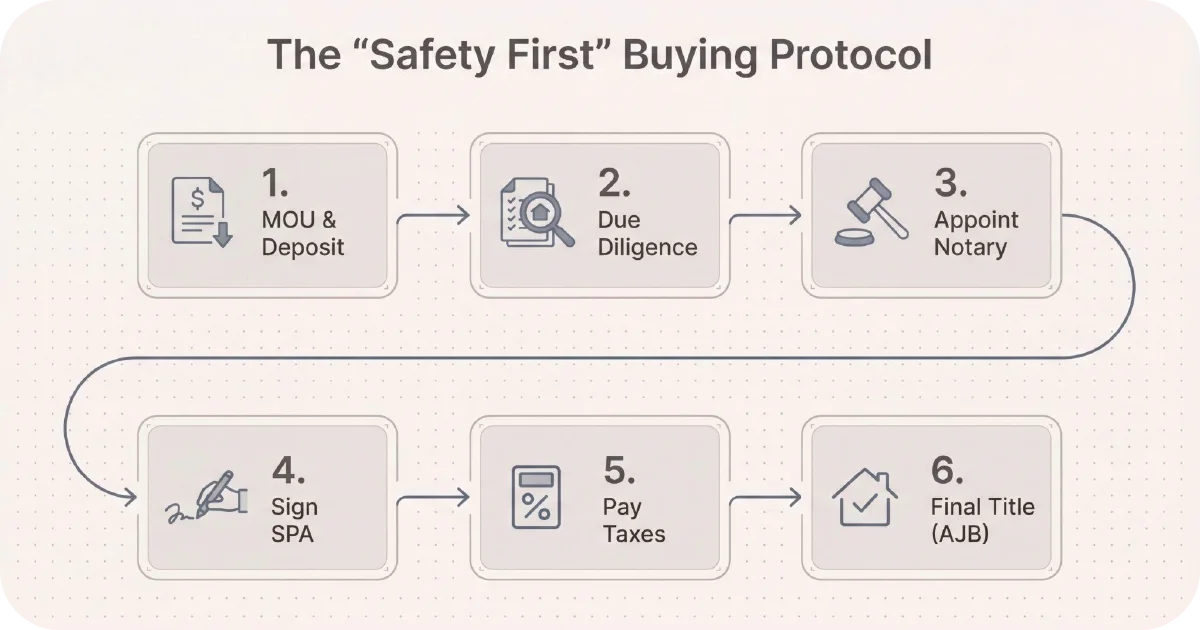
Once your legal structure is planned and you have selected a property based on solid investment strategy logic, the execution phase begins. Follow this exact sequence to protect your capital.
Step 1: The MOU (Memorandum of Understanding) & Deposit
Once you find the right plot or villa, speed is essential. The Bali market moves fast.
- The Action: You sign an MOU (pre-agreement) and pay a deposit (usually 10% to escrow).
- The Purpose: This “locks” the price and takes the property off the market while you conduct due diligence.
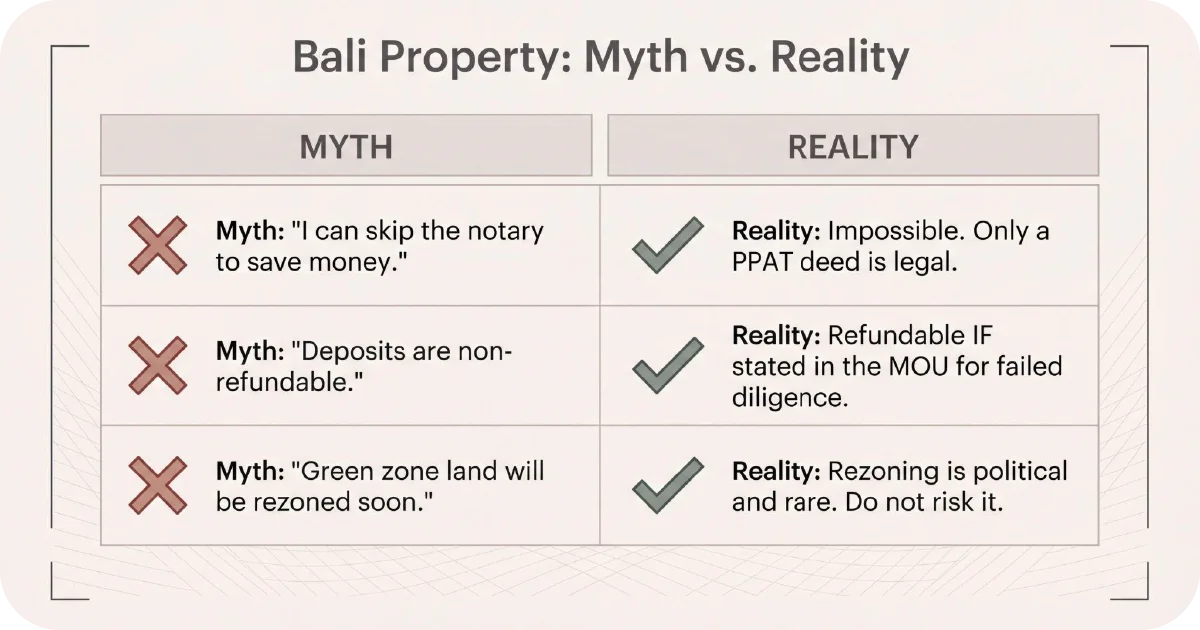
- Safety Rule: Ensure the MOU states the deposit is fully refundable if the property fails Due Diligence (e.g., if the zoning is bad).
Step 2: Due Diligence & The “Pink Zone” Reality
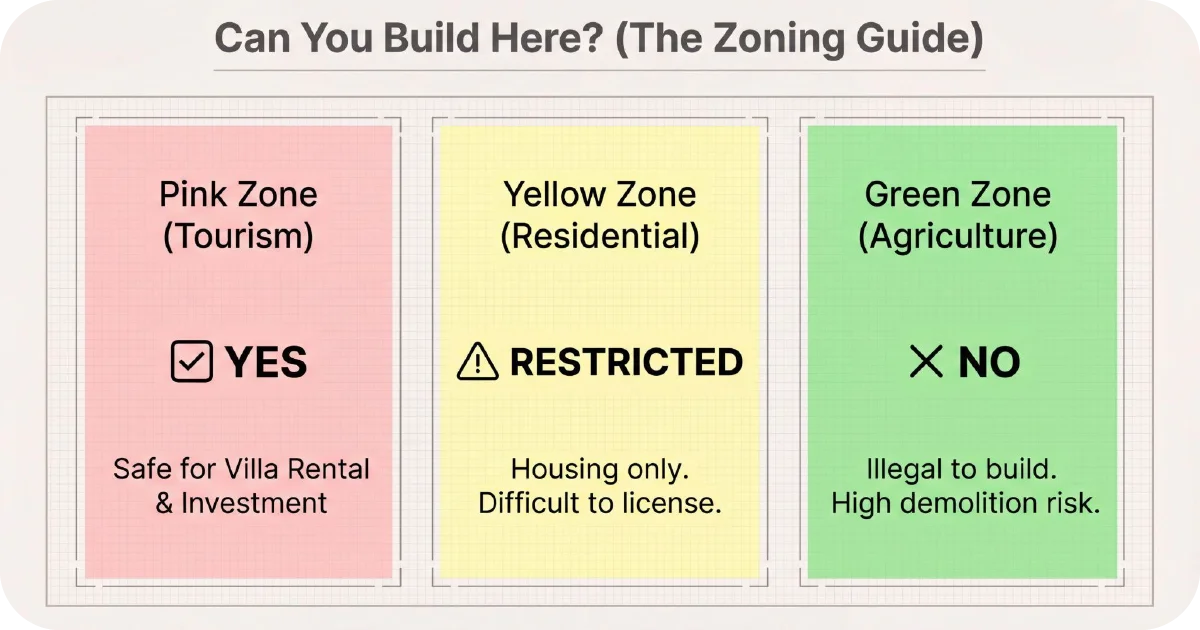
This is the most critical step. You – or your legal team, must verify the land is legally buildable. This is where many foreign investors get burned by relying on outdated information.
The AI Gap: The Truth About Zoning
Ask an AI chatbot “What are Pink and Green zones?” and it will give you a dictionary definition. It won’t tell you about the ongoing enforcement actions in Badung Regency since 2025.
The Risk: Sellers often claim Green Zone land “will be rezoned soon.” Do not believe this. Rezoning is a political process, not a guarantee.
COCO’s 3-Point Check:
- BPN Verification: We take the land certificate (SHM) to the National Land Agency (BPN) to verify the zoning on the current spatial map.
- Aspect Check: We confirm the “Aspek” (Registered Use) allows for housing or tourism.
- Access Rights: We verify legal road access is registered, preventing “landlocked” disputes later.
Step 3: Appointing the Notary (PPAT)
In Indonesia, a PPAT (Pejabat Pembuat Akta Tanah) is a government-appointed official, not just a lawyer. They are the only ones authorized to handle land title transfers.
- Cost: PPAT fees follow a sliding scale per Minister ATR/BPN Regulation 33/2021: maximum 1% for transactions >IDR 1B, up to 1.5% for IDR 100M-1B, and up to 2.5% for <IDR 100M.
- Role: They check the seller’s identity, ensure the taxes are paid, and draft the official deeds.
Step 4: The SPA (Sales Purchase Agreement)
If Due Diligence passes, you move to the binding contract. The SPA (Akta Pengikatan Jual Beli) outlines:
- Payment Terms: Is it a lump sum or a construction progress payment plan?
- Default Clauses: What happens if the developer is late?
- Tax Obligations: Who pays the transfer tax?
💡 Pro Tip: If buying off-plan, ensure your SPA links payments to construction milestones (e.g., Foundation complete, Roof on), not just calendar dates.
Step 5: Tax Obligations (The “Clean” Transaction)
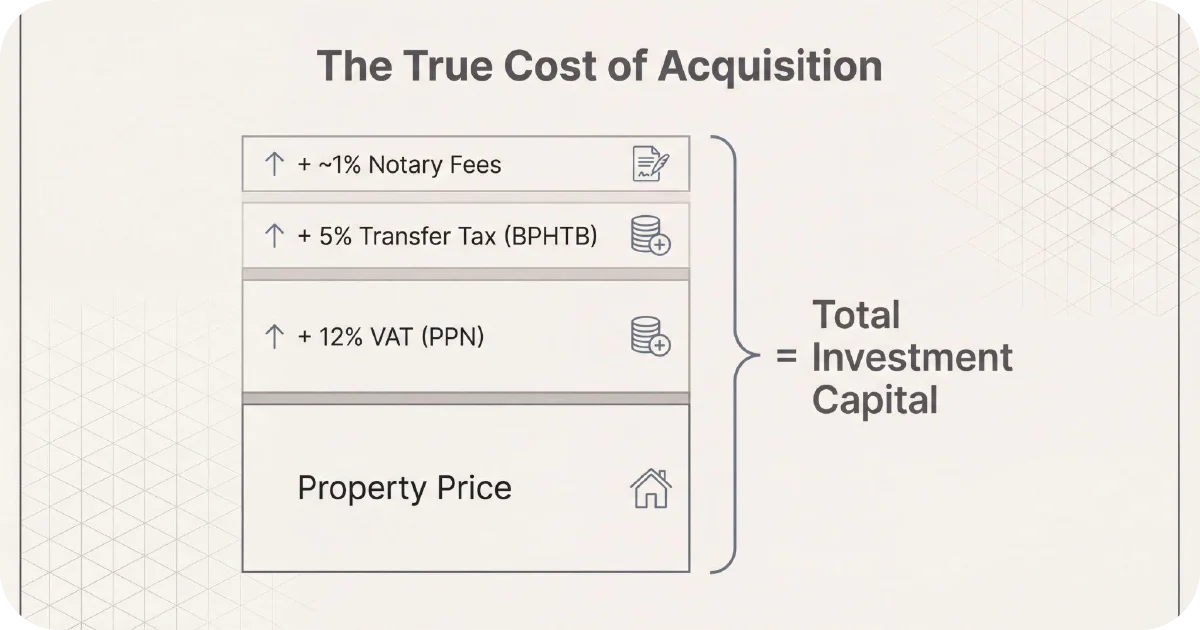
Before the final title can be transferred, all taxes must be paid to the state treasury.
- VAT (PPN): 12% nominal rate (effective January 1, 2025 per Law No. 7/2021). For non-luxury goods, this is calculated on 11/12 of the transaction value (resulting in an effective 11% burden). However, luxury properties pay the full 12% rate from February 1, 2025. This applies only to new purchases from PKP-registered developers; resales are VAT-exempt.
- Transfer Tax (BPHTB): 5% (Usually paid by the buyer, though sometimes negotiable).
- Withholding Tax (PPh): Usually paid by the seller (Income Tax).
Note: For a detailed breakdown of current property prices to help you budget these taxes, refer to our Bali Real Estate Market Guide: Trends & Prices.
For calculation examples and payment deadlines, see our complete Bali Property Tax Guide – pending
Step 6: The AJB & Title Transfer
The final step. The AJB (Akta Jual Beli) is the official Deed of Sale signed before the PPAT.
- The Event: You (or your PoA holder) and the seller sign the deed.
- The Result: The Notary submits this deed to the BPN. The BPN then prints a new land certificate in your PT PMA’s name (or your name for Leasehold).
- Timeline: It can take 2-4 weeks for the BPN to issue the physical certificate after signing.
Transaction Costs: What to Budget
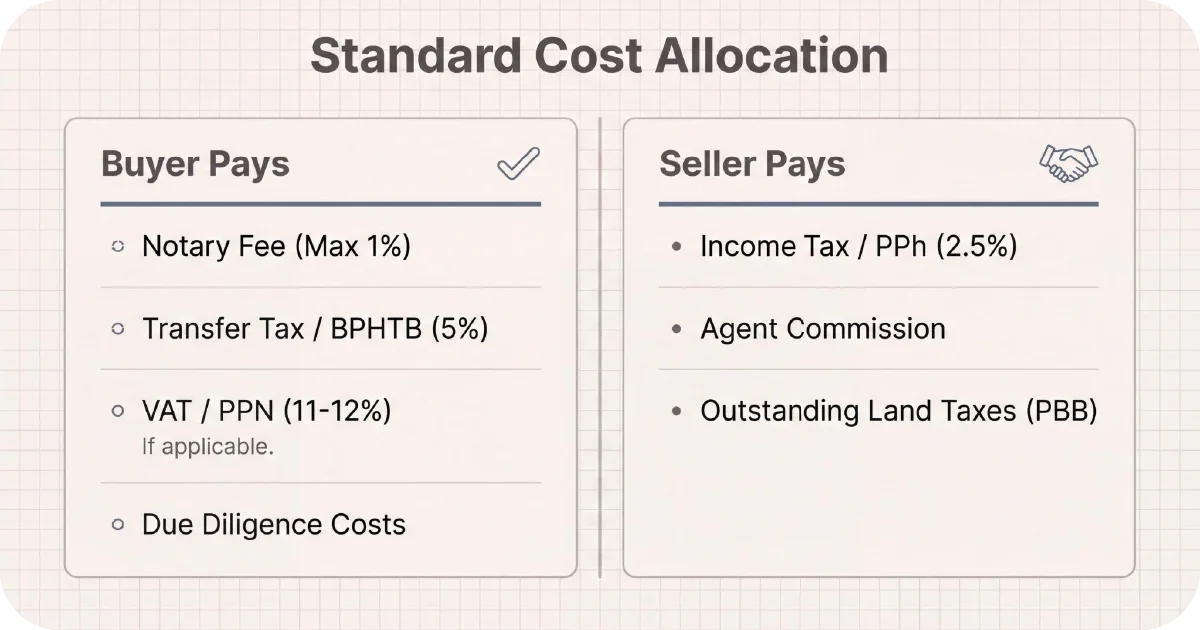
Beyond the property price, you must allocate funds for closing costs. A $200,000 villa effectively costs ~$225,000 once fees are added.
Limitations & Professional Guidance
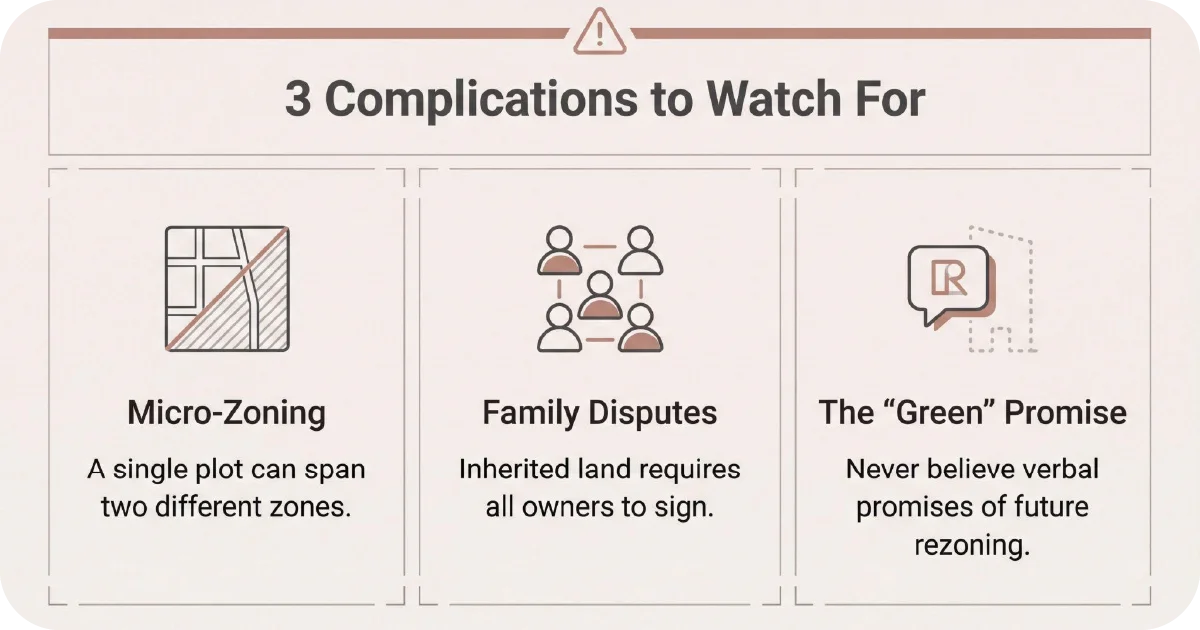
While this guide outlines the standard procedure, every transaction has nuances.
- Micro-Zoning: A single plot can sometimes span two zones (Pink and Green).
- Family Disputes: Inherited land often has multiple owners who must all agree to sell.
Professional Consultation
Do not attempt to navigate the BPN or tax office alone. We strongly recommend consulting with an independent legal advisor or using a turnkey developer who handles this entire pipeline in-house.
Need a Second Opinion on Your Acquisition Plan?
Unsure if a specific plot is truly “Pink Zone” or how to verify the seller’s certificate? Book a Free 30-Minute Strategy Call directly with our Founder & CEO, Rasmus Holst. We can review your potential acquisition path and highlight any red flags before you sign an MOU. No sales pressure, just a direct sanity check on your due diligence to ensure you don’t buy unbuildable land.
Lets Meet
Conclusion
Buying property in Bali is no longer the “Wild West” it is a sophisticated legal process. By following the MOU $\to$ Due Diligence $\to$ SPA $\to$ AJB roadmap, you eliminate 90% of the risks associated with foreign investment.
The goal is not just to “buy a villa,” but to secure a legal asset that offers peace of mind and high appreciation.
Ready to start?
Don’t guess on the zoning. Explore our fully zoned, turnkey resort units to see exactly how we apply these safety standards in practice.
7. Frequently Asked Questions (FAQ)
This allows 2 weeks for Due Diligence/MOU drafting, 1 week for SPA review, and 3-5 weeks for tax processing and title transfer (BPN).
As of the new BKPM Regulation No. 5 of 2025, the barrier to entry has been lowered. You now need a minimum paid-up capital of IDR 2.5 Billion (approx. $150,000 USD) to establish the company. However, your Total Investment Plan (filed with the OSS) must still exceed IDR 10 Billion per business sector, to be realized over time.
Yes, but only if your MOU is drafted correctly. The deposit should be fully refundable if the property fails Due Diligence (e.g., bad zoning or unclear certificate). Never pay a deposit without a signed MOU.
No. Under Indonesian law, a property transaction is only valid if the deed (AJB) is made by a government-authorized PPAT. "Under the table" deals are not legally binding and put your entire investment at risk.
References & Official Sources
Legal Framework & Regulations
Indonesian Agrarian Law No. 5 of 1960 (UUPA). “Basic Regulations on Agrarian Principles”. (Primary source defining Hak Milik (Freehold) vs. Hak Pakai (Right to Use) titles. Supports “Phase 1: The Prerequisites”). https://ojs.unud.ac.id/index.php/kerthanegara/article/download/9140/6898
Badung Regency Government (2025). “Spatial Planning (RTRW) Badung Regency 2025–2045”. (Official source for “Pink” vs. “Green” zoning designations and enforcement. Supports “Step 2: Due Diligence”). https://badungkab.go.id/instansi/disuptru/baca-artikel/667/Rencana-Tata-Ruang-Wilayah-Kabupaten-Badung.html
Directorate General of Immigration (2025). “Second Home Visa Requirements (E33)”. (Source for the proof of funds/property ownership requirements for long-term residency. Supports “Phase 1” and “FAQ”). https://www.imigrasi.go.id/wna/permohonan-visa-republik-indonesia/e33-visa-rumah-kedua
Bali Provincial Government (2024). “Foreign Tourist Levy Regulation”. (Official regulation regarding the tourist tax impacting rental yields. Supports “Investment Strategy Logic”). https://lovebali.baliprov.go.id/gov_notice
Market Data & Investment Economics
Badan Pusat Statistik (BPS) Bali (May 2025). “Tourism Overview in Bali Province: March 2025”. (Source for the “470,000+ foreign arrivals” statistic and market rebound data. Supports “Phase 2” context). https://bali.bps.go.id/en/pressrelease/2025/05/02/717955/tourism-overview-in-bali-province-march-2025.html
Bank Indonesia (Q3 2025). “Residential Property Price Index (IHPR)”. (Primary source for data on property price appreciation trends in primary vs. secondary markets. Supports “Step 5: Tax Obligations” context). https://www.bi.go.id/en/publikasi/ruang-media/news-release/Pages/sp_2726625.aspx
Udayana University E-Journal (2025). “Tourism and Sustainable Development in Badung”. (Academic source discussing the shift in development density and sustainability regulations. Supports “Limitations & Professional Guidance”). https://ejournal1.unud.ac.id/index.php/eot/article/view/2190
Taxes & Corporate Structure
BKPM / Ministry of Investment (Oct 2025). “Regulation No. 5 of 2025 on Investment Guidelines”. (Source for the new “IDR 2.5 Billion” paid-up capital requirement for PT PMA. Supports “FAQ: How much capital do I need?”). https://jdih.bkpm.go.id/ (Official Legal Documentation Network of BKPM)
Directorate General of Taxes (Pajak.go.id) (Jan 2025). “Press Release SP-1/2025: VAT (PPN) Rate Adjustment to 12%”. (Official confirmation of the VAT rate increase affecting commercial property transactions. Supports “Step 5: Tax Obligations”). https://pajak.go.id/sites/default/files/2025-01/SP%201%202025.pdf

Rasmus Holst is a serial entrepreneur and Co-Founder of COCO Development Group, where he helps drive innovation and growth through strategic business development. He is also the Co-Founder of Estate of Bali and Regnskabshelten.dk, Denmark’s fastest-growing accounting firm, which grew to 35 employees and generated $2.5M in turnover in 2023. Rasmus is passionate about building businesses that create long-term value and impact.