Skip to content




🎯 Quick Answer
Many international investors assume that looking for Bali property for lease means renting a villa for a holiday. However, in the context of investment, “Leasehold” is the primary legal vehicle for foreign ownership. You are effectively “buying” the right to use the land for decades, usually with a guaranteed option to extend.
But not all leases are created equal. There is a massive legal difference between a simple notary contract (Hak Sewa) and a state-registered certificate (Hak Pakai). If you structure this incorrectly, you are not an owner; you are just a long-term tenant with weak legal protections.
- Foreign Ownership Constraints: Under Indonesian Agrarian Law, foreigners cannot own Freehold (Hak Milik) land, necessitating the use of alternative legal structures like Leasehold (Hak Sewa) or Right to Use (Hak Pakai) to acquire property rights.
- The Leasehold (Hak Sewa) Structure: This common mechanism is a private, notarized long-term rental contract (typically 25–30 years) that grants personal rights to build and use land but does not result in a state-registered land certificate.
- The Right to Use (Hak Pakai) Title: A superior, government-registered land title available to foreign residents (KITAS holders) or PT PMA companies, offering stronger legal security, mortgageability, and a statutory duration of up to 80 years.
- Critical Risk Factors: While Hak Sewa relies on the integrity of a private contract and the landowner, Hak Pakai provides a public registry title that safeguards against the land being sold underneath the investor.
- Essential Contract Safeguards: Investors using the Hak Sewa model must ensure their deeds include specific “Top-Up” (guaranteed extension), succession (binding on heirs), and zoning clauses to protect the asset’s value as the lease term depreciates.
- Strategic Investment: Investors are warned to strictly avoid illegal “Nominee” arrangements and instead focus on secure, legal vehicles that guarantee “secured time” and high ROI rather than pursuing impossible permanent ownership.
Written by: Rasmus Holst (Founder & CEO of Coco Development Group) | Reviewed by: COCO Development Legal Team | Last updated: 31 March, 2026
Transparency: COCO Development Group is a premier developer of lifestyle resorts in Bali. While we sell leasehold and Hak Pakai properties, this article is strictly educational. Real estate laws in Indonesia are complex (Agrarian Law No. 5 of 1960). We strongly recommend engaging a certified PPAT Notary for any transaction.
Table of Contents
- Introduction
- The Legal Reality: Hak Sewa vs. Hak Pakai
- The “Leasehold” (Hak Sewa) Structure Explained
- The “Right to Use” (Hak Pakai) Structure Explained
- Critical Lease Agreement Clauses
- Limitations, Alternatives & Professional Guidance
- Conclusion
- Frequently Asked Questions (FAQ)
- References & Official Sources
Introduction
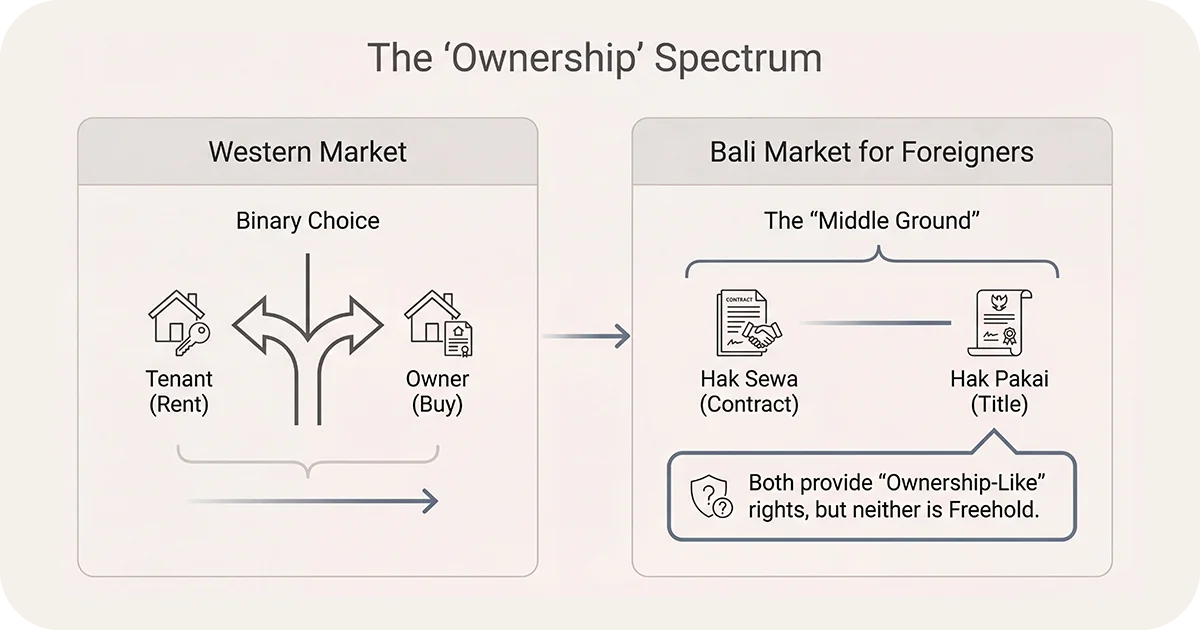
In Western markets, you either rent a property (tenant) or you buy it (owner). In Indonesia, specifically for foreigners, the line is blurred.
Because Indonesian Agrarian Law prohibits foreigners from owning Hak Milik (Freehold/Fee Simple) land, the market has evolved two primary mechanisms to give you “ownership-like” rights: the Leasehold Agreement (Hak Sewa) and the Right to Use Title (Hak Pakai).
Many brokers will simply call both of these “Leasehold,” but legally, they are worlds apart. One is a contract; the other is a title. If you are browsing Bali property for lease with the intention of investing $200,000+ into a villa, knowing the difference will determine whether your asset is truly secure or just a long-term promise.
This article dissects the mechanics of both, helping you choose the structure that matches your investment horizon and security needs.
⚖️ Need the full ownership context? Read our master guide: Buy Property in Bali
The Legal Reality: Hak Sewa vs. Hak Pakai
Foreigners often use the term “Leasehold” as a catch-all, but Indonesian law distinguishes sharply between two types of tenure.
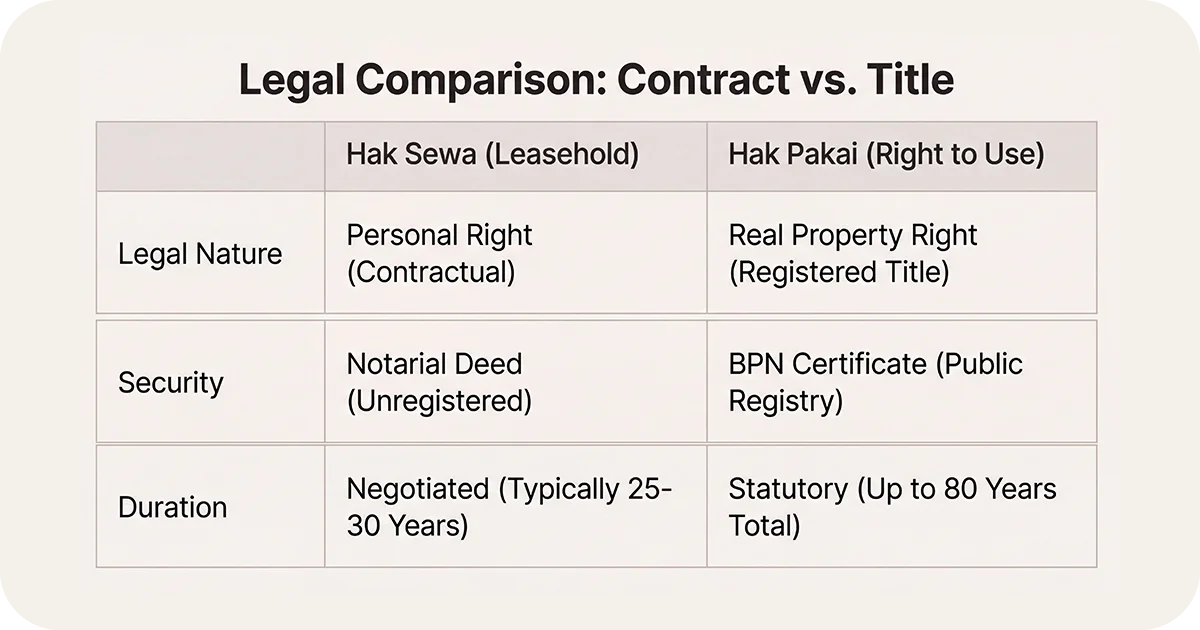
1. Hak Sewa (The Right to Lease)
Defined in the Basic Agrarian Law (Law No. 5 of 1960), Hak Sewa is a private agreement between a landowner (Lessor) and a tenant (Lessee).
- Nature: It is a personal right, not a real property right. It grants you the right to construct and use a building on someone else’s land.
- Security: It is generally not registered on the land certificate at the National Land Office (BPN). It exists as a Notarial Deed.
- Duration: Typically negotiated for 25 to 30 years, often with extension options.
2. Hak Pakai (The Right to Use)
Government Regulation No. 18 of 2021 solidifies Hak Pakai as the gold standard for foreign residents.
- Nature: It is a registered land title. The certificate is issued in your name (or your PT PMA’s name).
- Security: Stronger than Hak Sewa because the state recognizes your specific right to the land, independent of the original landowner’s whims.
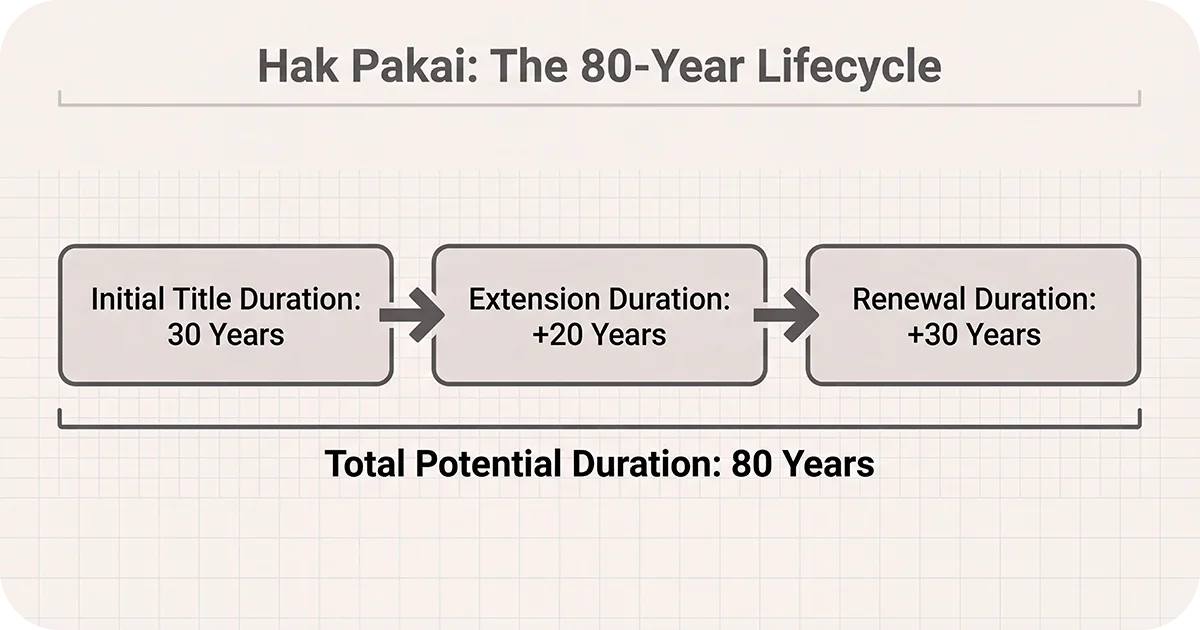
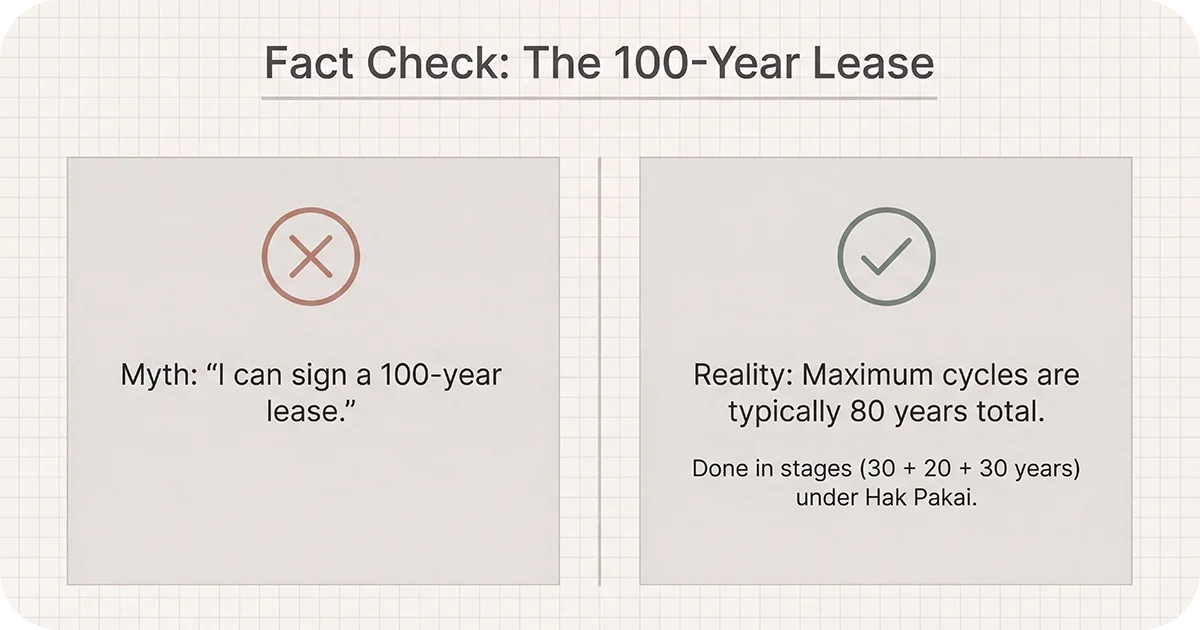
- Duration: Up to 30 years initially, extendable for 20 years, and renewable for another 30 (Total up to 80 years).
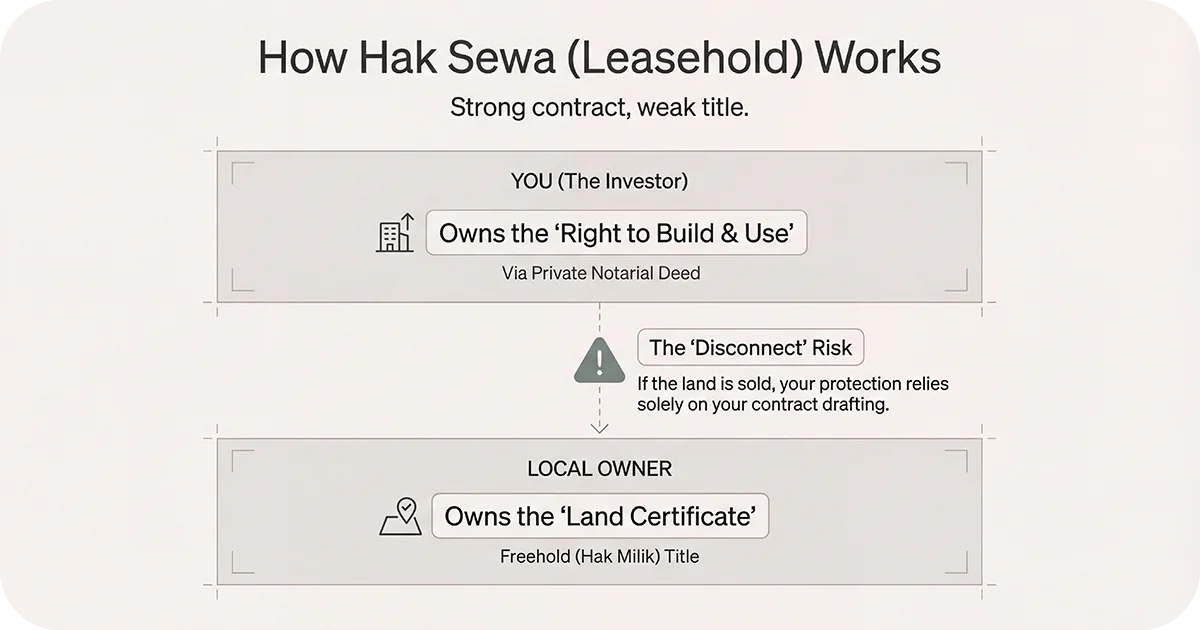
⚠️ Crucial Distinction: If you just sign a lease contract (Hak Sewa), the land certificate remains fully in the local owner’s name. If you secure Hak Pakai, a new certificate is issued to you.
💡 Deep Dive: understand the laws and what your actual options are in our Bali Investor Guide
The “Leasehold” (Hak Sewa) Structure Explained
When you see Bali property for lease listed for sale, 90% of the time it refers to the Hak Sewa structure. This is the most common method for foreigners to acquire villas because it is simpler and requires fewer prerequisites than a PT PMA.
How It Works
You pay a lump sum upfront (e.g., $200,000) to “rent” the land for 25 or 30 years. During this period, you have full rights to build, renovate, and sublease (rent out) the property, provided these rights are explicitly written in the Notarial Deed.
The “Leasehold” Trap
Because Hak Sewa is a private contract, its strength depends entirely on the quality of the drafting.
- The Landowner Risk: If the landowner sells the underlying Freehold (Hak Milik) title to a third party, your lease should remain valid, but disputes can arise if the lease wasn’t properly recorded or acknowledged.
- Mortgage: You generally cannot mortgage a Hak Sewa property because you do not hold the title certificate.
The “Right to Use” (Hak Pakai) Structure Explained
For serious investors, Hak Pakai is the superior vehicle. According to the Omnibus Law (Job Creation Law) and subsequent regulations, Hak Pakai grants foreigners possessing a residency permit (KITAS/KITAP) legitimate property rights.
Why It Is Safer
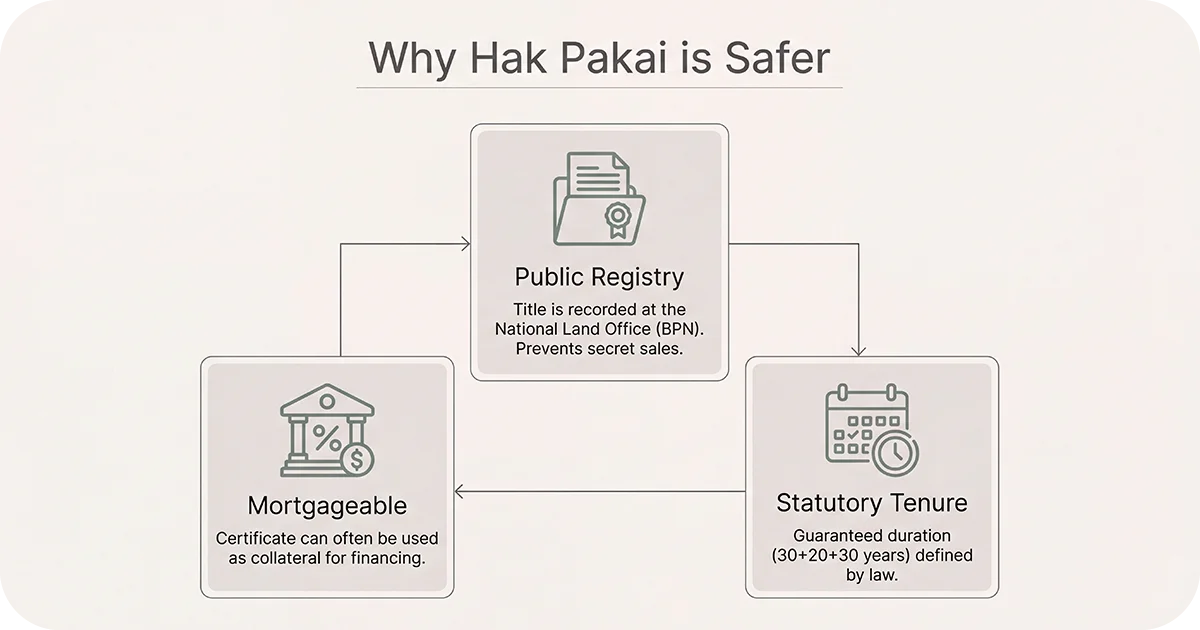
- Mortgageable: Unlike a private lease, a Hak Pakai certificate can often be used as collateral (fiduciary security).
- Public Registry: The title is recorded at the National Land Office (BPN). This prevents the original owner from secretly selling the land out from under you.
- Defined Tenure: The timeline is statutory (30+20+30 years), offering clearer long-term security than a negotiated private contract.
To access Hak Pakai for investment purposes (renting it out), you typically need to set up a foreign-owned company.
Critical Lease Agreement Clauses
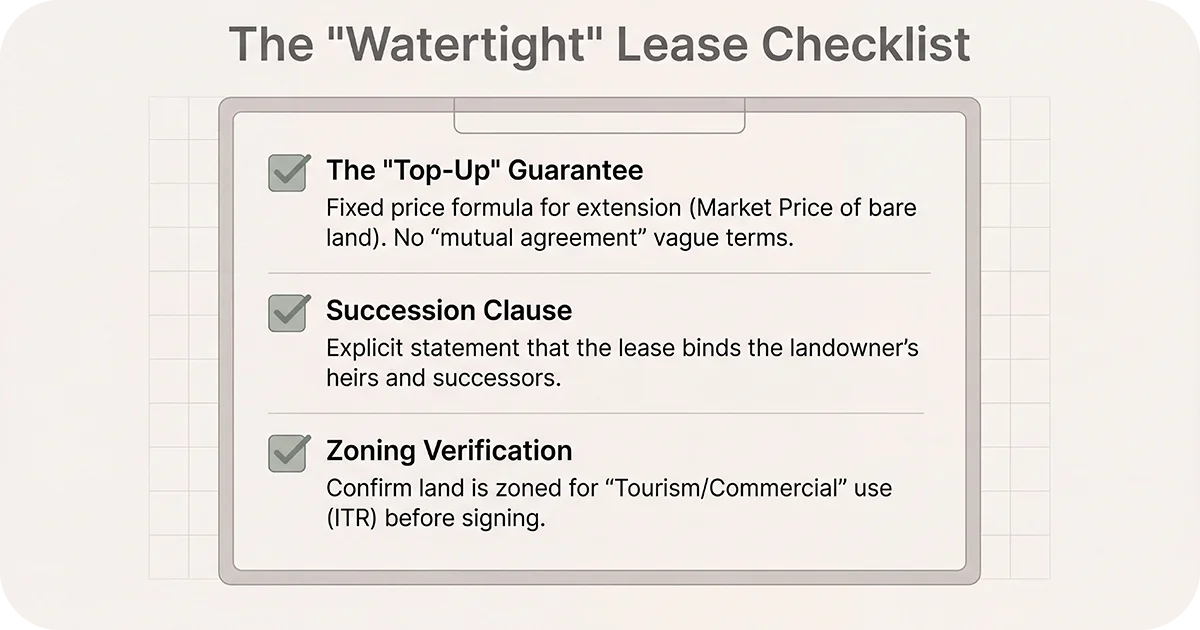
If you proceed with a standard bali property for lease (Hak Sewa) transaction, your protection relies entirely on the contract clauses. Never sign a standard template. Ensure these three pillars are present:
1. The “Top-Up” Clause (Extension)
A 25-year lease implies your asset value hits $0 in Year 25. To prevent this, you need a pre-agreed extension clause.
- Bad Clause: “Extension subject to mutual agreement.” (The landlord can demand 10x the market price later).
- Good Clause: “Lessee has the guaranteed right to extend for 25 years at the market price of bare land at the time of extension, determined by three independent appraisers.”
2. Succession Clause
What happens if the landowner passes away? Under Indonesian inheritance law, heirs must respect valid lease agreements, but it can get messy.
- Requirement: The agreement must explicitly state that the lease is binding upon the landowner’s heirs and successors.
3. Purpose of Use (Zoning)
You cannot legally run a rental business if the land is not zoned for it.
- Due Diligence: Ensure the lease states the land is for “commercial/tourism accommodation” and attach the zoning (ITR) verification to the deed.
🔍 Check the zones: How to Buy Property in Bali
Limitations, Alternatives & Professional Guidance
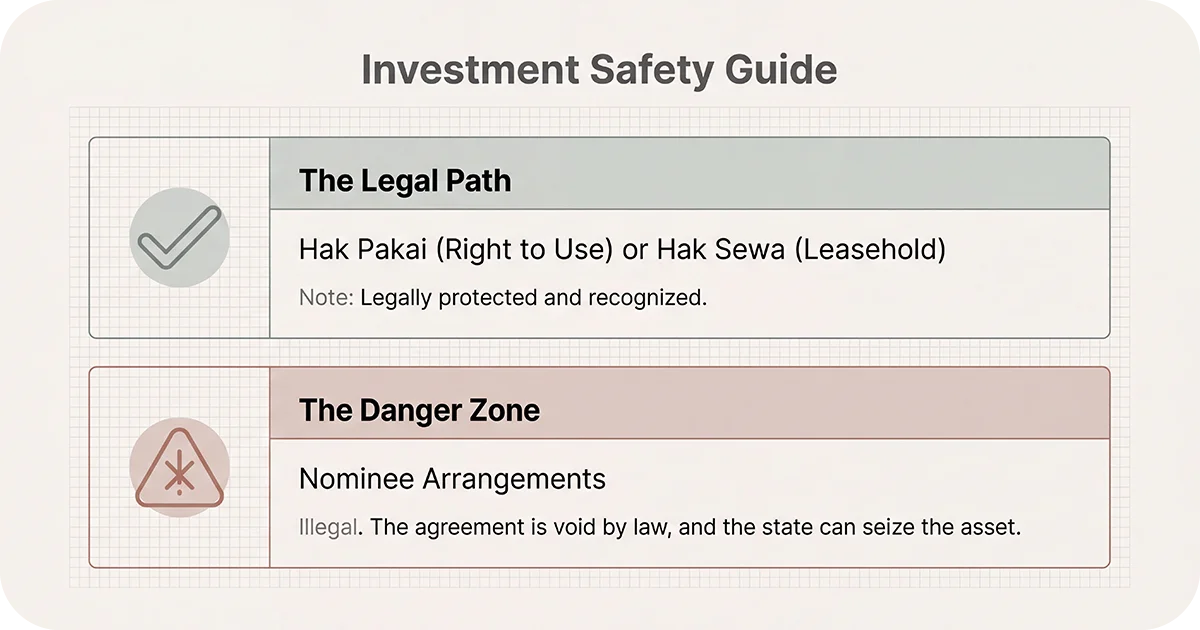
While leasing is the standard for foreign investment, it has limitations compared to true ownership.
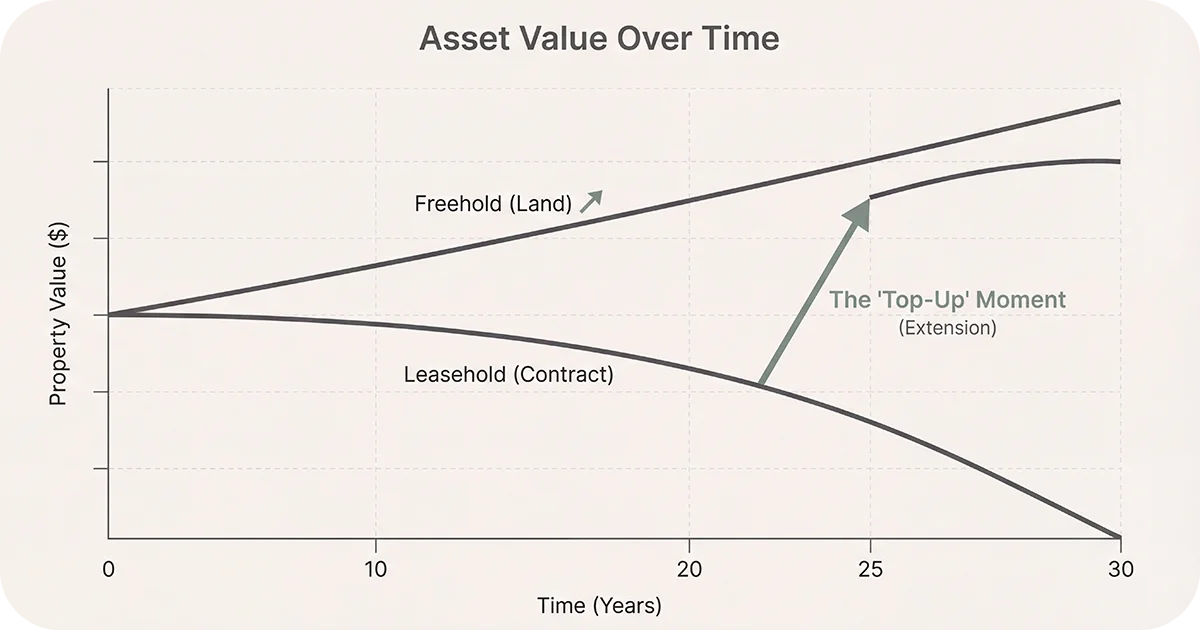
- Depreciating Asset: Unlike Freehold land which appreciates indefinitely, a Leasehold asset is a ticking clock. As the lease term shortens, the resale value decreases unless you extend the lease.
- No “Forever” Ownership: You cannot pass this land down to your great-grandchildren in perpetuity.
- The “Nominee” Alternative (Avoid This): Some foreigners use a local “Nominee” to buy Freehold land on their behalf. This is illegal under the Agrarian Law. The agreement is void by law, and the state can seize the asset. Always stick to Hak Sewa or Hak Pakai.
Professional Guidance:
Do not rely on a handshake. Every lease transaction requires a PPAT (Land Deed Official) to draft the deed. At COCO Development Group, we exclusively use Hak Pakai titles or secure Hak Sewa structures with guaranteed extension clauses to protect investor ROI.
Unsure About Your Contract? Get a Second Opinion.
Navigating Indonesian property law can be intimidating, and a single clause can cost you thousands. If you are worried about a contract you are about to sign, or simply want clarity on Hak Sewa vs. Hak Pakai for your specific situation, let’s talk.
Book a free 30-minute strategy call with our founder Rasmus Holst. No sales pitch – just honest, developer-to-investor guidance to ensure your capital is safe.
Lets Meet
Conclusion

Understanding Bali property for lease is about shifting your mindset from “Permanent Ownership” to “Secured Time.”
In Bali, you don’t need to own the soil forever to generate 15-20% annual returns. You simply need a secure vehicle – either a watertight Hak Sewa contract or a registered Hak Pakai title – that guarantees your rights for the next 30 to 80 years.
By choosing the right structure and avoiding the illegal “Nominee” route, you turn a complex legal landscape into a high-yield investment advantage.
🌴 Explore Secure Investment Units: Property in Bali for Sale
Frequently Asked Questions (FAQ)
Yes. You can sell the remaining years of your lease to another party. This is known as a "Leasehold Transfer," and there is a very active secondary market for these contracts. 📈 Check market liquidity: Bali Real Estate Market Guide 2026: Trends, Prices & Areas
No. Indonesian law does not recognize 100-year leases. Private leases (Hak Sewa) are usually 25-30 years. Hak Pakai allows for up to 80 years total (30 initial + 20 extension + 30 renewal), but this is done in stages, not a single 100-year block.
If the lease expires and is not extended, the land and everything attached to it (the villa) typically revert to the landowner. This is why securing an extension clause now is critical for long-term value.
Yes, for a private Hak Sewa (Leasehold) agreement... However, for a Hak Pakai (Right to Use) title certificate, you generally need a residency permit (KITAS/KITAP) or a foreign-owned company (PT PMA). 🏢 Learn the setup: [PT PMA Setup in Bali: The Ultimate Foreign Ownership Guide] - pending.
References & Official Sources
- Government of Indonesia (1960). “Law No. 5 of 1960 concerning Basic Regulations on Agrarian Principles”. (Defines the fundamental rights of Hak Sewa and Hak Pakai). https://peraturan.bpk.go.id/Home/Details/51310/uu-no-5-tahun-1960
- Government of Indonesia (2021). “Government Regulation No. 18 of 2021 regarding Right to Management, Right to Land, Flat Units, and Land Registration”. (The modern regulation clarifying foreigner access to Hak Pakai). https://peraturan.bpk.go.id/Home/Details/161848/pp-no-18-tahun-2021
- OECD (2021). “Investment Policy Reviews: Indonesia 2020”. (Discusses the modernization of Indonesia’s investment climate and land rights). https://www.oecd.org/en/publications/oecd-investment-policy-reviews-indonesia-2020_b56512da-en.html

Rasmus Holst is a serial entrepreneur and Co-Founder of COCO Development Group, where he helps drive innovation and growth through strategic business development. He is also the Co-Founder of Estate of Bali and Regnskabshelten.dk, Denmark’s fastest-growing accounting firm, which grew to 35 employees and generated $2.5M in turnover in 2023. Rasmus is passionate about building businesses that create long-term value and impact.