



🎯 Quick Answer
Bali property management services typically charge 30% of gross revenue to handle guest acquisition, maintenance, and legal compliance. With the enforcement of Permenpar No. 6/2025 (March 2026 deadline) and mandatory 12% VAT reporting, self-management has become legally risky for foreign investors. While standard third-party agencies handle bookings, they often lack the incentive to preserve long-term asset value (“tropical rot” prevention). Consequently, sophisticated investors are shifting toward Integrated Developer Management (like COCO Development Group), which consolidates licensing, tax, and maintenance into a single “Done-For-You” ecosystem for true passive income.
- The Shift to Professionalism: Investors must move from casual “Airbnb hosting” to strategic Asset Management, as rising guest expectations and humidity-driven maintenance risks (“tropical rot”) make self-management a financial liability.
- Three Tiers of Operations: The market offers three paths: Self-Management (high effort, low conversion), Third-Party Agencies (misaligned incentives, hidden costs), and Integrated Developer Management (aligned interests, full automation).
- The 2026 Regulatory Cliff: Effective March 31, 2026, enforcement of Permenpar No. 6/2025 mandates valid Pondok Wisata licenses and Tourism Zoning (Pink Zone), with non-compliant properties facing immediate delisting from OTAs.
- Tax & Financial Compliance: The Indonesian tax office now requires strict monthly reporting of VAT (12%) and Income Tax (10%), ending the era of unreported rental income and requiring professional financial oversight.
- The Integrated Solution: The COCO Development Group model replaces fragmented outsourcing with a single “Done-For-You” ecosystem, handling everything from legal licensing and engineering to quarterly Net Profit payouts.
- ROI & Yield Strategy: Professional management utilizes Dynamic Pricing Algorithms to outperform static rentals, leveraging higher occupancy and Instant Booking efficiency to offset management fees and maximize cash-on-cash returns.
Written by: Rasmus Holst (Founder & CEO of Coco Development Group) | Reviewed by: Head of Hospitality & Operations | Last updated: 31 March 2026
ℹ️ Transparency: We are a developer with a commercial interest in our own projects. However, the data in this article regarding Indonesian taxes, licenses, and maintenance is universal. We do not manage external properties, but we encourage you to use this guide as a checklist to verify the compliance and quality of any third-party agency you consider.
Table of Contents
- Introduction
- The 3 Levels of Management: Which One Are You?
- The “Hidden” Work: Licenses, Taxes & Compliance
- The COCO Approach: True A-Z Integration
- The Cost of Management vs. The Cost of Vacancy
- Limitations, Alternatives & Professional Guidance
- Conclusion
- Frequently Asked Questions (FAQ)
- References & Official Sources
Introduction
Many investors buy the “Bali Dream” only to wake up to the nightmare of a broken pool pump, a leaking roof, and an angry guest calling at 3 AM. In the tropical climate of Indonesia, a property is a living organism. It fights humidity, salt air, and intense usage. Without a professional operations team, your high-yield asset can quickly become a liability.
For the modern investor living in Singapore, Sydney, or London, the goal of buying property in Bali is not to become a hotelier; It is to secure Passive Income. However, market research shows that “passive” requires active selection: picking the wrong manager can lead to opaque reporting and yield dilution.
With the Indonesian government professionalizing the tourism sector, the days of operating a rental villa as a casual side-hustle are effectively over. Investors today face a clear choice: treat their property as a business requiring significant operational oversight, or partner with a management team that handles the heavy lifting.
This guide breaks down exactly how property management works in Bali, the new regulatory realities for 2026, and why the “Integrated Developer” model is the safest route for your portfolio.
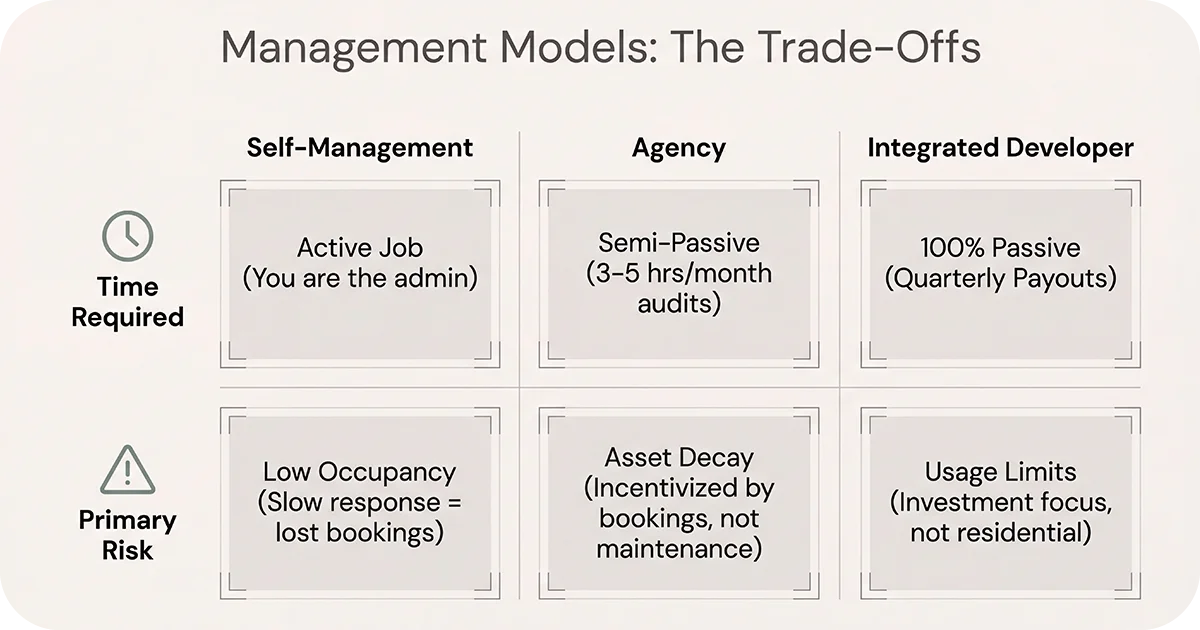
Bali Property Management: 3-Tier Comparison
To help you identify which operational style fits your goals, the table below compares the three standard management models found in Bali:
| Management Level | Who It Is For | Time Commitment | Primary Risk |
|---|---|---|---|
|
1. Self-Management |
Expats living in Bali full-time with hospitality experience. |
Active Job: You are the cleaner, plumber, and admin. |
Low Occupancy: Slow response times (>4 hours) can drop conversions by 25–35%. |
|
2. Third-Party Agency |
Investors with standalone villas needing operational help. |
Semi-Passive: 3–5 hours/month for audits and approvals. |
Misaligned Incentives: Agencies profit from bookings, not long-term asset health. |
|
3. Integrated Developer |
Investors seeking true passive income (The COCO Model). |
Passive: Fully “Done-For-You” with quarterly payouts. |
Usage Limits: Designed for investment; typically not for year-round personal living. |
The 3 Levels of Management: Which One Are You?
Not all “management” is created equal. In Bali, you generally have three options to operate your rental business.
Level 1: Self-Management (The “Airbnb” Trap)
- Who it’s for: People living in Bali full-time with hospitality experience.
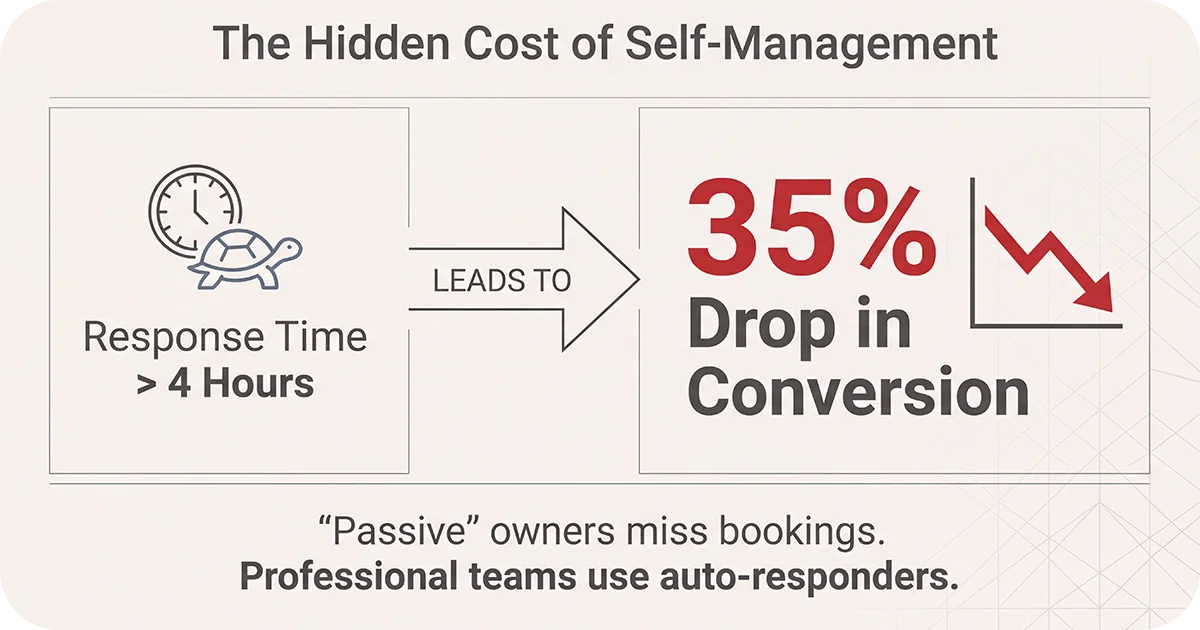
- The Reality: You keep the 30% fee, but you pay with your time. You are the cleaner, the plumber, the tax agent, and the concierge.
- The Risk: Data shows that self-managed villas often suffer significantly lower occupancy. A key factor is speed: response times over 4 hours correlate with 25–35% lower booking conversion, directly impacting your revenue.
Level 2: Third-Party Agency
- Who it’s for: Investors who bought a standalone villa and need someone to run it.
- The Reality: You hire an external company. They charge 30% of gross revenue.
- The Hidden Work: Even with an agency, this is often a Semi-Passive role. You must typically commit 3-5 hours per month to:
- Audit monthly financial statements.
- Approve maintenance expenses above a set threshold (e.g., >$500).
- Coordinate license renewals.
- The Risk: Misaligned incentives. Agencies often manage hundreds of disparate villas. If the roof leaks, most of them will just call a contractor and bill you. They profit from the booking, not the long-term health of your building.
Level 3: Integrated Developer Management (The COCO Model)
- Who it’s for: Investors seeking true passive income.
- The Reality: The company that built the property also manages it.
- The Advantage: We are physically on-site. Our engineers maintain the resort daily. We don’t just “fix” problems; we prevent them to protect the asset value, because our brand is on the building.
The “Hidden” Work: Licenses, Taxes & Compliance
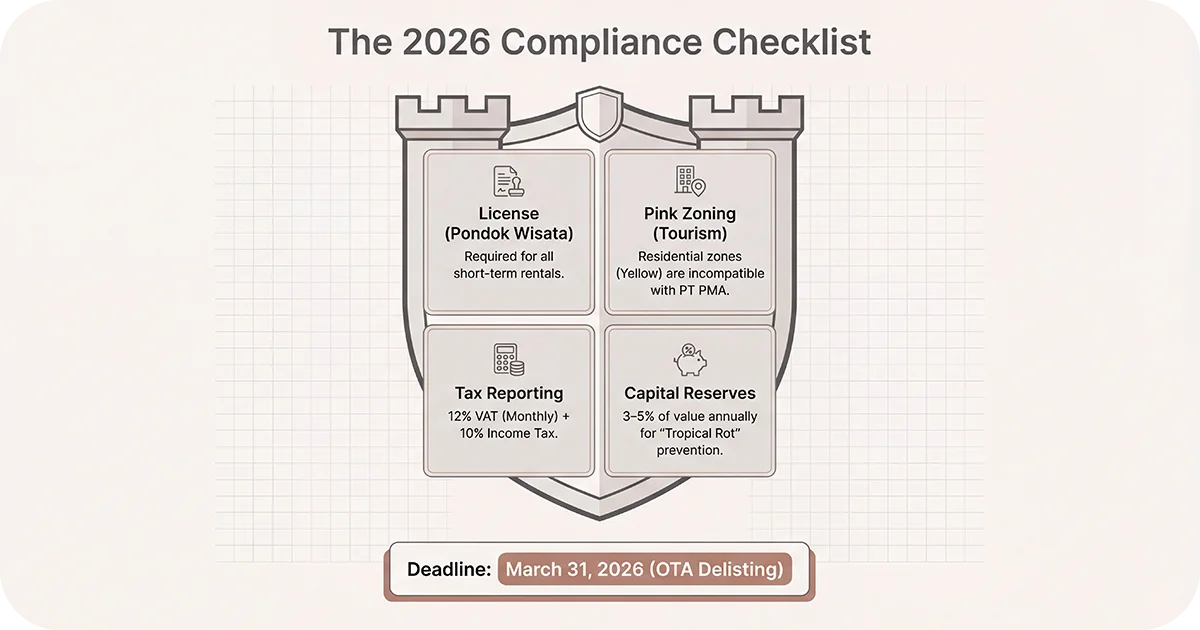
Effective March 31, 2026, the Bali government has strictly enforced new compliance rules for rental properties. You can no longer fly under the radar.
1. The License (Pondok Wisata) & The 2026 Deadline
Under Permenpar No. 6/2025, all short-term rental properties must have valid business registration and tourism permits.
- The Risk: As of March 31, 2026, properties without these permits face automatic delisting from platforms like Airbnb and Booking.com.
- The 5-Bedroom Limit: A Pondok Wisata license is strictly capped at 5 bedrooms. Properties larger than this require a full Hotel License, which is impossible to obtain in residential zones.
- The Zoning Trap: Many investors are unaware that ~80% of properties in Canggu are situated in “Yellow Zones” (Residential). These zones are legally incompatible with commercial short-term rental licenses for PT PMA companies.
- The Solution: Ensure your property is in a Pink Zone (Tourism Zoning), like our developments in Uluwatu, which allows for full legal compliance under KBLI Code 55193.
2. The Tax Burden
Indonesia’s tax office is digitizing rapidly. Every dollar of rental income must be reported.
- VAT (PPN): 12% on revenue.
- Income Tax (PPh): 10% (Final Tax) for residents/companies.
- Reporting: Monthly filing is mandatory.
- 🧾 Confused by the rates? See the full breakdown in our Bali Investor Guide
3. The “Tropical Rot” (Maintenance)
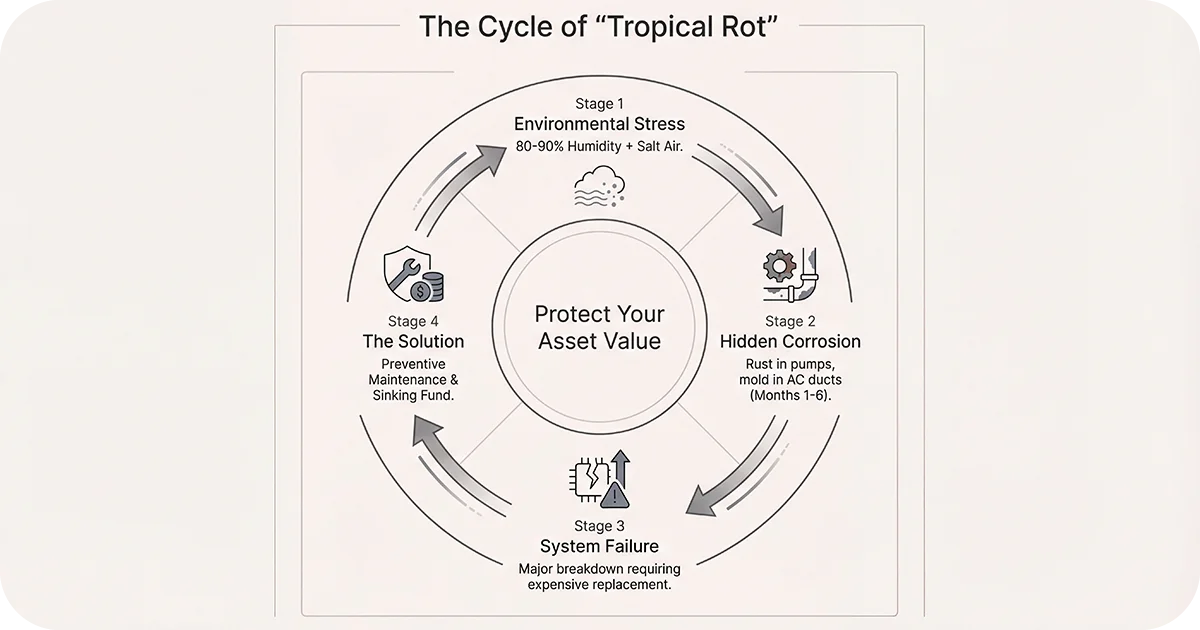
Bali has 80-90% humidity and salt air. Unmanaged villas develop mold, rust, and pump failures within 6-12 months.
- The Financial Reality: Experienced investors budget 3-5% of the property value annually for capital reserves (Capex).
- The Danger: Many agencies ignore preventive maintenance to show higher short-term profits, leading to a massive $5,000+ repair bill (e.g., roof leaks or AC failure) down the line. Our sinking fund model prevents these nasty surprises.
2026 Regulatory & Tax Requirements for Foreign Investors
The following checklist summarizes the critical March 2026 regulatory requirements and tax obligations you must meet to operate legally:
| Compliance Category | Requirement / Rate | Critical Note / Deadline |
|---|---|---|
|
Operating License |
Pondok Wisata / NIB (KBLI 55193) |
Mandatory for all short-term rentals. |
|
Enforcement Deadline |
March 31, 2026 |
Platforms (Airbnb/Booking) will delist non-compliant properties. |
|
Zoning Rule |
Pink Zone (Tourism) |
Yellow Zones (Residential) are incompatible with PT PMA rental licenses. |
|
VAT (PPN) |
12% on Revenue |
Monthly filing is mandatory. |
|
Income Tax (PPh) |
10% (Final Tax) |
For residents and companies. |
|
Capital Reserves |
3–5% of Property Value |
Recommended annual budget to combat “Tropical Rot” (humidity/salt). |
The COCO Approach: True A-Z Integration
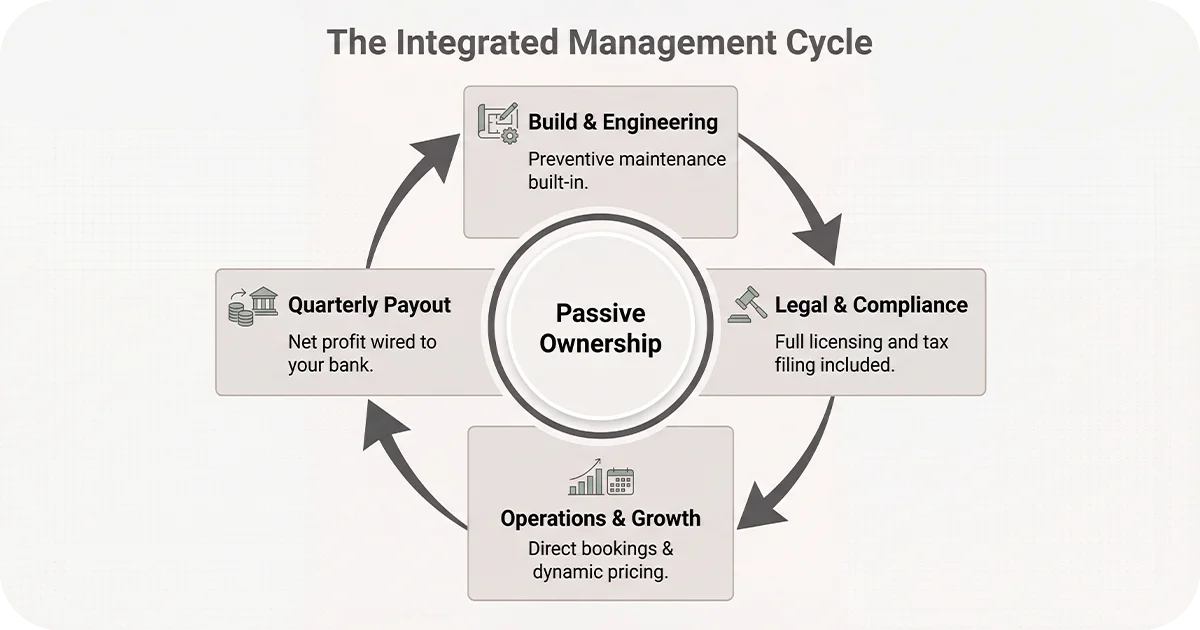
We designed our management service to solve the friction points of foreign ownership. We don’t just hand you the keys; we hand you the dividends.
Here is what “Done-For-You” actually looks like:
| Feature | Standard Agency | COCO Development Group |
|---|---|---|
|
Legal Setup |
You hire a separate agent |
We handle PT PMA & Licenses |
|
Maintenance |
Outsourced (Often w/ hidden markup) |
In-House Engineering Team |
|
Marketing |
Airbnb/Booking.com only |
Global Network + Direct Booking |
|
Guest Experience |
Keybox / Remote Host |
On-Site Concierge & Staff |
|
Reporting |
Often vague (“Ops: $2,000”) |
Itemized, transparent reporting |
|
The Payout |
Variable / Monthly manual |
Quarterly Direct Bank Transfer |
The Transparency Standard (No Kickbacks)
A common “hidden revenue stream” for budget operators is sourcing items (linens, repairs, furniture) and marking up the cost by 25–50% before billing the owner.
At COCO Development Group, we strictly prohibit vendor kickbacks. Our reporting is itemized and transparent, ensuring you pay the real cost, not an inflated one.
The “Quarterly Payout” System
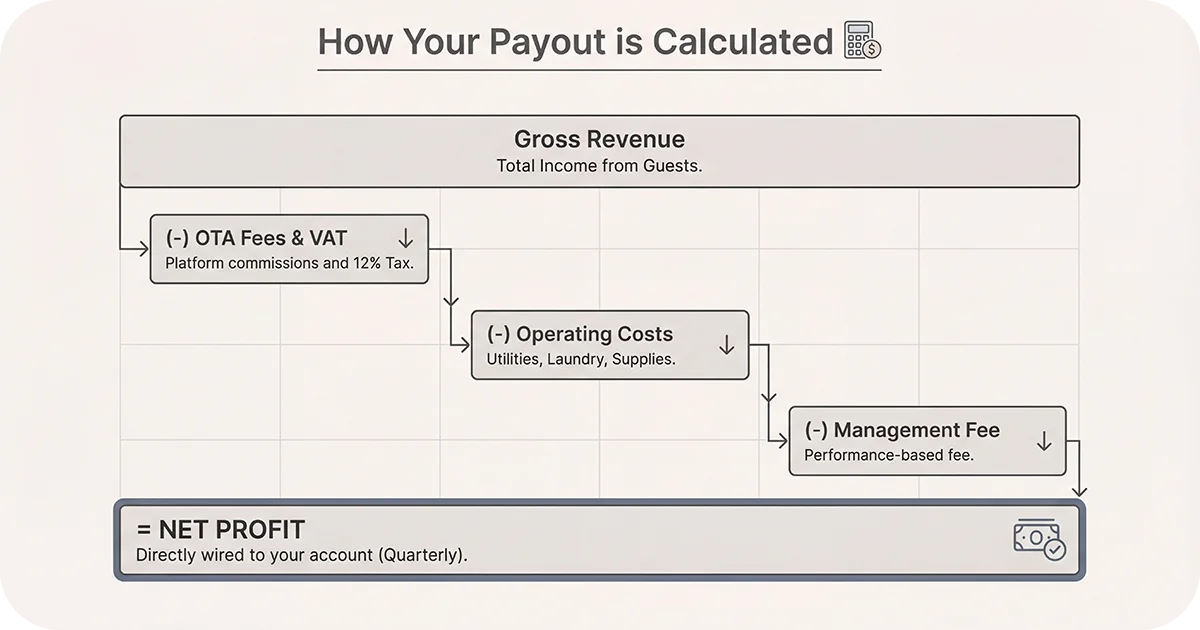
You do not need to open an Indonesian bank account if you don’t want to.
We consolidate your revenue, deduct the operating costs (utilities, management fee, tax), and wire the Net Profit directly to your international bank account every quarter.
The Cost of Management vs. The Cost of Vacancy
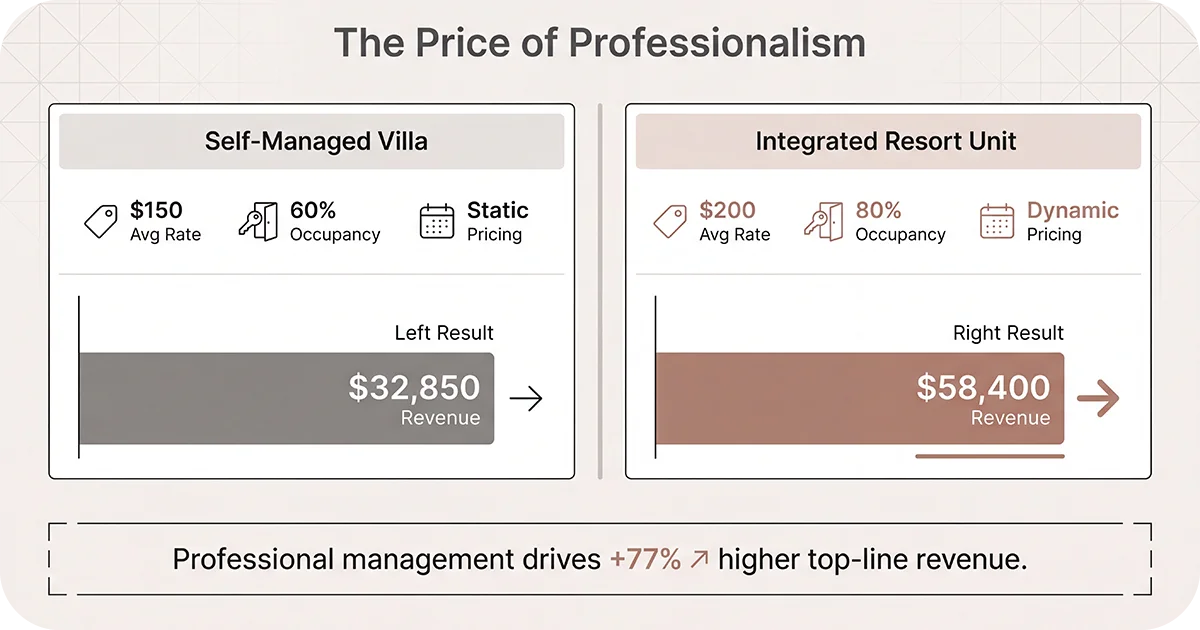
Investors often ask: “Is the management fee worth it?”
Let’s look at the ROI logic. A professional management team uses Dynamic Pricing Algorithms (adjusting rates daily based on demand), which studies show can drive 18-30% higher annual revenue compared to static monthly pricing.
The Market Reality Check:
Data from 2025–2026 indicates that the realistic cash-on-cash return for an average, standalone villa is only 2–5% due to high operating expenses (consuming 50-60% of revenue). To achieve double-digit returns, you need the efficiency of a resort model.
- Standalone Villa (Self-Managed): 60% Occupancy @ $150/night = $32,850 Revenue
- Resort Unit (Managed): +80% Occupancy @ $200/night = $58,400 Revenue
Even after deducting a management fee, the Net Income from the managed asset is significantly higher. Features like Instant Booking enablement (which we manage) further increase conversion rates by over 20%.
Revenue Potential: Standalone Villa vs. Managed Resort Unit
To visualize the ROI impact, the table below highlights the revenue difference between a typical standalone villa and a managed resort unit:
| Feature | Standalone Villa (Self-Managed) | Resort Unit (Managed) |
|---|---|---|
|
Occupancy Rate |
60% |
+80% |
|
Average Nightly Rate |
$150 |
$200 |
|
Annual Revenue |
$32,850 |
$58,400 |
|
Pricing Strategy |
Static / Manual |
Dynamic Pricing Algorithms |
|
Net Yield Outlook |
2–5% (Cash-on-Cash) |
Double-Digit Potential |
📈 Want to see the yield data? Read our Bali Property Investment Report.
Limitations, Alternatives & Professional Guidance
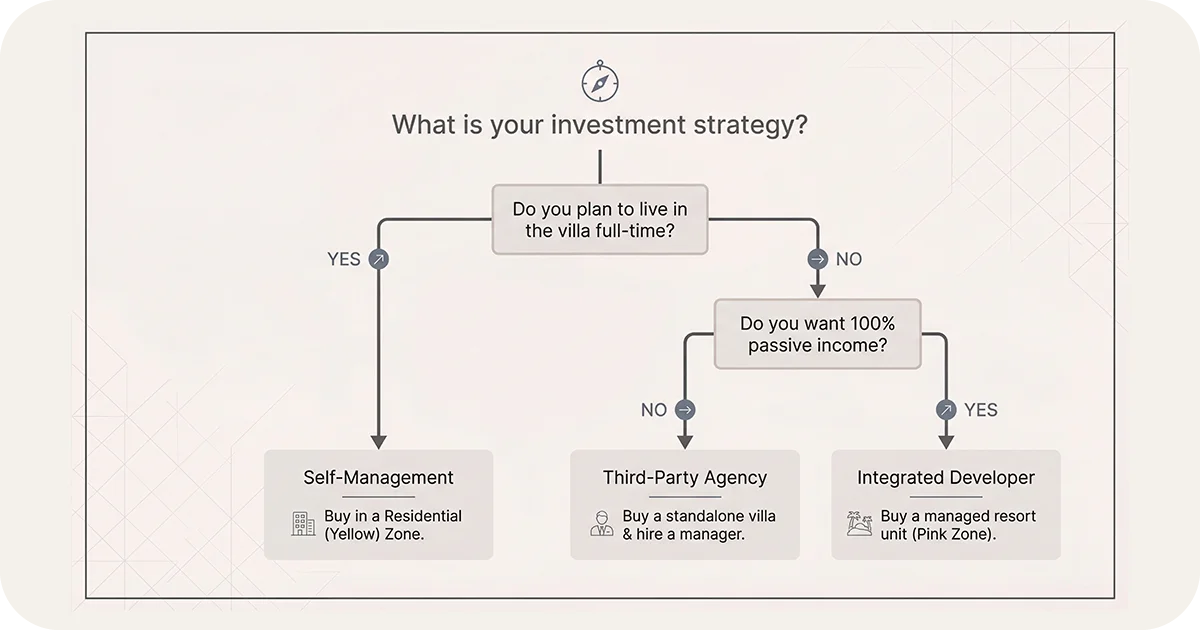
While our model offers convenience, it is important to understand the trade-offs.
Limitations
- Usage Restrictions: In a fully managed resort, you typically cannot live in your unit year-round and expect full rental returns. Most investors use the unit for 4-8 weeks a year and rent it out the rest of the time.
- Standardization: To maintain high rental standards, you cannot fill the unit with personal furniture. The design package is standardized (though high-spec).
Alternatives
- Long-Term Lease: You can rent your villa out yearly (e.g., for $25,000 upfront). This eliminates management hassle but caps your earnings.
- Commercial Real Estate: Buying a shop or restaurant space involves different management dynamics.
Professional Guidance
If you already own land and need a standalone manager, look for companies that use Channel Managers (software to sync calendars) and have a physical office in your area.
However, if you are yet to buy, we strongly recommend considering a Managed Development to avoid the headache entirely.
Thinking about your strategy?
Understand the difference between active and passive investing in our guide: How to Buy Investment Property in Bali. [Pillar 2 – How to Buy Investment Property in Bali: The “Hands-Off” Model]
Still unsure about your strategy? If you are navigating conflicting advice from agents and developers, we offer a solution to cut through the noise. You can book a free consultation with our founder, Rasmus Holst. Whether you invest with us or not, he will help you validate your numbers and legal structure against the new 2026 regulations.
Lets Meet
Conclusion
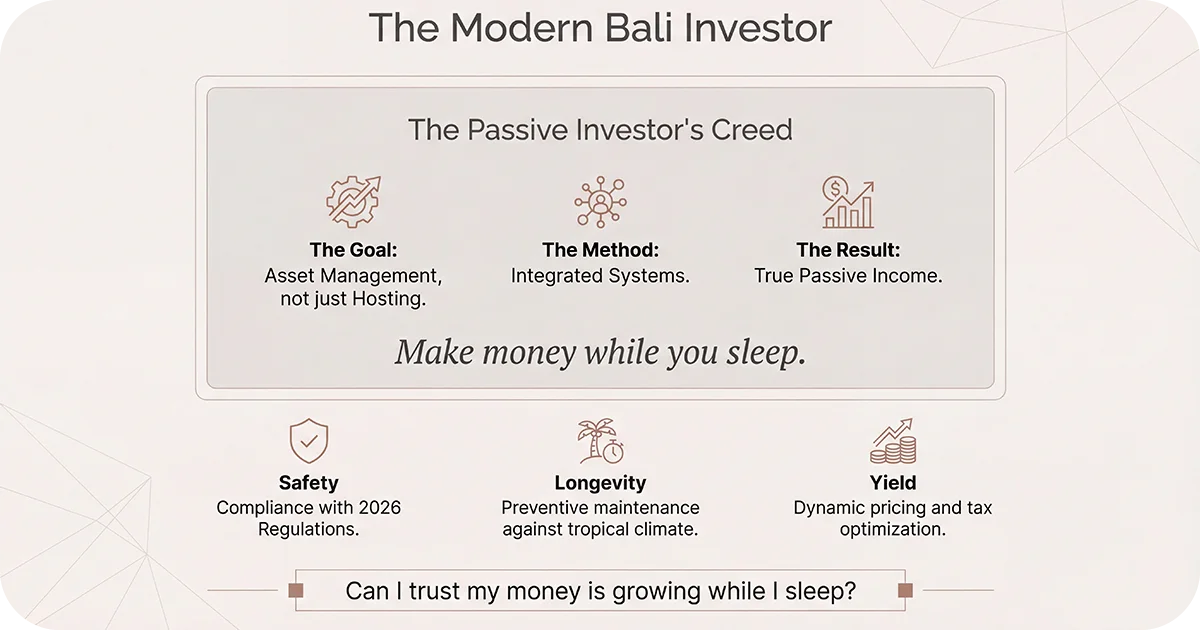
In 2026, Bali property management is no longer just about cleaning sheets; it is about Asset Management.
With stricter government regulations (the March 2026 deadline) and higher guest expectations, the era of the “amateur host” is ending.
At COCO Development Group, we built our entire company structure to answer one question for our investors: “Can I trust that my money is safe and growing while I sleep?”
By handling everything from the construction brick to the tax filing, we ensure the answer is yes.
Ready for a truly passive investment?
Explore our fully managed resort units where the only thing you need to do is check your bank balance.
👉 View Our Exclusive & High Yield Property in Bali for Sale
Frequently Asked Questions (FAQ)
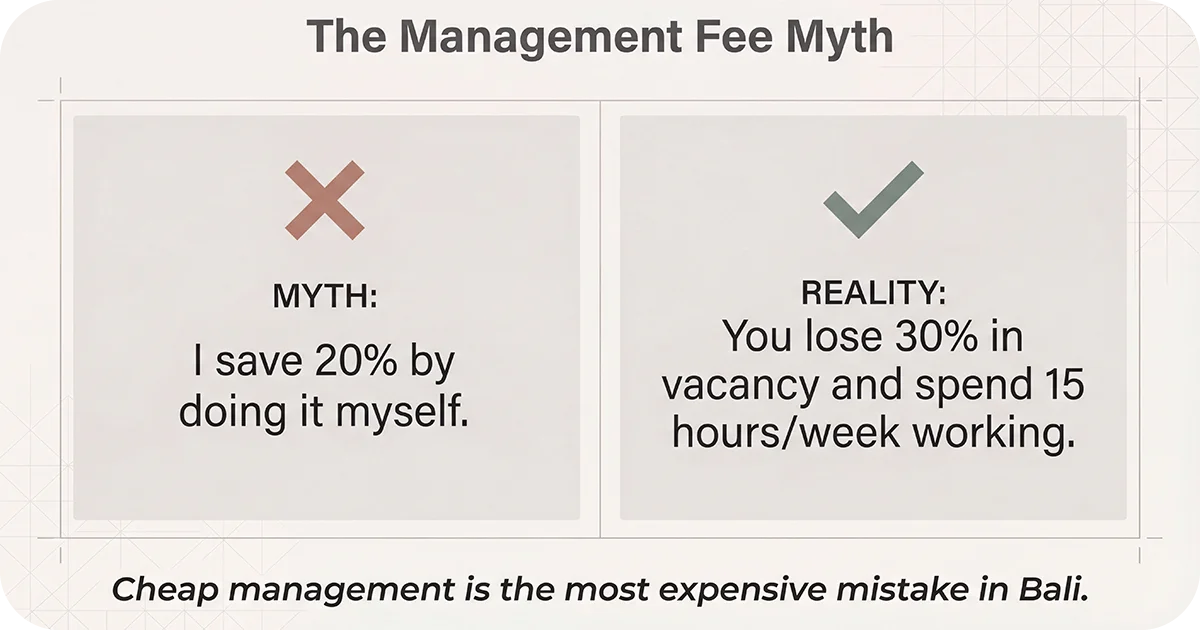
Most reputable agencies charge 30% of gross rental revenue. This fee typically covers marketing and guest handling, while expenses for electricity, pool chemicals, and laundry are deducted separately. At COCO, our integrated model is designed to be cost-efficient by sharing staff costs across the resort.
Yes. You strictly require a Pondok Wisata (Homestay License) or NIB with KBLI 55193. Operating without one is illegal. Be aware that March 31, 2026 is the hard deadline for platform compliance; properties without valid permits will be delisted from OTAs like Airbnb.
Technically yes, but it is highly inadvisable. You will face challenges with time zones, maintenance supervision, and tax compliance. Most remote owners eventually switch to professional management after realizing the "passive" income actually requires 15-20 hours of work per week.
We offer a streamlined Quarterly Payout system. We calculate your net income (Revenue minus Fees & Tax), and wire the funds directly to your designated bank account (local or international). We handle the withholding tax so the money you receive is clean and compliant.
In our Managed Resort model, we have a dedicated In-House Engineering Team. Unlike standalone villas where you must call a freelancer for every broken lightbulb, our staff is on-site 24/7. We budget a 3-5% capital reserve to ensure the property withstands the tropical climate for decades, not just years.
References & Official Sources
- Audit Board of the Republic of Indonesia (BPK) (2025). “Regulation of the Minister of Tourism No. 6 of 2025”. (Official legal text of the risk-based licensing regulation establishing the March 2026 compliance standards). https://peraturan.bpk.go.id/Details/331639/permenpar-no-6-tahun-2025
- Directorate General of Taxes (DJP) (2024). “VAT Rate Adjustment to 12%”. (Official government confirmation of the VAT rate increase to 12% effective January 1, 2025). https://pajak.go.id/en/artikel/vat-rate-increase-12-percent-indonesia-challenges-and-opportunities-0
- TTG Asia (2026). “Indonesia to Tighten Licensing for Unregistered Hotels & Villas”. (Industry report confirming the March 31, 2026 enforcement deadline for OTA delisting of non-compliant properties). https://www.ttgasia.com/2026/01/05/indonesia-to-tighten-licensing-for-unregistered-hotels-and-villas-in-bali-and-jakarta/
- PwC Indonesia (2025). “Indonesia Tax Summaries: Income Determination”. (Independent verification of the 10% final tax rate on rental income for residents and PE). https://taxsummaries.pwc.com/indonesia/individual/income-determination
- Valpro / KBLI Registry (2026). “KBLI 55193: Villa Accommodations”. (Technical definition of the specific business classification code required for legal short-term villa rentals). https://www.valprointertech.com/kbli/55193

Rasmus Holst is a serial entrepreneur and Co-Founder of COCO Development Group, where he helps drive innovation and growth through strategic business development. He is also the Co-Founder of Estate of Bali and Regnskabshelten.dk, Denmark’s fastest-growing accounting firm, which grew to 35 employees and generated $2.5M in turnover in 2023. Rasmus is passionate about building businesses that create long-term value and impact.