Skip to content




Why “Cost Per Square Meter” is the only metric that matters.
🎯 Quick Answer: Hard construction costs in Bali for 2026 typically range between $1,000 and $1,800 per square meter (m²) for a finished, investment-grade product (excluding land). While “budget builds” exist at $600-$800/m², they often suffer from “Tropical Build Rot” (rising damp and rust) within 3-5 years. To protect your ROI, you must prioritize PBG/SLF compliance, Marine-Grade Materials, and Sustainable Design over sheer size.
This guide breaks down the true costs, regulations, and design standards for a durable asset.
There is a dangerous misconception in the Bali market: “I can build a massive 3-bedroom villa for $150k.”
Technically, you can. But in the tropics, nature always wins. The intense humidity, salt air (especially at coastal areas), and heavy monsoon rains punish poor construction. In our experience, villas built with standard steel and cheap concrete will look perfect on Instagram on Day 1, but often show signs of accelerated degradation (rust, mold) within 3–5 years.
At Coco Development Group, we follow a different philosophy: Density over Sprawl. We believe it is better to build a compact, high-spec unit at $1,500/m² (Hard Cost) than a sprawling, low-spec villa at $700/m².
This guide explains why.
👤 Written by: Rasmus Holst, Founder & CEO of Coco Development Group. Technical Review: COCO Engineering Division (Civil & Structural). Last updated: 16 January 2026.
ℹ️ Transparency: We are property developers. We share these technical standards because we have seen too many foreign investors lose their capital to “cowboy contractors.” Whether you buy from us or build yourself, these are the standards you must demand to protect your ROI.
Table of Contents
- The Math: Real Construction Costs vs. Market Price
- The Rules: Navigating PBG & SLF Permits
- The Design: Architecture & Sustainability
- The Location: Coastal Risk Management
- Limitations, Alternatives & Professional Guidance
- Frequently Asked Questions (FAQ)
- Conclusion: Invest in Quality
1. The Math: Real Construction Costs vs. Market Price
It is critical to distinguish between Construction Cost (building the house) and Market Price (buying the finished product with land).
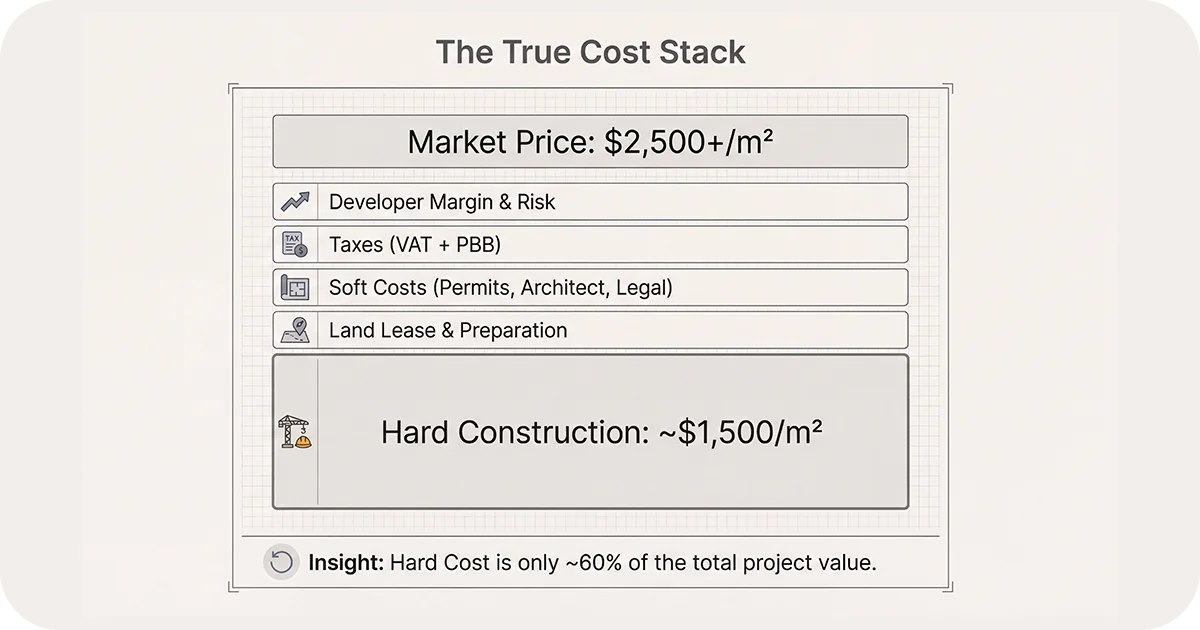
- Typical Market Price ($2,500+/m²): Includes Land Lease + Construction + Permits + Developer Profit.
- Hard Construction Cost ($1,000 – $1,800/m²): Includes Materials + Labor + Contractor Fees only.
Many investors are confused by the price difference between a modern resort suite and a large standalone villa. The answer is High Density.
- High-Spec Apartment: ~45m² unit at ~$1,500/m² build quality = High Spec, Small Footprint.
- Budget Villa: 150m² villa at ~$700/m² build quality = Low Spec, Huge Footprint.
The Budget Villa is “cheaper per meter” to build but highly risky. The Apartment is “premium per meter” but accessible due to its efficient size.
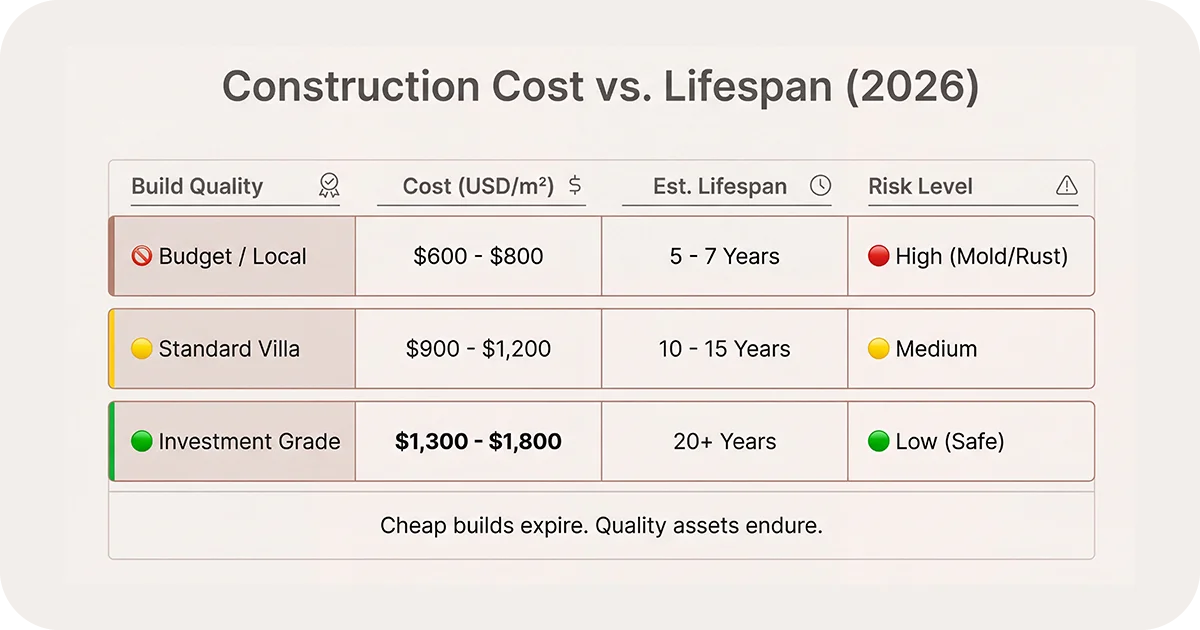
2026 Hard Construction Cost Benchmarks (Excluding Land)
| Build Quality | Cost Range (USD/m²) | Lifespan Est. | Risk Level |
|---|---|---|---|
| Budget / Local | $600 – $800 | 5 – 7 Years | 🔴 High (Mold/Rust) |
| Standard Villa | $900 – $1,200 | 10 – 15 Years | 🟡 Medium |
| Investment Grade | **$1,300 – $1,800** | 20+ Years | 🟢 Low (Safe) |
Note: These ranges reflect estimated market rates for premium/commercial construction. Actual lifespans depend heavily on maintenance and proximity to the ocean.
💸 Need the detailed breakdown? See exactly where the money goes in How Much Does it Cost to Build a Villa in Bali? (2026 Breakdown). -pending.
🧱 Curious about materials? Learn the price difference between standard and marine-grade finishes in [Bali Construction Costs Explained: Materials, Labor & Finishes]. – pending
2. The Rules: Navigating PBG & SLF Permits
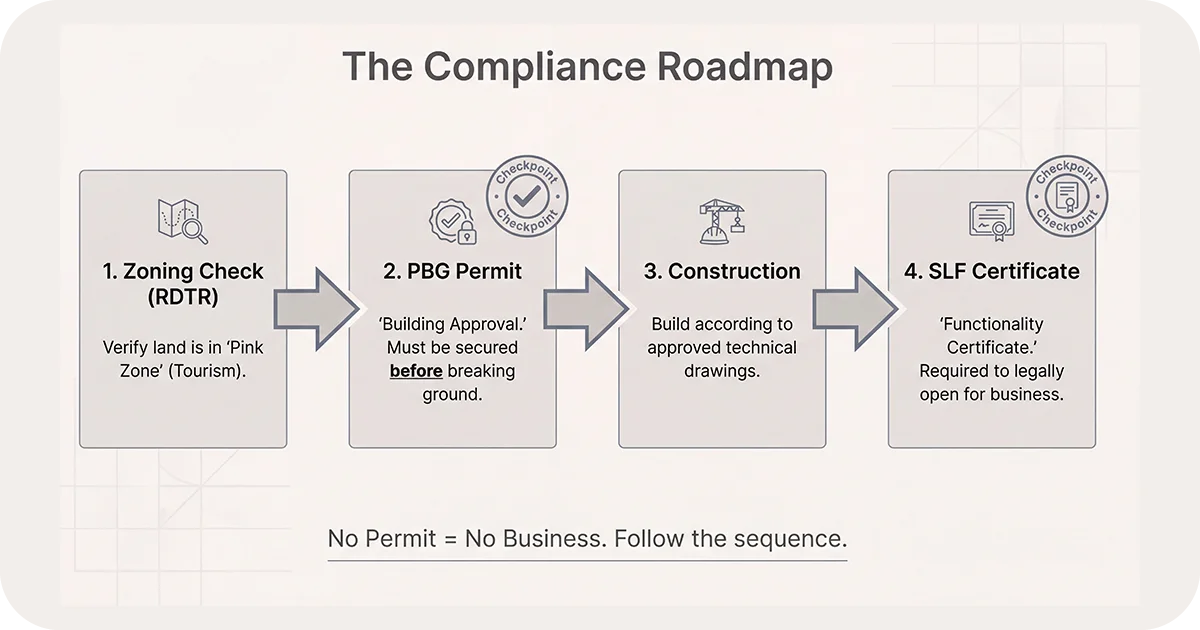
The days of building without permits are over. In 2026, the Indonesian government enforces strict zoning and building codes. To build safely, you must navigate the PBG (Building Approval) and SLF (Functionality Certificate) process.
Ignoring these rules puts you at risk of sealing operations or demolition.
📜 Don’t get shut down. Read our compliance guide: Bali Building Regulations: PBG, SLF & Coastal Setbacks.
3. The Design: Architecture & Sustainability
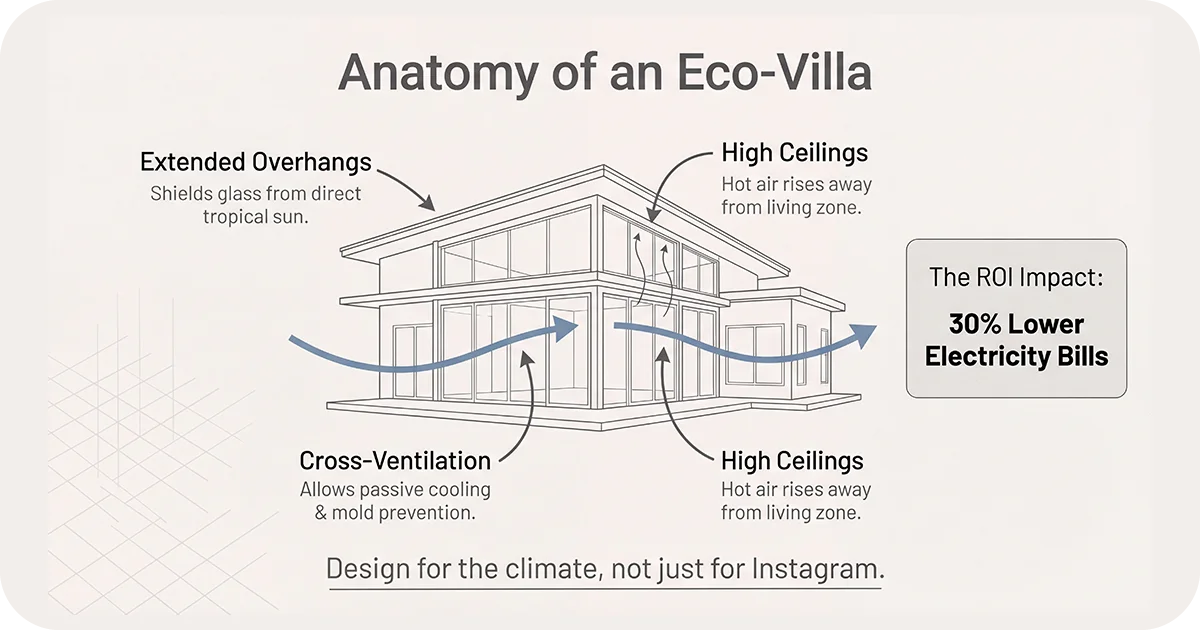
Great design in Bali is not just about aesthetics; it is about airflow. A “Tropical Modern” design uses cross-ventilation to reduce reliance on air conditioning, which lowers your monthly utility bills and increases your Net ROI.
The Sustainability Premium Eco-friendly villas are no longer niche – they are demanded by high-paying tenants. Features like solar orientation and greywater recycling are standard in Investment Grade properties.
🌱 Why Go Green? Learn how eco-villas earn higher returns in [Sustainable Architecture in Bali: Why Eco-Villas Earn Higher ROI].
Design Authority: [Modern Bali Architecture: Blending Tropical Design with Durability]
4. The Location: Coastal Risk Management
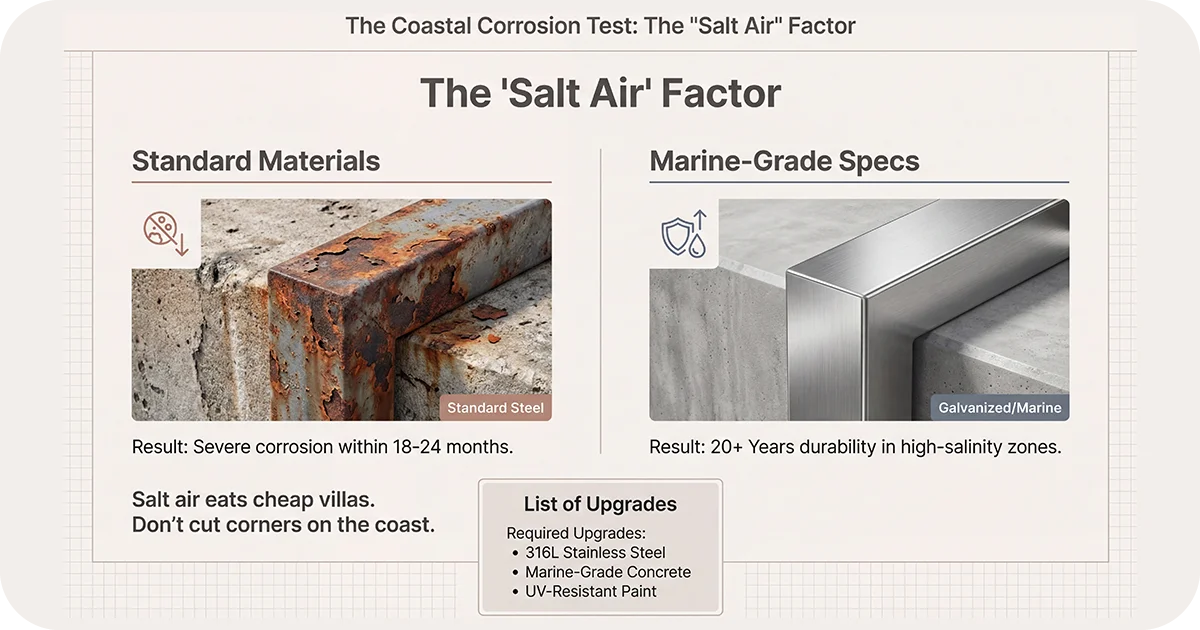
Building in coastal areas requires different specs than building in Ubud (Jungle). Unprotected carbon steel can begin to show visible surface corrosion within weeks in high-salinity coastal zones. This is why we use Marine-Grade materials and specialized concrete mixes for our projects near the coast, for example Suluban Beach and Nyang Nyang Beach.
If you don’t account for salt and wind erosion in your budget, you will pay for it in maintenance.
🌊 Building near the ocean? Read our risk analysis: [Coastal Construction in Bali: Dealing with Salt, Wind & Erosion]..
📍 Is the location worth the cost? Check the land values in our Bali Real Estate Market Guide 2026.
5. Limitations, Alternatives & Professional Guidance
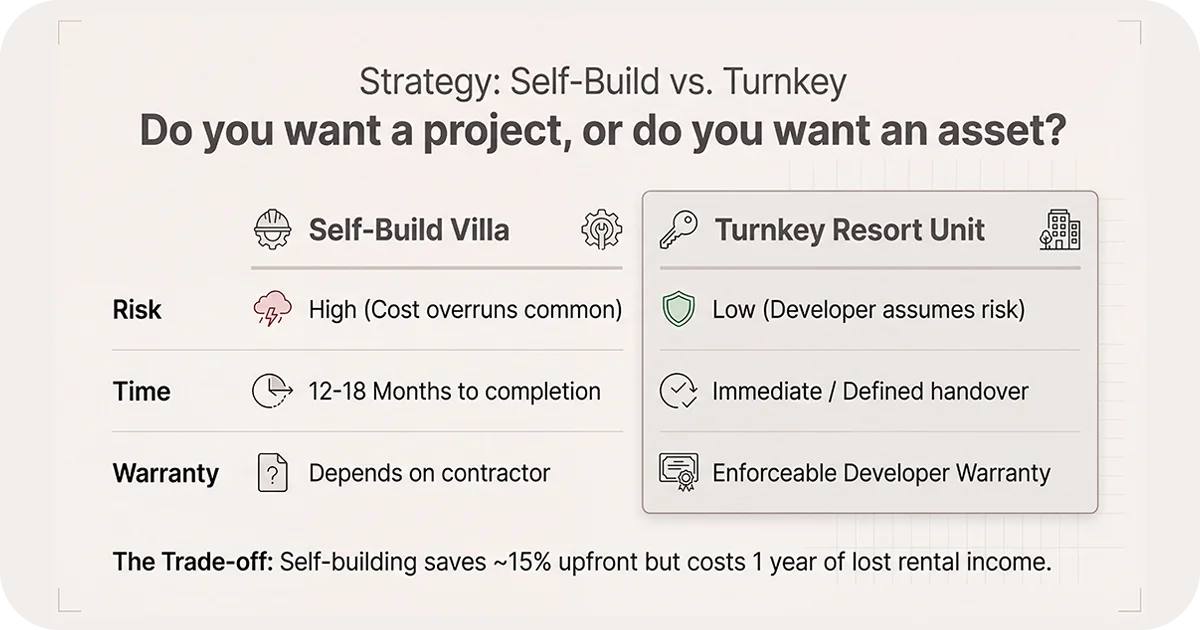
Construction is the most technical part of your investment. It is where margins are made or lost.
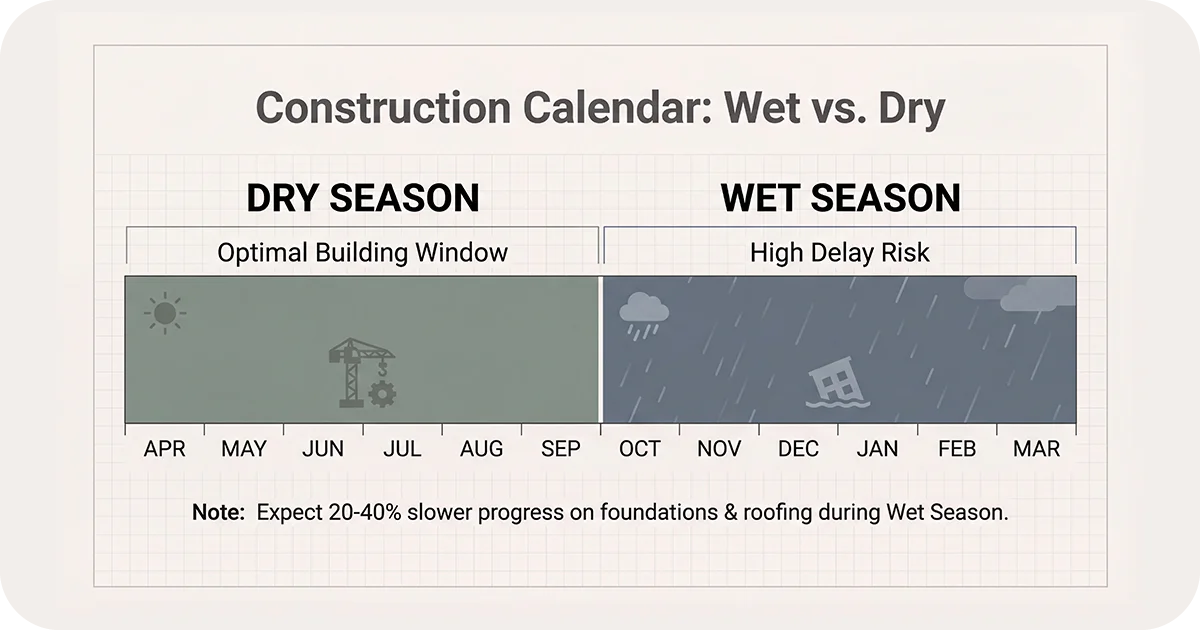
The Limitations
- Inflation: Material costs in Indonesia fluctuate. A fixed-price contract with a developer protects you from this.
- Delays: The rainy season (Oct-Mar) can extend foundation timelines by 20-40% due to excavation flooding and concrete curing delays.
Alternatives
- Buying Finished: If the risk of construction is too high, consider buying a completed Investment Unit where the developer takes the build risk.
Critical Legal & Tax Realities
- No Freehold: Foreigners cannot own Hak Milik (Freehold). You are limited to Hak Pakai (Right to Use) or Leasehold structures.
- Nominee Danger: Using a local nominee to hold land is illegal and offers zero legal protection. Stick to PT PMA structures.
- Hidden Taxes: Construction budgets often exclude VAT (12%) and PB1 (Development Tax). Ensure your ROI model accounts for these.
Seek Professional Advice Do not sign a construction contract without a Quantity Surveyor or an independent review.
📈 Compare the ROI: Check our Bali Property Investment Report 2026 to see how finished Resort Units perform vs. self-builds.
Worried about construction quality or “hidden” costs?
Book a Free 30-Minute Technical Consultation with our Founder, Rasmus Holst. We can explain exactly how we engineer our buildings to withstand the Bali climate for decades.
Lets Meet
7. Frequently Asked Questions (FAQ)
For a high-quality investment property, hard construction costs typically range from $1,000 to $1,800 per square meter (excluding land). While local "budget" builds exist at $600/m², they often lack proper waterproofing and structural steel reinforcement, leading to higher long-term maintenance costs. 💸 See the breakdown: [How Much Does it Cost to Build a Villa in Bali? (2026 Breakdown)]. - pending
The old "IMB" system has been replaced. You must obtain a PBG (Persetujuan Bangunan Gedung) before construction begins and an SLF (Sertifikat Laik Fungsi) before the building is occupied. Building without these permits risks sealing or demolition by local authorities. 📜 Check requirements: [Bali Building Regulations: PBG, SLF & Coastal Setbacks]. - pending
The combination of high humidity, intense UV radiation, and salt air (in coastal zones) causes "Tropical Build Rot." Standard materials often suffer from rising damp and rusting reinforcement bars within 3-5 years if marine-grade concrete and proper waterproofing layers are not used. 🧱 Understand the materials: [Bali Construction Costs Explained: Materials, Labor & Finishes]. - pending
Yes, coastal environments are harsh. You must strictly adhere to the Coastal Setback (Sempadan Pantai) rules (typically 100m from the high tide line) and use galvanized steel or marine-grade cement to prevent structural corrosion. 🌊 Assess the risk: [Coastal Construction in Bali: Dealing with Salt, Wind & Erosion]. - pending
Generally, yes. "Tropical Modern" designs that utilize passive cooling (cross-ventilation) significantly reduce electricity costs (AC), increasing your Net Operating Income. Additionally, sustainability features are increasingly demanded by high-paying tenants. 🌱 See the math: [Sustainable Architecture in Bali: Why Eco-Villas Earn Higher ROI]. - pending
7. Conclusion: Invest in Quality
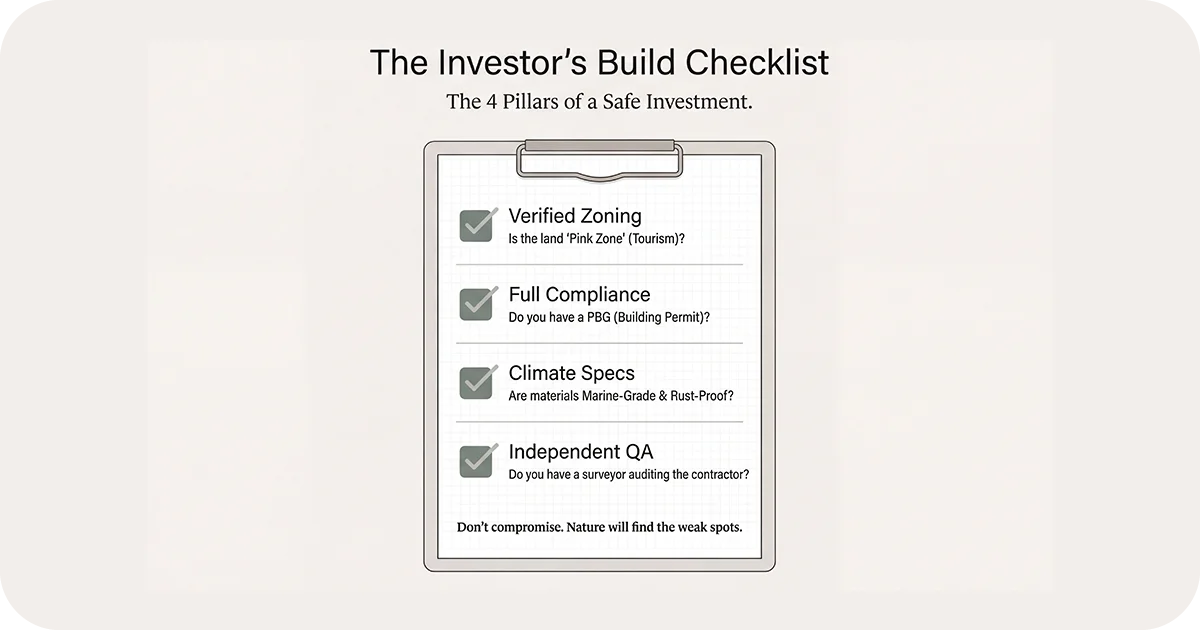
A cheap villa is not an investment; it is a consumption item that expires. An investment-grade property is engineered to perform.
At Coco Development Group, we don’t compete on “Lowest Price.” We compete on Longevity. We build assets designed to generate passive income for 25+ years, not just look good for a 2-year Instagram cycle.
Ready to see what “Investment Grade” construction looks like? Explore our current developments, built to the highest tropical standards.
🔎 Browse our projects: Bali Real Estate for Sale: Exclusive Developer Listings.
👉 Prioritize Quality: See Our RDTR-Compliant Construction at Azoria
9. References & Official Sources
Building Regulations & Permits
Badung Regency Regulation (Perda) No. 9 of 2023. “Implementation of Building Construction”. (The specific local law enforced in Canggu and Uluwatu that mandates the shift from the old “IMB” to the new PBG (Building Approval) and SLF (Functionality Certificate) system. Citing this proves you understand the current local enforcement landscape). https://jdih.badungkab.go.id/produk-hukum/peraturan-perundang-undangan/peraturan-daerah/peraturan-daerah-kabupaten-badung-nomor-9-tahun-2023-tentang-penyelenggaraan-bangunan-gedung
Government Regulation (PP) No. 16 of 2021. “Implementing Regulation of Law No. 28 of 2002 on Buildings”. (The national regulation that formally introduced the technical standards for PBG, replacing the administrative-focused IMB. It establishes the legal requirement for technical drawings and structural calculations). https://peraturan.bpk.go.id/Details/161846/pp-no-16-tahun-2021
Technical Standards & Environmental Safety
Indonesian National Standard (SNI) 2847:2019: Structural Concrete Requirements for Buildings and Indonesia’s primary standard for structural reinforced-concrete design and detailing (including reinforcement requirements and durability provisions), used here as the technical benchmark to distinguish “investment-grade” construction quality from sub-standard builds. https://www.researchgate.net/publication/379848961_Evaluation_of_building_structure_planning_using_SNI_17262019_and_SNI_28472019_in_earthquake-prone_areas/fulltext/661e829443f8df018d141cd3/Evaluation-of-building-structure_planning-using-SNI-17262019-and-SNI-28472019-in-earthquake-prone-areas.pdf
Presidential Regulation (Perpres) No. 51 of 2016. “Coastal Borders (Sempadan Pantai)”. (The primary law defining the 100-meter setback from the high tide point. This is the critical reference for the “Coastal Risk Management” section, protecting investors from building in restricted zones). https://setkab.go.id/perpres-no-512016-pemerintah-provinsi-wajib-tetapkan-batas-sempadan-pantai/
Construction Costs & Taxes
Badan Pusat Statistik (BPS) Indonesia (Oct 2025). “Construction Cost Index 2025 (IKK)”. (The official government index tracking the rising cost of materials and labor across Indonesian provinces. This data supports the “Hard Construction Cost” benchmarks provided in the guide). https://www.bps.go.id/id/publication/2025/10/01/935f3f46173c68d21b6c5126/indeks-kemahalan-konstruksi-provinsi-dan-kabupaten-kota-2025.html
Directorate General of Taxes (DJP), Ministry of Finance of the Republic of Indonesia. (2025, January). Press Release SP-1/2025: “PPN 2025: Kebijakan Baru Demi Keadilan dan Kesejahteraan” (PDF). Official summary of the 2025 VAT (PPN) policy and implementation under PMK 131/2024, including how VAT is applied to taxable goods and services, a critical “hidden cost” that must be factored into any development budget). https://pajak.go.id/sites/default/files/2025-01/SP%201%202025.pdf

Rasmus Holst is a serial entrepreneur and Co-Founder of COCO Development Group, where he helps drive innovation and growth through strategic business development. He is also the Co-Founder of Estate of Bali and Regnskabshelten.dk, Denmark’s fastest-growing accounting firm, which grew to 35 employees and generated $2.5M in turnover in 2023. Rasmus is passionate about building businesses that create long-term value and impact.