




🎯 Quick Answer: Can Foreigners Buy Property in Bali? Yes. While foreigners cannot own Freehold (Hak Milik) land, you can legally secure property through Leasehold (Hak Sewa) structures for 25-80 years or via a PT PMA (Foreign Company).
⚠️ Important: The legal structure you choose impacts your taxes and visa eligibility. 👉 Read the full legal breakdown: [Can Foreigners Buy Property in Bali? (Freehold vs. Leasehold Guide)]
Buying property in Bali is one of the highest-yield real estate strategies in 2026, offering returns of 17-20%. The key to success is bypassing middlemen by buying directly from reputable developers and ensuring your property is in a professionally managed resort ecosystem.
This guide covers the legal process, prices, and critical steps to buy safely.
For decades, buying property in Bali was seen as a “Wild West” adventure – risky, legally grey, and reserved for surfers or risk-takers. In 2026, that narrative has collapsed. Bali has matured into a sophisticated, global investment asset class, outperforming London, Dubai, and Sydney with yields that frequently hit double digits.
However, the question remains: How do you actually buy property in Bali without getting burned?
This comprehensive hub connects you to every resource you need, from navigating the “Freehold vs. Leasehold” confusion to finding the right developer. Whether you are looking for a lifestyle villa or a pure investment vehicle, this is your roadmap.
👤 Written by: Rasmus Holst, Founder & CEO of Coco Development Group. Reviewed by: COCO Legal Compliance Team (Specialists in Indonesian Agrarian Law). Last updated: 16 January 2026
ℹ️ Transparency: This guide provides a strategic roadmap for buying property in Bali, based on current 2026 regulations and market data. While we are a property development firm, the advice here is objective and verified by legal experts to ensure you navigate the market safely, regardless of who you choose to buy from.
Table of Contents
- The Legal Framework: Can Foreigners Actually Buy?
- The Process: How to Buy in 5 Steps
- The Market: Property Prices & Locations (2026)
- The Partners: Developer vs. Agent
- The After-Care: Property Management & ROI
- Limitations, Alternatives & Professional Guidance
- Frequently Asked Questions (FAQ)
- Conclusion: Start Your Search
- References & Official Sources
1. The Legal Framework: Can Foreigners Actually Buy?
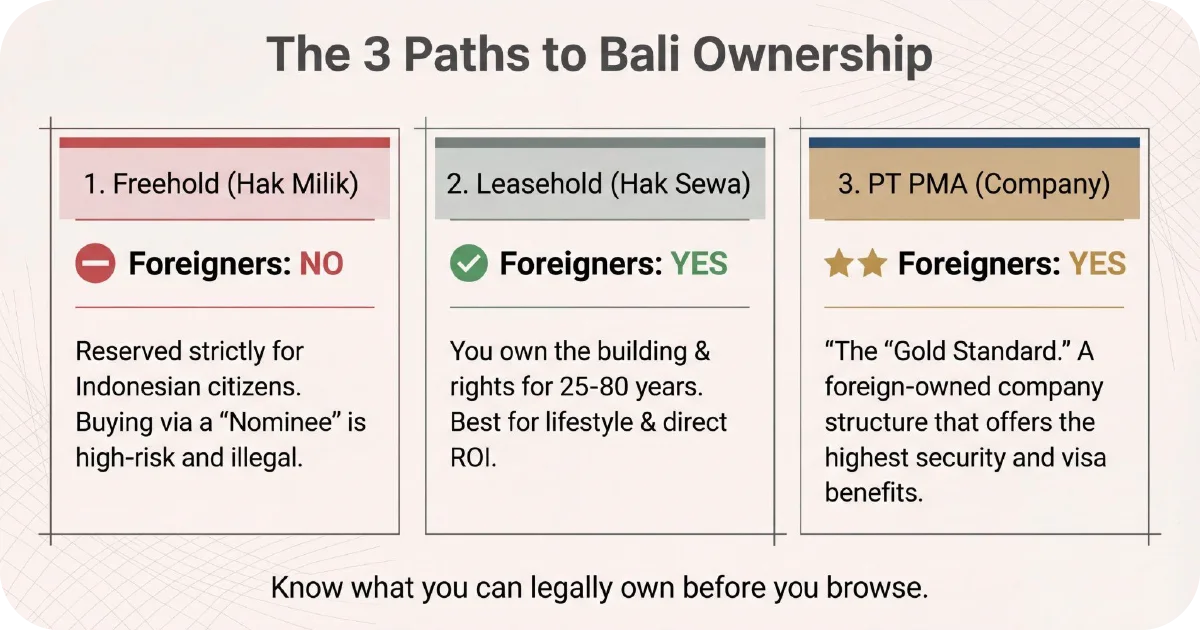
The short answer is Yes, but the terminology is different from the West. Foreigners cannot own “Freehold” (Hak Milik) land, that is reserved exclusively for Indonesian citizens. Instead, you hold rights to the land through two primary mechanisms.
Freehold vs. Leasehold
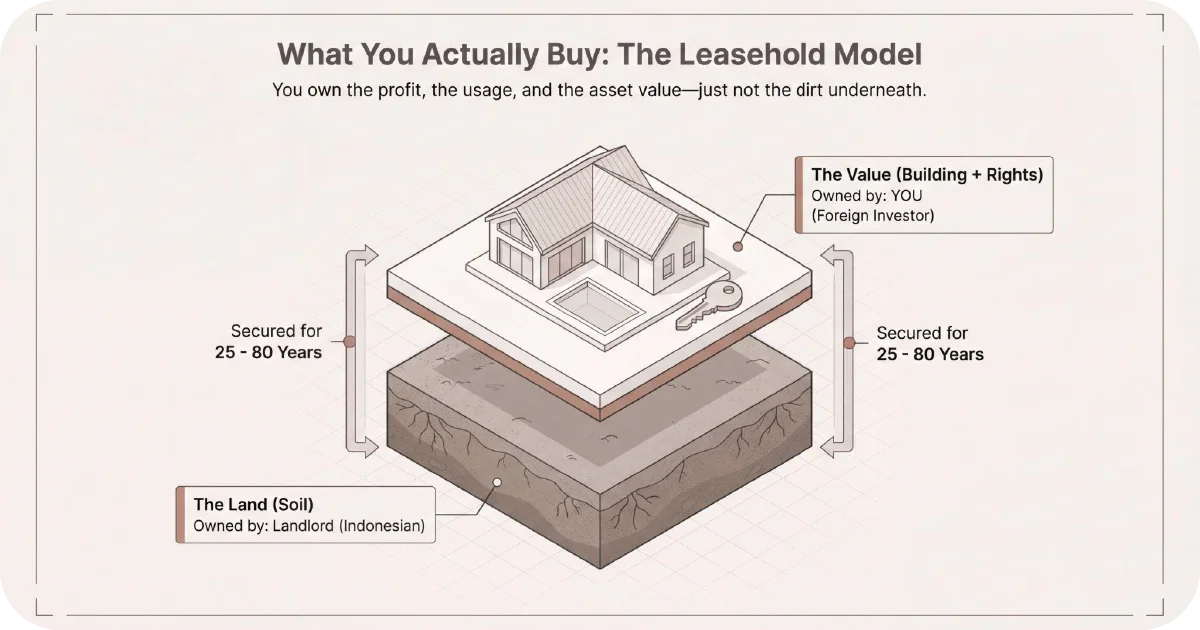
The most common structure is Leasehold (Hak Sewa). You pay upfront for a 25-30 year term, effectively owning the building and the right to profit from it. This offers the same ROI potential as ownership, without the legal grey areas of nominee structures.
📜 Confused by the rules? Read our full legal breakdown: Can Foreigners Buy Property in Bali?
Looking for Leasehold Villas?
Many investors specifically search for [Bali property for lease] to find assets with 25-30 year terms. This is distinct from “renting” monthly; it is a long-term asset acquisition that sits on your balance sheet.
🏠 Understanding the asset: Read our guide on Leasehold Villas: Understanding Bali Property for Lease.
The Gold Standard: PT PMA
For serious investors, setting up a PT PMA (Foreign Owned Company) allows you to upgrade your title to Hak Pakai (Right to Use) or HGB (Right to Build), offering even greater security and the ability to issue investor visas.
🏢 Setting up a company? See the costs and benefits in our Bali Investor Guide 2026: Visas, Taxes & Legal Setup.
2. The Process: How to Buy in 5 Steps
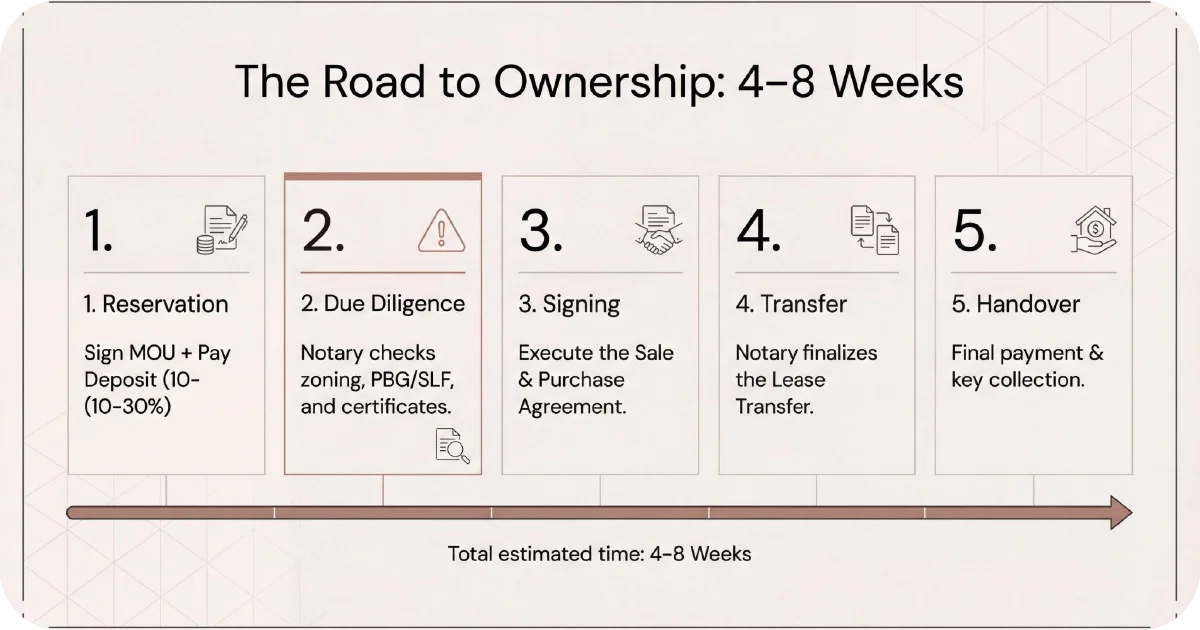
Buying property in Bali is not like buying in Europe. There is no central “Land Registry” accessible online in the Western sense, and “Due Diligence” is a manual process involving local land offices (BPN). The journey typically takes 4-8 weeks from reservation to signing.
✅ Don’t miss a step. Follow our chronological checklist: Step-by-Step: How to Buy Property in Bali Safely.
The Condensed Checklist:
- Reservation: Sign an MOU and pay a deposit (usually 10-30%) to take the unit off the market.
- Due Diligence: Your notary checks the land certificates and zoning (ITR/RDTR). Crucial: Ensure the property has the correct PBG (Building Approval) and SLF (Certificate of Fitness), which replaced the old “IMB” system in 2021.
- Sale & Purchase Agreement: You sign the binding contract.
- Lease Transfer: The notary finalizes the transfer of rights.
- Payment: Final payments are made (often in stages for off-plan builds).
3. The Market: Property Prices & Locations (2026)
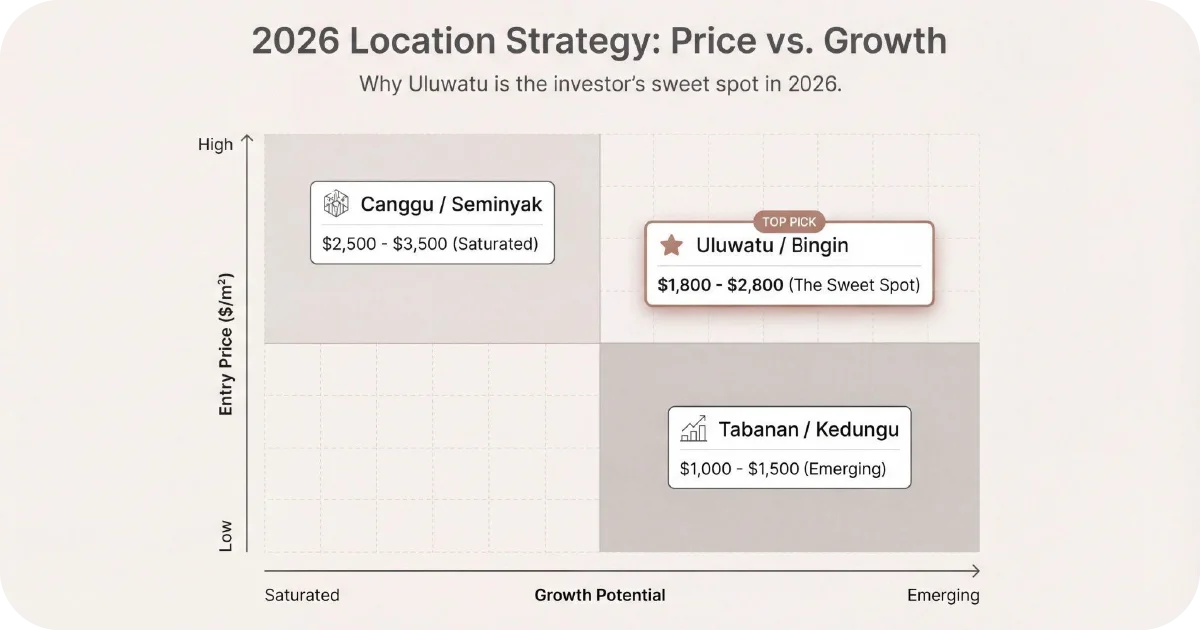
Is Bali expensive? It depends on where you look. While beachfront land in Canggu has reached global metropolitan prices, high-growth areas like Uluwatu still offer exceptional value for money – especially for off-plan developments.
💰 Planning your budget? See the full price history in our Bali Real Estate Market Guide 2026.
2026 Price Benchmarks (Averages): Note: Prices below refer to completed villa pricing, not raw land.
- Canggu/Seminyak: $2,500 – $3,500 per m² (Saturated)
- Uluwatu/Bingin: $1,800 – $2,800 per m² (High Growth)
- Tabanan/Kedungu: $1,000 – $1,500 per m² (Emerging)
🌍 Bali vs. The World: Curious how these yields compare to London, Dubai, or Sydney? Read our full report: Why Bali Property Investment Outperforms Global Markets.
| Location | Price Range (USD/m²) | Market Status |
|---|---|---|
|
Canggu / Seminyak |
$2,500 – $3,500 |
Saturated |
|
Uluwatu / Bingin |
$1,800 – $2,800 |
High Growth |
|
Tabanan / Kedungu |
$1,000 – $1,500 |
Emerging |
4. The Partners: Developer vs. Agent
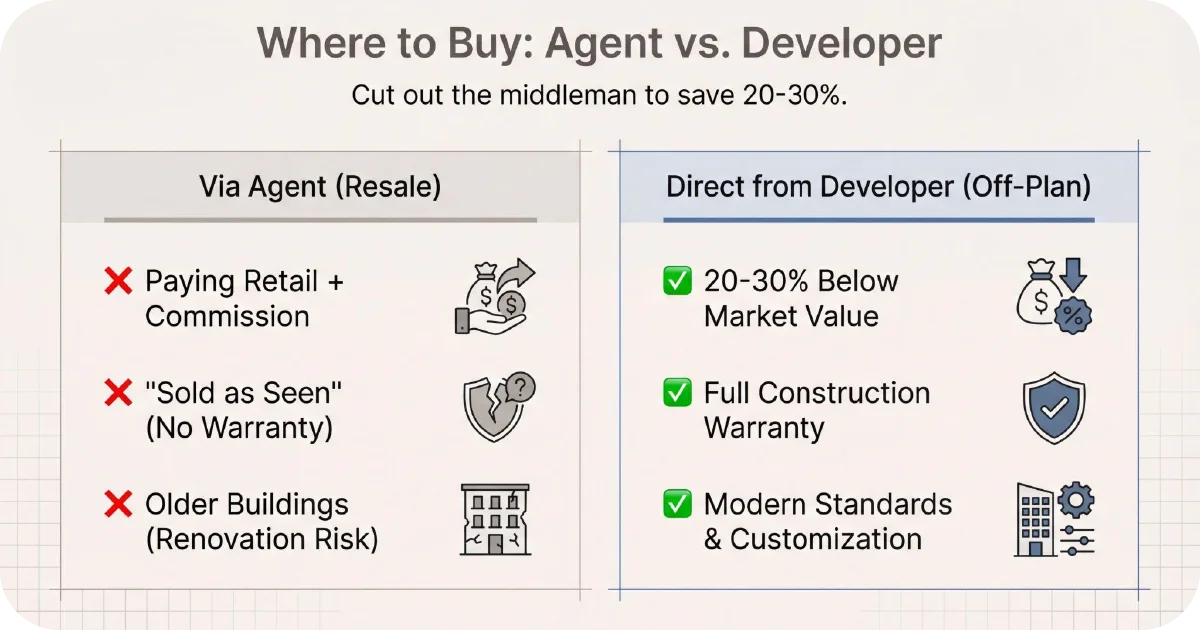
Most buyers start by browsing agent listings, but smart investors eventually realize that [buying direct from the developer] offers significant advantages.
- Agents: Good for browsing “second-hand” (resale) villas, but they charge commissions and cannot control build quality.
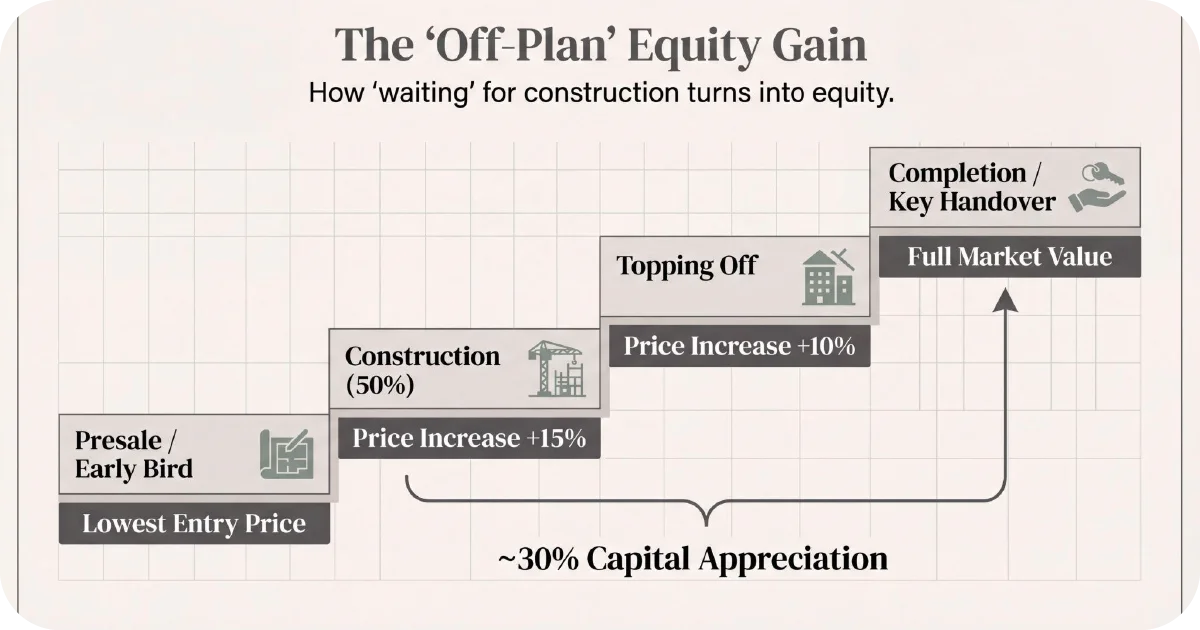
- Developers: Selling “off-plan” (new) units allows you to buy at a 20-30% discount before construction completes. Plus, you get construction warranties that resale villas lack.
🤝 Who should you trust? Read our honest comparison: Property Agent vs. Developer: Who Should You Buy From?.
🏗️ Why go direct? Learn the benefits in Top Property Developer in Bali: Why Buy Direct?.
| Feature | Buying via Agent | Buying Direct from Developer |
|---|---|---|
|
Best For |
“Second-hand” (Resale) Villas |
Off-plan / High-Yield Investments |
|
Price Point |
Market Value + Commission |
20-30% Below Market (Off-plan) |
|
Warranty Included? |
❌ No (Sold “As Is”) |
✅ Yes (Construction Warranty) |
|
Customization |
❌ None (Requires renovation) |
✅ Yes (If bought early) |
5. The After-Care: Property Management & ROI
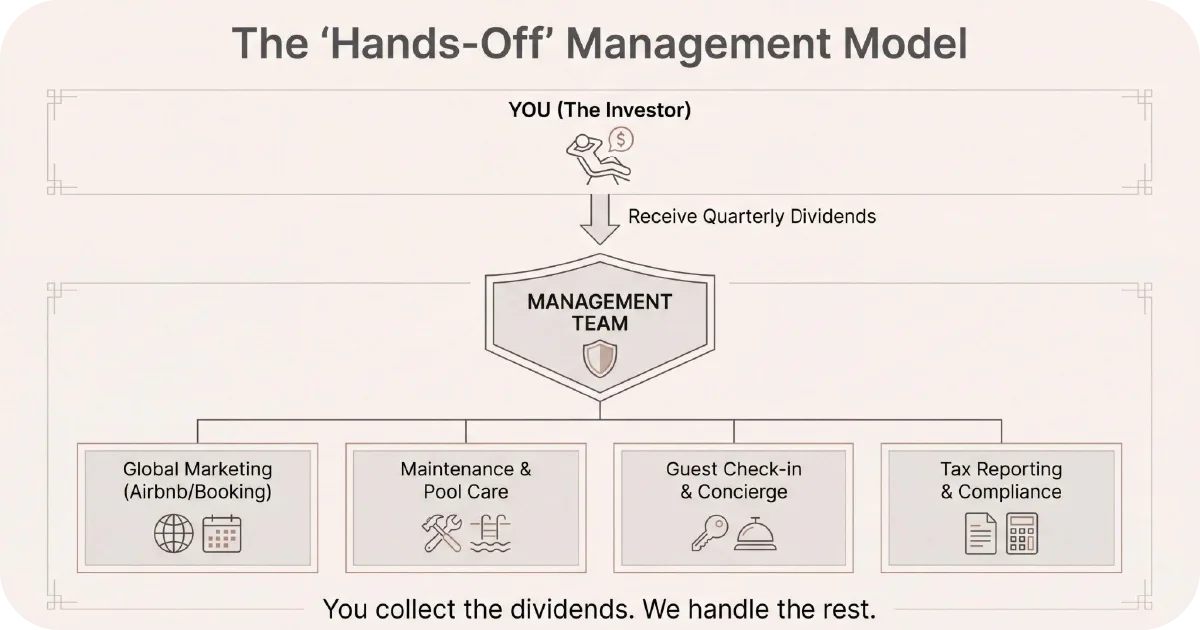
Buying the property is only half the battle. The “Passive Income” dream only works if the property is managed correctly. You cannot manage a Bali villa from London or Sydney – the humidity, pool maintenance, and guest check-ins require a professional team.
The “Hands-Off” Model At developments like Azoria Living, property management is integrated. Investors simply receive a quarterly report and their dividends, while the on-site team handles marketing, maintenance, and taxes.
🛠️ Living overseas? Learn how to manage your asset in Bali Property Management Services: Passive Income Solutions.
6. Limitations, Alternatives & Professional Guidance
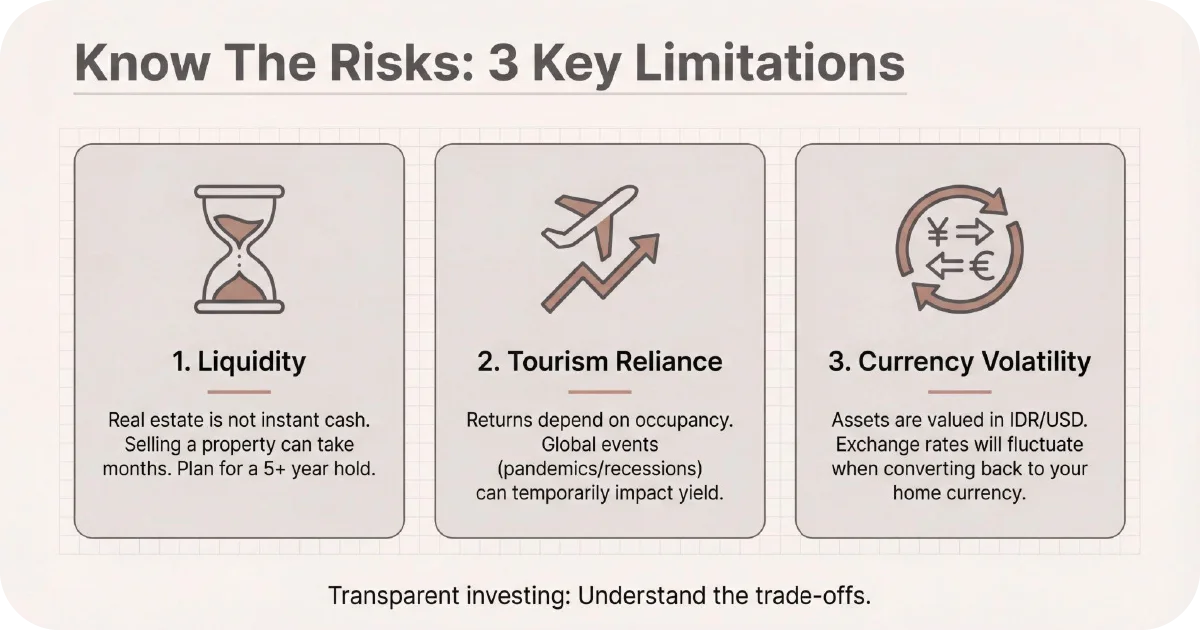
While Bali real estate offers some of the highest yields globally, it is not a “get rich quick” scheme, nor is it suitable for every investor. Transparency is core to our philosophy, so it is important to understand the trade-offs.
The Limitations
- Liquidity: Unlike stocks or crypto, real estate is an illiquid asset. Selling a property in Bali can take months. You should view this as a medium-to-long-term hold (5+ years).
- Tourism Dependence: Bali’s economy is heavily reliant on tourism. While the sector has proven resilient (rebounding post-2002, 2017, and 2020), global economic downturns can temporarily impact occupancy rates.
- Currency Fluctuations: Your asset is valued in IDR (Indonesian Rupiah) or USD/EUR depending on your contract. Exchange rate volatility can impact your final returns when converting back to your home currency.
Investment Alternatives If you require high liquidity or lower risk exposure, you might consider:
- Indonesian Government Bonds (SBN): Lower yield (approx 6%), but near-zero risk.
- Indonesia Stock Exchange (IDX): High liquidity, but higher volatility and requires active trading knowledge.
- REITs (Real Estate Investment Trusts): Gain exposure to Southeast Asian property without owning physical assets, though yields are typically lower (4-6%).
Seek Professional Advice This guide is for educational purposes. While we are experts in development, navigating the legal and financial nuances of a foreign market requires personalized strategy.
Most developers hide behind sales teams. We do things differently.
Still have questions about legal structures or specific ROI projections?
Book a Free 30-Minute Strategy Call directly with our Founder & CEO, Rasmus Holst. No sales pressure, just honest answers to help you determine if Bali is the right asset class for your portfolio.
Lets Meet
7. Frequently Asked Questions (FAQ)
Yes, but you cannot own "Freehold" (Hak Milik) land directly in your individual name. Foreigners can legally secure property through Leasehold (Hak Sewa) structures (typically 25-30 years) or by setting up a PT PMA (Foreign Owned Company) to obtain Right to Use (Hak Pakai) titles, which are valid for up to 80 years. 📜 Read the full rules: [Can Foreigners Buy Property in Bali?]. - pending
Yes, provided you follow the legal framework. The market is safe if you conduct proper Due Diligence (checking zoning and land certificates) and use a qualified Notary (PPAT). Risks primarily arise from using illegal "Nominee" structures or buying land without Road Access or PBG building permits. ✅ Check your safety: Follow our [Step-by-Step: How to Buy Property in Bali Safely]. - pending
Prices vary significantly by location and title. In 2026, a high-end off-plan villa in Uluwatu typically costs between $1,800 - $2,800 per square meter, while saturated areas like Canggu can reach $3,500/m². Entry-level investment units can start from approximately $130,000. 💰 See current prices: [Bali Property Prices 2026: Market Report by Area]. - pending
While Canggu remains popular for tourism, it is facing oversaturation. Emerging luxury zones like Uluwatu (Bingin, Suluban) offer higher capital appreciation potential and ROI due to scarcity of beachfront land and growing infrastructure. 📍 Compare locations: [Bali Real Estate Market Guide 2026]. - pending
Yes. The Indonesian government introduced the Second Home Visa, which grants a 5-10 year stay permit for foreigners who purchase property valued at approximately USD 130,000 (IDR 2 Billion) or more. You can also obtain an Investor KITAS if you buy through a PT PMA. ✈️ Check requirements: [Bali Second Home Visa: Live in Your Investment for 5-10 Years]. - pending
Buyers typically pay VAT (11-12%) on new builds and a Transfer Tax (BPHTB) of 5% on the land value (though this can sometimes be negotiated in leasehold deals). You must also factor in the 1% Notary Fee. 🧾 Calculate your costs: [Bali Property Tax Guide: PBB, BPHTB & VAT Explained]. - pending
8. Conclusion: Start Your Search
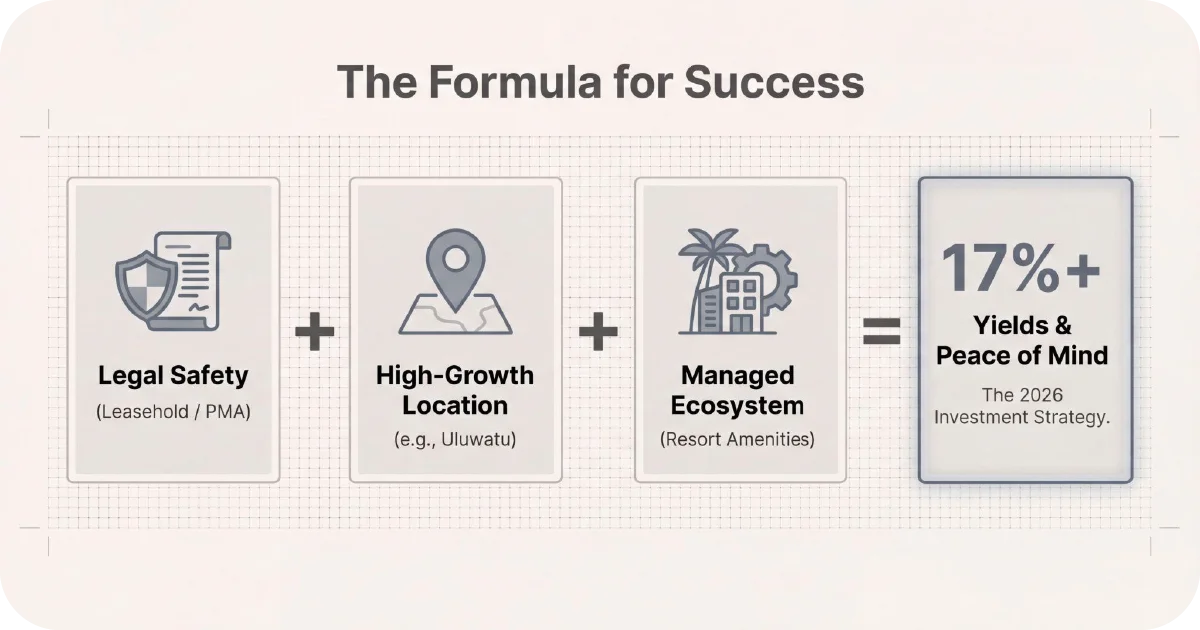
Buying property in Bali is one of the few remaining opportunities to secure 17%+ yields in a stable, democratic economy. But the market penalizes amateurs. The winners in 2026 will be those who buy legally (Leasehold/PT PMA), buy in the right location, and buy into a managed ecosystem rather than a standalone struggle.
Ready to explore the market? View our curated selection of investment-grade resort units in Bali, designed specifically for high-yield passive income.
🔎 Prefer to browse first? See our full inventory: Property in Bali for Sale.
👉 Ready to buy? View High-Yield Resort Units at Azoria
9. References & Official Sources
Legal Framework & Land Rights
Government Regulation (PP) No. 18 of 2021. “Right to Manage, Land Rights, Flat Units, and Land Registration”. (The primary regulation implementing the Omnibus Law, explicitly defining Hak Pakai (Right to Use) and Strata Title ownership rights for foreigners with a stay permit. Supports “Phase 1: The Legal Framework”). https://peraturan.bpk.go.id/Details/161848/pp-no-18-tahun-2021
Law No. 5 of 1960 (UUPA). “Basic Regulations on Agrarian Principles”. (The foundational law stating that Hak Milik (Freehold) is reserved exclusively for Indonesian citizens (Article 21), validating “No Freehold” warning). https://peraturan.bpk.go.id/Details/51310/uu-no-5-tahun-1960
Corporate Structure (PT PMA)
BKPM Regulation No. 5 of 2025. “Guidelines and Procedures for Risk-Based Business Licensing”. (The new regulation reducing the minimum paid-up capital requirement for PT PMA establishment to IDR 2.5 Billion (approx. $150k), while maintaining the total investment value at IDR 10 Billion. Supports “Step 2: The Vehicle”). https://www.tmi.gr.jp/service/global/asia-pacific/2025/17732.html
Visas & Immigration
Directorate General of Immigration (2025). “Second Home Visa (Index E33) Requirements”. (Official source confirming the IDR 2 Billion (or equivalent luxury property) proof-of-funds requirement for the 5-10 year stay permit. Supports “Section 3: Visas”). https://indonesia.nl/en/golden-visa/
Taxes & Transaction Costs
Ministry of Finance Regulation (PMK) No. 131 of 2024. “Implementation of Value Added Tax (VAT) Rate Adjustment”. (Official confirmation of the VAT (PPN) rate increase to 12% effective January 1, 2025, which impacts new developer unit purchases. Supports “Step 5: Payment & Taxes”). https://peraturan.bpk.go.id/Details/312080/pmk-no-131-tahun-2024
Directorate General of Taxes (DJP). “PPH Final on Land and Building Transfer”. (Regulation governing the Final Income Tax sellers pay and the BPHTB (5%) buyers pay. Supports “Step 5: Payment”). https://pajak.go.id/id/pph-pasal-4-ayat-2#:~:text=adalah%20sebesar%205%25%20(lima%20persen,atas%20tanah%20dan%2Fatau%20bangunan.

Rasmus Holst is a serial entrepreneur and Co-Founder of COCO Development Group, where he helps drive innovation and growth through strategic business development. He is also the Co-Founder of Estate of Bali and Regnskabshelten.dk, Denmark’s fastest-growing accounting firm, which grew to 35 employees and generated $2.5M in turnover in 2023. Rasmus is passionate about building businesses that create long-term value and impact.