🎯 Summary of Content
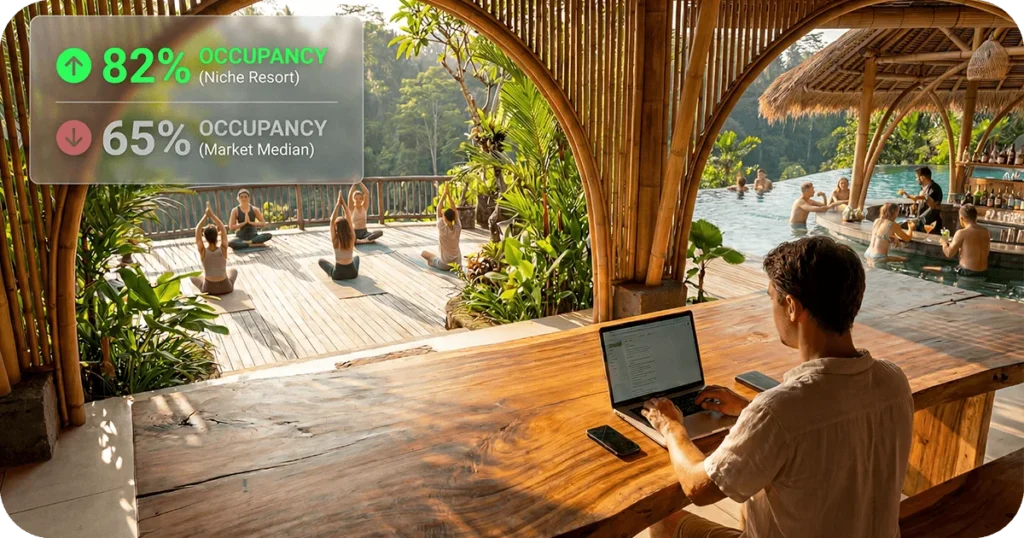
Is Airbnb in Bali a good investment in 2026? For the smart investor expecting good returns, the answer is a hard no. The market is oversaturated, with a 29% surge in listings driving median occupancy down to 65% and compressing yields. The “easy money” era is dead. However, the answer becomes a “yes” for a specific type of operator. While generic villas struggle, professionally managed properties within integrated wellness resorts (gyms, coworking, Spa, community) are defying the trend, commanding 80%+ occupancy and premium rates by solving the “loneliness” problem for long-stay digital nomads.
- The “Two Balis” Crisis: A massive 29% supply surge (reaching ~38,000 listings) has split the market in 2026. While generic villas suffer from yield compression (median occupancy dropping to 65%), professional operators in niche markets continue to thrive.
- Location Dynamics: Central hubs like Canggu are now oversaturated (43% occupancy), whereas supply-constrained luxury areas like Uluwatu remain high-yield (median ADR $255+) and offer superior investment potential.
- The Wellness Pivot: Success now depends on the “Lifestyle Resort” model, integrating gyms, coworking, and community, which commands 80%+ occupancy by solving loneliness for the ~40,000 digital nomads and wellness seekers on the island.
- Regulatory Crackdown: The “Wild West” era is over; 2026 brings strict enforcement of Pondok Wisata licenses. Using “Nominee” structures is now critically risky, making the PT PMA (Foreign Investment Company) the only safe legal vehicle.
- Financial Reality: The “easy money” is gone; standalone villas barely break even (0.6% cash-on-cash). However, the wellness resort model expands margins (3.5–7%+) through economies of scale and higher daily rates ($240+).
- Strategic Opportunities: Profitable investing now requires a “Build-to-Rent” approach (saving 30–40% on entry costs) or a “Portfolio” strategy (clustering villas to reduce management fees), rather than buying turnkey properties.
Written by: Rasmus Holst (Founder & CEO of Coco Development Group) | Reviewed by: COCO Chief Investment Officer (CIO) | Last updated: 17 April, 2026.
Transparency: COCO Development Group develops lifestyle resorts in Bali. We explicitly acknowledge our bias: the investment model favored here aligns with our commercial interests. We advocate for this strategy because we genuinely believe in it, and our own capital and developments are exclusively tied to this model. This article is for educational purposes only, not financial advice. We firmly recommend independent due diligence and consulting a certified Notary (PPAT) and tax advisor before investing.
Table of Contents
- Introduction
- The “Two Balis”: Why the Median Operator is Struggling
- The Solution: Why Wellness & Community Drive 80%+ Occupancy
- The 2026 Regulatory Reality: Licenses or Shutdown
- Financial Reality: Standalone Villa vs. Resort Model
- Who Should Still Invest? (The 3 Exceptions)
- Limitations, Alternatives & Professional Guidance
- Frequently Asked Questions (FAQ)
- Conclusion
- References & Official Sources
Introduction
In 2025, Bali recorded approximately 6.95 million direct foreign arrivals according to BPS, while Governor Koster cited 7.05 million based on airport passenger data. This surge in arrivals is a primary driver in our comprehensive Bali property investment report, which tracks why resort models are now outperforming standalone villas.
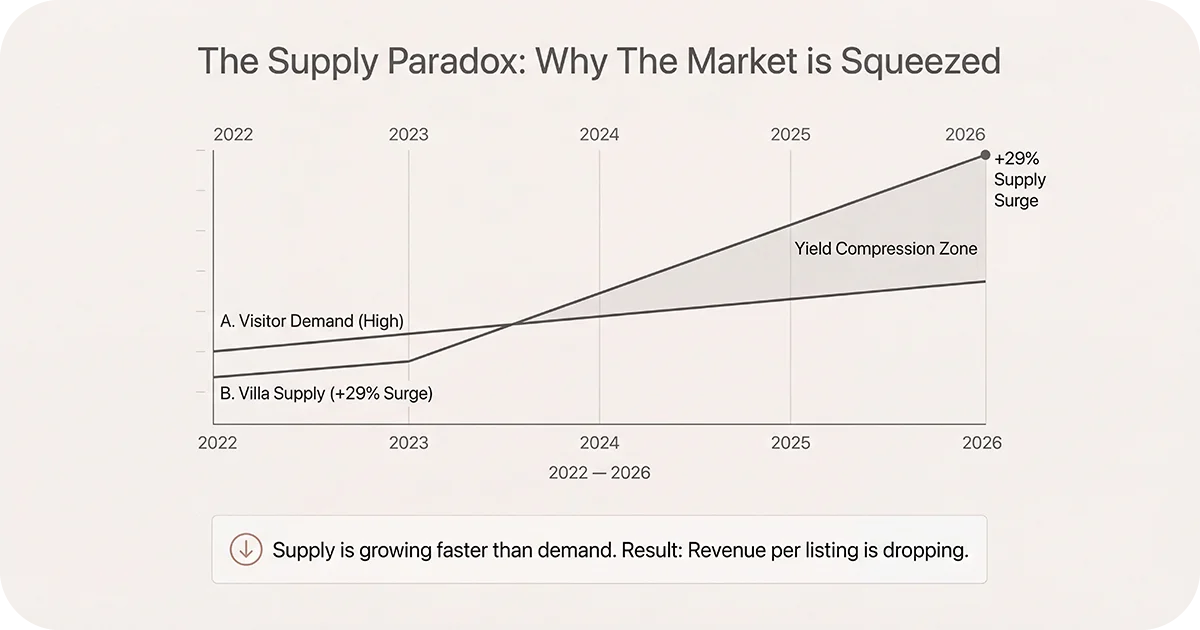
Why? Because while demand is at an all-time high, supply has exploded. According to Airbtics, a private STR analytics firm, Airbnb listings in Bali approximately doubled from ~20,000 in 2022 to nearly 38,000 by the end of 2025. The result is a market described by Airbtics as “Declining”, where supply growth (+29.4%) is outpacing revenue growth.
This does not mean you cannot make money, it means the strategy must change. The days of simply picking a generic 2-bedroom villa, listing it on Airbnb, and expecting 15% passive returns are gone. Today, the market is split into two realities: the struggling median operator and the thriving “Lifestyle Resort” ecosystem.
Investing in Bali today therefore requires a shift in mindset. You are not buying a “vacation home that pays for itself”; you are entering a highly competitive hospitality market. The “Two Balis” phenomenon means that while tourism numbers are up, the revenue is not evenly distributed. A holistic investment strategy is no longer optional, it is the only way to protect your capital against inflation and saturation.
This article examines the hard data behind the market’s bifurcation, explaining why standard villas are seeing yield compression while community-integrated properties are outperforming. We will analyze the financial realities of both models and the critical legal frameworks required to operate safely in 2026.
The “Two Balis”: Why the Median Operator is Struggling
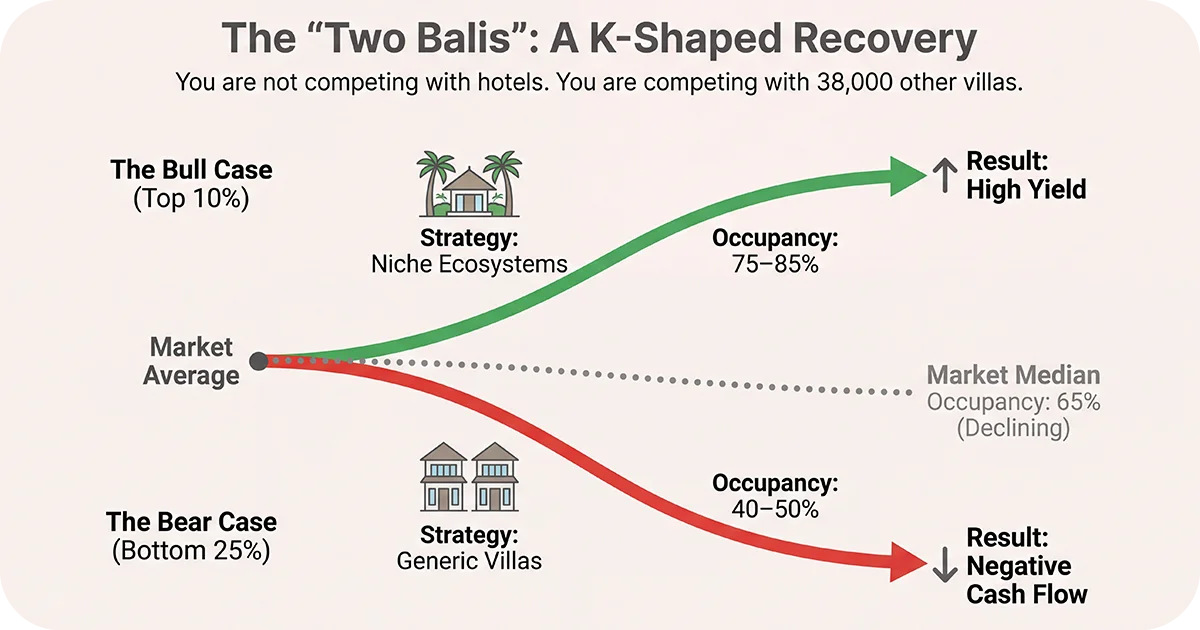
If you look at the surface-level numbers, Bali looks like a goldmine. But dig deeper into the rental yield of property in Bali, and you find a dangerous trap for the uninformed investor. The market is currently experiencing Yield Compression.
The Saturation Problem
The core issue is simple economics: Supply is growing faster than demand.
- Supply Surge: +8,919 new listings were added in 2025 alone (a 29% increase).
- Revenue Decline: Average revenue per listing dropped by ~6–11% year-over-year.
- Occupancy Reality: The median occupancy rate across the island is 65%. In highly saturated areas like Canggu, the median has dropped to 43% for generic properties.
The Bifurcation of Returns
This saturation has created a “K-shaped” market.
- The Bottom 25% (The Bear Case): Amateur landlords with generic villas, poor management, and no unique selling points. They are seeing 40–50% occupancy and negative cash flow after operating expenses.
- The Top 10% (The Bull Case): Professionally managed properties in niche ecosystems (wellness, surf, family luxury). These properties are defying the trend, achieving 75–85% occupancy and maintaining ADRs (Average Daily Rates) of $240+.
The “Two Balis”: Market Performance Data (2025/2026)
Key Takeaway: You are not competing with hotels anymore; you are competing with 38,000 other villas. To survive, you must offer more than just a bed and a pool.
Location Bifurcation: The “Crowded Center” vs. The “High Yield”
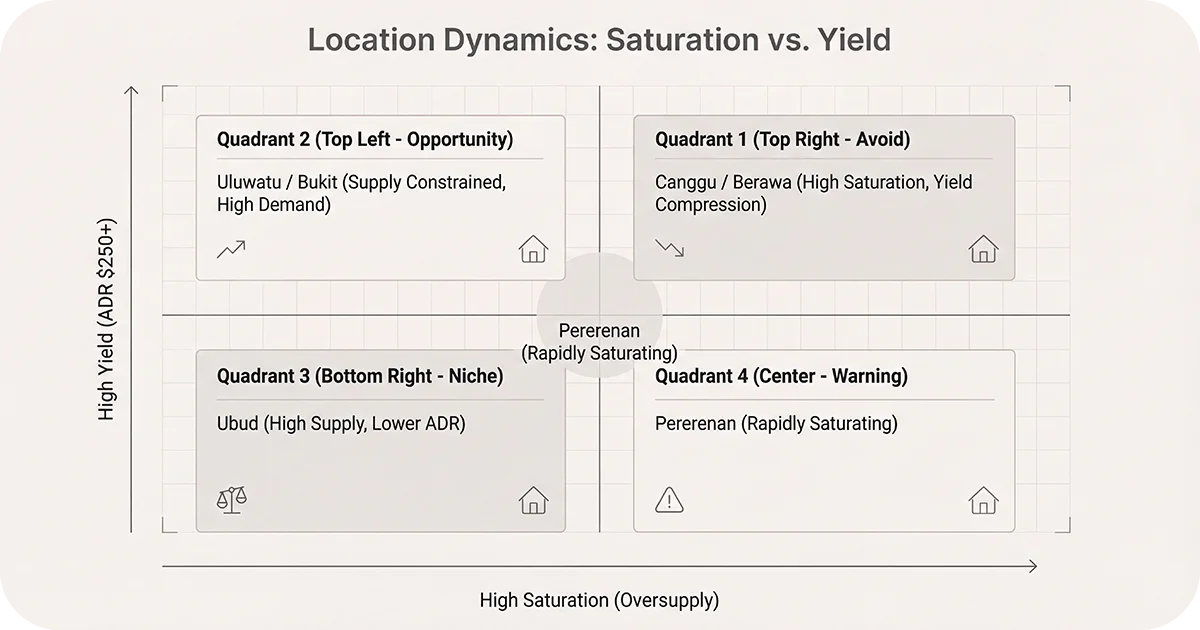
Not all locations face the same saturation risks. Data from 2025 reveals a distinct performance gap between the oversaturated central zones and the emerging high-yield luxury markets.
The Solution: Why Wellness & Community Drive 80%+ Occupancy
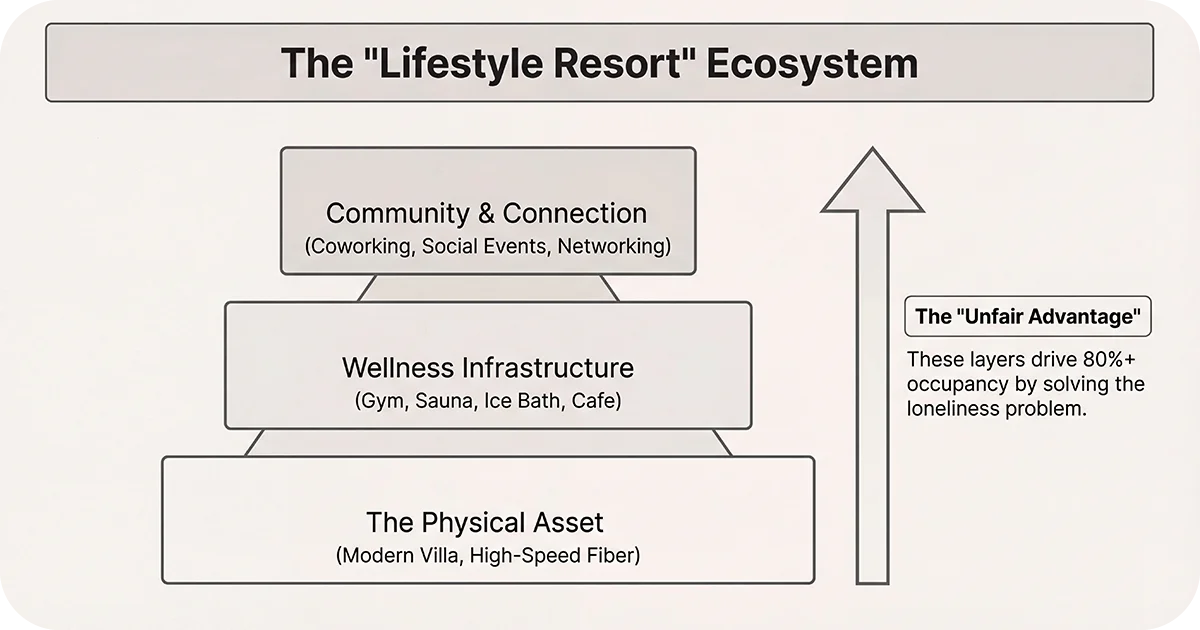
Why do some properties sit empty while others are booked months in advance? The data points to one clear differentiator: The Ecosystem.
Modern travelers, specifically the 40,000+ digital nomads and wellness seekers. This demand is the core driver behind [property investment opportunities in Bali – Pillar hub 2] – pending focused on wellness. They are not just renting a room; they are renting a lifestyle.
Nuance: Bali hosts a large but difficult-to-quantify population of remote workers. Official digital nomad visa grants number approximately 3,000 annually (CNA, 2025), though estimates from private firms suggest the broader remote-worker community is around 40,000+ when including those on tourist and business visas.
1. The “Amenities Arm Race”
A standalone private villa forces the guest to commute for everything: the gym, the coworking space, the yoga studio. A Wellness Resort Model integrates these on-site.
- Coworking: With the E33G Remote Worker Visa (launched April 2024), eligible digital nomads can stay up to one year, renewable for a second year, but demand enterprise-grade fiber internet and ergonomic workspaces.
- Wellness: On-site gyms, ice baths, and saunas allow properties to charge a premium.
- Community: Solo travelers prioritize locations that facilitate connection.
2. Operational Superiority
The “Top 10%” performance isn’t just about bricks and mortar; it’s about software. Achieving 80% occupancy requires:
- Dynamic Pricing: Algorithms that adjust rates daily based on demand (like airlines).
- Instant Booking & 24/7 Response: Professional teams respond to inquiries in under 5 minutes.
- Brand Trust: Guests are increasingly wary of scams and “catfish” listings. Established resort brands offer a safety guarantee that individual hosts cannot match.
The 2026 Regulatory Reality: Licenses or Shutdown
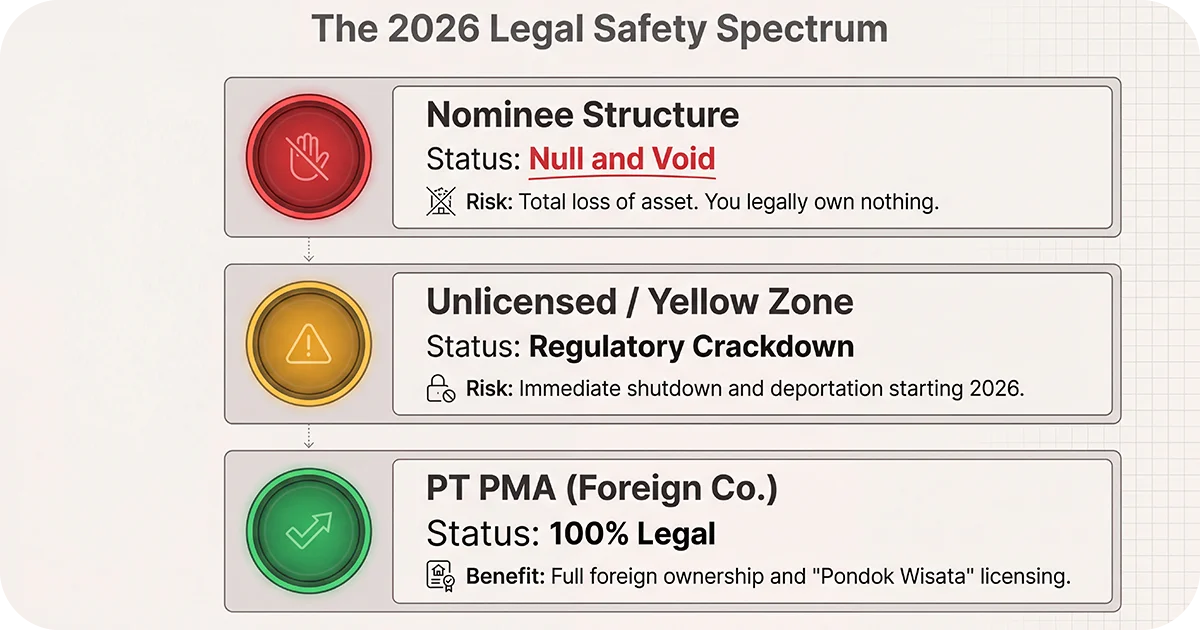
The most significant risk to Airbnb investment in Bali is not market saturation, it is legality. The “Wild West” era of operating illegally is ending.
The “Pondok Wisata” Requirement
To legally rent a property for daily stays (Airbnb), you must have a Pondok Wisata (Homestay License).
- The Trap: This license is only available to properties in specific zoning (Pink/Tourism Zones) and typically requires a PT PMA (Foreign Investment Company) structure.
- The Risk: The Governor of Bali has announced a crackdown on unlicensed villas starting in 2026. Properties found operating without a license face immediate shutdown, fines, and potential deportation for the owners.
The Nominee Structure is Dead
Many investors try to bypass these rules using a “Nominee” (putting the land in a local Indonesian’s name).
- Legal Status: Under Indonesian Investment Law, nominee agreements are Null and Void.
- Consequence: You legally own nothing. If your nominee dies, divorces, or decides to take the land, you have zero recourse.
- Solution: The only safe route is the [PT PMA setup in Bali – Pillar hub 5] – pending structure, which allows 100% foreign ownership, which allows 100% foreign ownership of the company that holds the Hak Guna Bangunan (Right to Build) title.
⚖️ Confused about the rules? Ensure your investment is 100% compliant by reading our Bali Investor Guide
Legal Compliance: Nominee Arrangements vs. PT PMA
Financial Reality: Standalone Villa vs. Resort Model
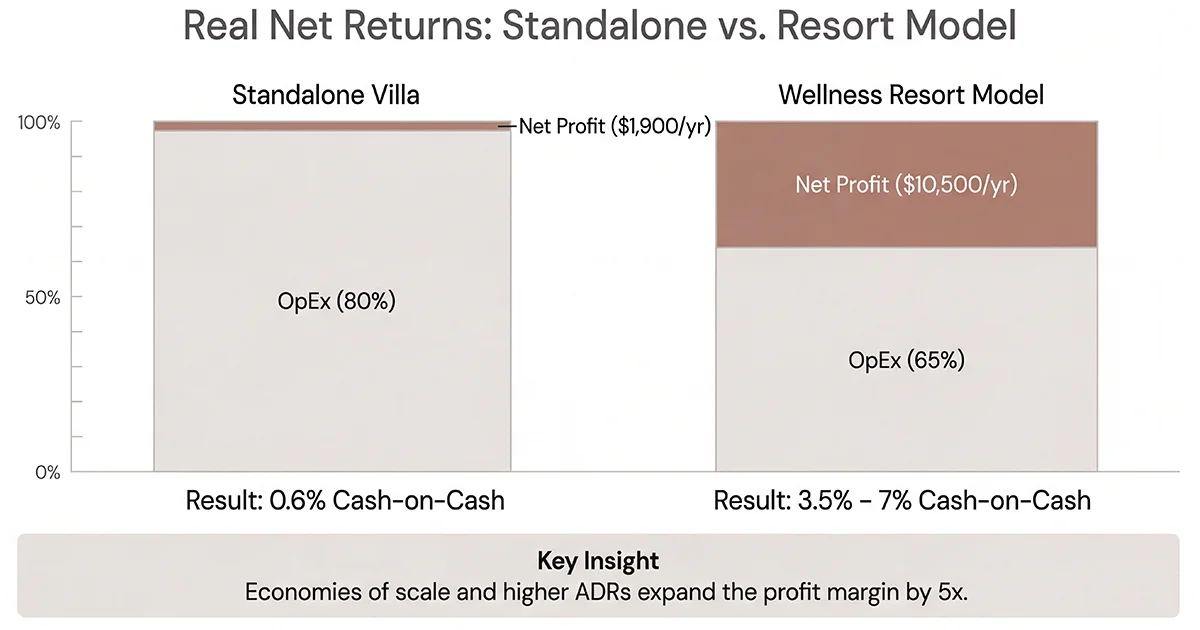
Let’s look at the numbers. Based on portfolio data from over 40 managed villas, here is the realistic financial difference between a “Base Case” (Standalone Villa) and a “Bull Case” (Resort/Niche Villa).
Assumption: $300,000 Total Investment | PT PMA Structure
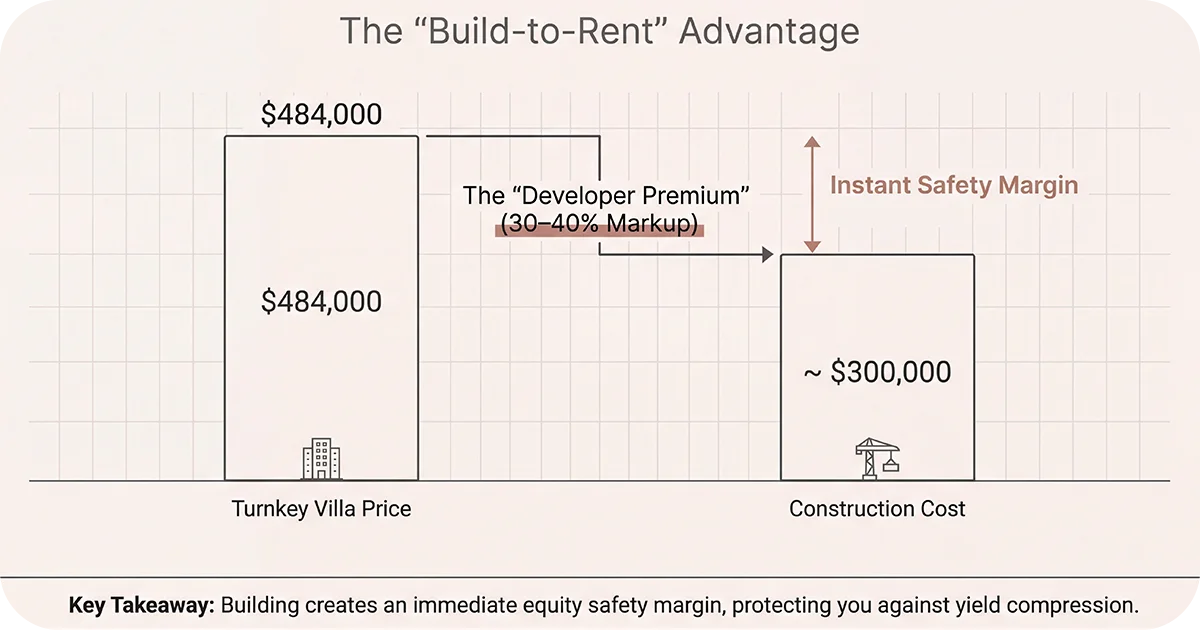
The Insight: The “Base Case” barely breaks even after you account for proper maintenance, taxes, and sinking funds. The “Bull Case” works because the higher occupancy and ADR cover the fixed costs, allowing the profit margin to expand significantly. This highlights why build-to-rent cost efficiency is critical, saving 30-40% on entry price is the only way to secure a margin of safety.
Who Should Still Invest? (The 3 Exceptions)
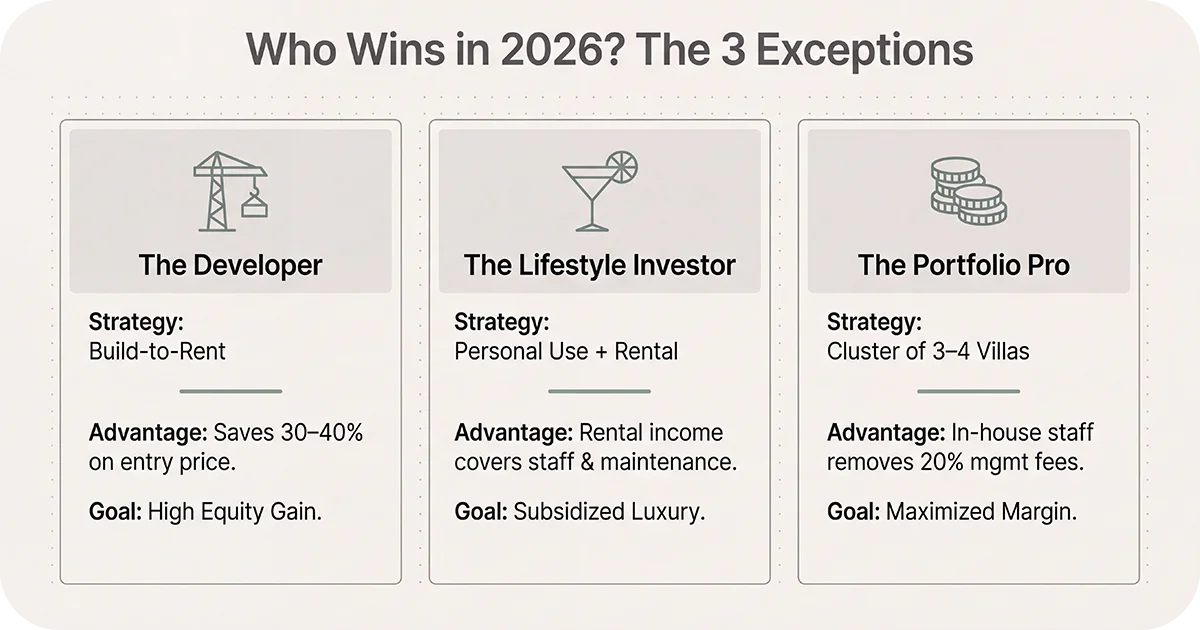
While the general market is saturated, our data identifies three specific investor profiles who can still generate healthy returns or strategic value in 2026.
Which Bali Investment Strategy Fits You?
1. The “Build-to-Rent” Developer
If you buy a finished villa, you are paying the developer’s profit margin. However, investors who build from scratch capture significant equity immediately.
- The Data: According to industry sources, asking prices for turnkey villas in premium Bali locations averaged approximately $484,000 in 2025, while construction costs remain stable.
- The Advantage: Building typically saves 30–40% compared to buying turnkey. Even if rental yields compress, you have a massive safety margin because your entry basis is lower.
🏗️ Worried about build quality? See the full breakdown of materials and permits in our Bali villa construction guide.
2. The “Lifestyle” Investor
Not everyone needs 15% ROI. If your primary goal is owning a vacation home in Uluwatu or Canggu that you use for 2 months a year, the math changes.
- The Win: You enjoy a luxury lifestyle asset and use rental income to cover operating costs (staff, utilities, maintenance).
- The Verdict: If you break even or make 3–4% net while getting free holidays, this is still a success, just view it as a “subsidized luxury” rather than a financial instrument.
3. The “Portfolio” Pro
Investors willing to deploy over $1M to build a cluster of 3–4 villas can afford to hire their own dedicated staff (manager, butler, driver). This removes the 20% management fee paid to third parties, instantly boosting net margins by ~20%.
Limitations, Alternatives & Professional Guidance
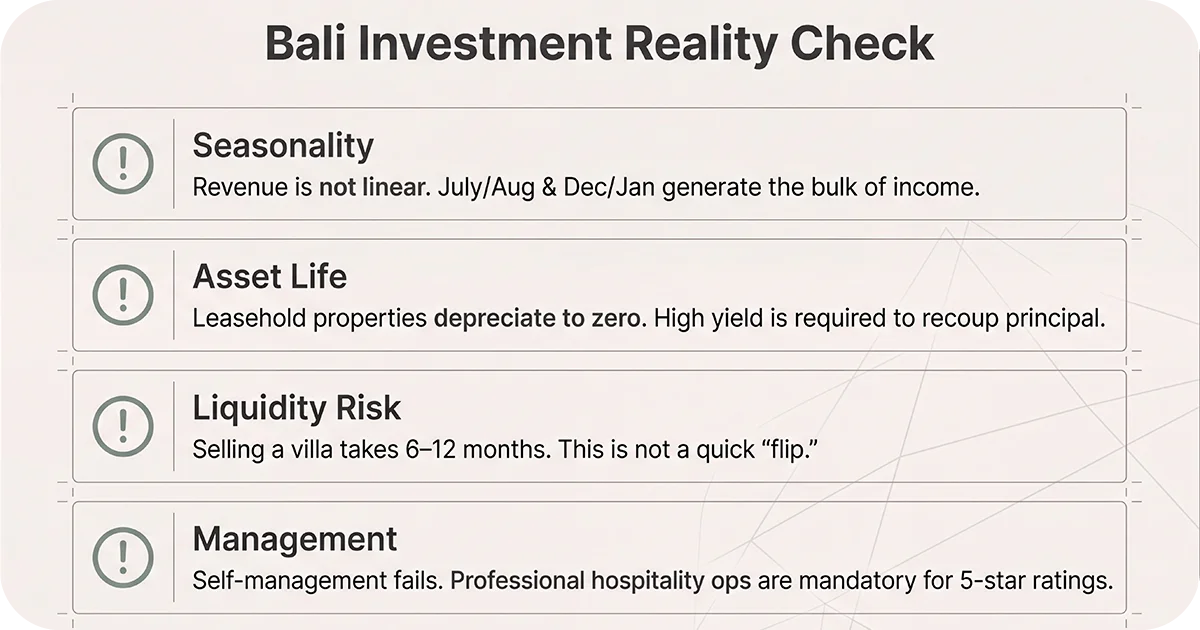
Limitations of this Analysis
- Seasonality: Revenue is not linear. A disproportionate share of annual revenue is concentrated in peak months (typically July–August and December–January), making cash flow management critical during low season.
- Leasehold Depreciation: Most foreign investment in Bali is Leasehold (Hak Sewa). Your asset value declines to zero at the end of the lease. High annual yield is required to recoup the principal.
- Liquidity Risk (The “Exit” Problem): Unlike property in Sydney or Singapore, Bali villas are illiquid assets. The buyer pool for leasehold property is limited. Data indicates you should budget 6–12 months to sell a property. This investment requires a 5+ year horizon; it is not a short-term “flip
Alternatives to Airbnb
If the operational intensity of Airbnb scares you, consider:
- Long-Term Rental: Lower returns (3–5% net), but significantly lower operating costs and wear-and-tear.
- Managed Development: Investing with a developer who handles the [Pondok Wisata license] and daily operations for you.
Professional Guidance
- Don’t DIY: Self-management from overseas has a high failure rate. Guest complaints in different time zones lead to bad reviews, which kill your ranking algorithms.
- Verify Zoning: Before buying any land or villa, check the zoning at the local BPN (Land Office). If it’s “Yellow” (Residential), you likely cannot get a legal Airbnb license.
📞 Still unsure if your projected returns will survive the 2026 saturation? Stop guessing. Schedule a Free Strategy Consultation directly with our founder, Rasmus Holst. No sales pitch, just honest market data and guidance on whether your Airbnb model is built to outperform the median or destined to struggle.
Lets Meet
Conclusion
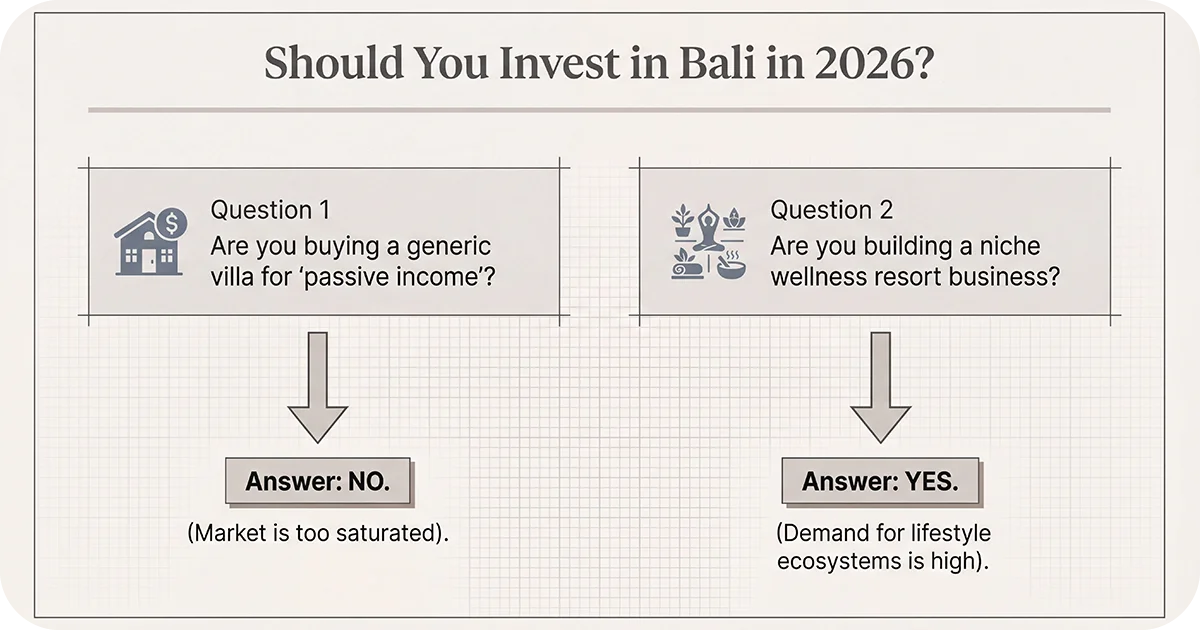
Is Airbnb in Bali a good investment? No, if you are planning to be average. The market is too saturated for “set it and forget it” passive income from a generic villa.
However, the answer is Yes, if you approach it as a professional hospitality business. The demand for high-quality, community-centric, wellness-integrated accommodation is insatiable. By positioning your asset in the top 10% through superior amenities, legal compliance, and professional management, you can still achieve healthy returns in one of the world’s most desirable destinations.
🌊 Want to invest in the top 10%? View our property in Bali for sale at Azoria Living, 1 minute from Suluban Beach.
Frequently Asked Questions (FAQ)
For most investors, no. Oversupply has reduced occupancy and returns for generic villas. However, professionally managed, niche properties—especially wellness-focused resorts—can still perform well.
Because supply is growing faster than demand. A surge in listings has increased competition, lowered occupancy, and compressed nightly rates and margins.
It describes a split market: struggling, low-performing generic villas versus high-performing, professionally managed niche properties with strong concepts and branding.
The market median is around 65%, but generic villas may see 40–50%, while top-tier properties can still achieve 75–85% with the right setup.
Oversaturated areas like Canggu carry higher risk, while supply-constrained markets like Uluwatu currently offer stronger pricing power and better yield potential.
Properties that offer a full experience—such as wellness resorts with coworking, gyms, and community—consistently outperform standard standalone villas.
In most cases, returns are minimal after costs. It can still work if built at a low cost basis, used partly for personal use, or positioned in a strong niche.
The primary risks are legal non-compliance, market oversaturation, poor operational execution, and unrealistic return expectations.
Yes. Operating legally requires proper licensing (such as Pondok Wisata where applicable). Enforcement is increasing, and non-compliance carries serious consequences.
No. It offers little to no legal protection and exposes investors to significant risk. A compliant structure should always be used.
Generic villas may barely break even. Higher returns are typically only achievable through optimized models such as resort-style developments or portfolio strategies.
Investors with a clear strategy: build-to-rent developers, lifestyle buyers, or experienced operators who can create scale, efficiency, and a differentiated guest experience.
References & Official Sources
On Bali Tourism Statistics & Government Data:
- Indonesian National Police (INP) (2026). “Bali Governor Reports 7 Million Foreign Tourist Arrivals in 2025”. (https://inp.polri.go.id/artikel/bali-governor-reports-7-million-foreign-tourist-arrivals-in-2025)
- ANTARA News / Statistics Indonesia (BPS) (2026). “Bali’s foreign tourist arrivals rise nearly 10 pct in 2025”. (https://en.antaranews.com/news/402594/balis-foreign-tourist-arrivals-rise-nearly-10-pct-in-2025-bps-says)
- The Bali Sun (2026). “Bali’s Record Breaking Year For Tourism Sets New Horizons For 2026”. (https://thebalisun.com/balis-record-breaking-year-for-tourism-sets-new-horizons-for-2026/)
- Statistics Indonesia (BPS) Bali (2019). “Bali Province Tourism Development September 2019”. (https://bali.bps.go.id/en/pressrelease/2019/11/01/717190/bali-province-tourism-development-september-2019.html)
On Legal Regulations (Investment Law, Visas & Zoning):
- Republic of Indonesia (BKPM/JDIH) (2007). “Law of the Republic of Indonesia Number 25 of 2007 on Investment”. (https://jdih-storage.bkpm.go.id/jdih/jdih/2007UUINVESTMENT25-ENGLISH-.pdf)
- Indonesia Investments (2025). “How to Establish a Foreign Company (PT PMA) in Indonesia”. (https://www.indonesia-investments.com/business/foreign-investment/establish-foreign-company-pt-pma/item5739)
- Emerhub (2026). “Understanding the Pondok Wisata Bali Homestay License”. (https://emerhub.com/bali/pondok-wisata-bali-homestay-license/)
- Fragomen (2024). “Indonesia: Remote Worker Visa Implemented”. (https://www.fragomen.com/insights/indonesia-remote-worker-visa-implemented.html)
- EY Global (2024). “Indonesia implements new visa for remote workers (E33G)”. (https://www.ey.com/en_gl/technical/tax-alerts/2024-0800-indonesia-implements-new-visa-for-remote-workers)
- Tempo.co (2025). “Bali Governor Plans to Stop Airbnb Accommodation (Crackdown on Unlicensed Villas)”. (https://en.tempo.co/read/2070665/bali-governor-plans-to-stop-airbnb-accommodation)
On Short-Term Rental Market Data (Private Analytics):
- Airbtics (2025). “Indonesia Short-Term Rental Market Report 2025”. (https://airbtics.com/short-term-rental-market-report-2025-indonesia)
- Airbtics (2025). “Bali Airbnb Data 2025: Revenue, Occupancy & ROI Insights”. (https://airbtics.com/annual-airbnb-revenue-in-bali-indonesia/)
- AirROI (2026). “Canggu, Bali Airbnb Data 2026: STR Market Analysis & Stats”. (https://www.airroi.com/report/world/indonesia/bali/canggu)
- AirROI (2026). “Uluwatu, Bali Airbnb Data 2026: STR Market Analysis & Stats”. (https://www.airroi.com/report/world/indonesia/bali/uluwatu)

Rasmus Holst is a serial entrepreneur and Co-Founder of COCO Development Group, where he helps drive innovation and growth through strategic business development. He is also the Co-Founder of Estate of Bali and Regnskabshelten.dk, Denmark’s fastest-growing accounting firm, which grew to 35 employees and generated $2.5M in turnover in 2023. Rasmus is passionate about building businesses that create long-term value and impact.