🎯 Summary of Content
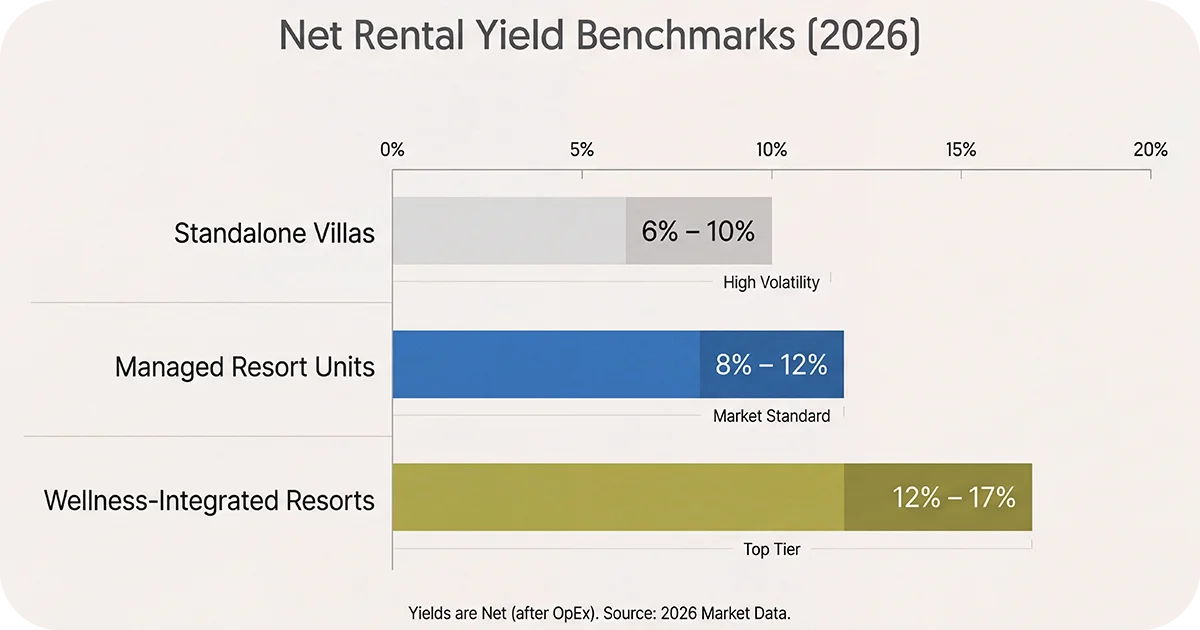
The average rental yield of property in Bali for standalone private villas typically sits between 6% and 10% net per year. In contrast, professionally managed resort complexes – specifically those with integrated wellness and coworking amenities – frequently achieve 8% to 12%+ net yields, with top-tier performers reaching 15-17%. While managed resorts often have higher operating expenses (35-50%) than private villas, they generate significantly superior returns through higher Average Daily Rates (ADR), ancillary revenue streams (F&B, Spa), and occupancy stability during the low season.
- Market Divergence: The 2026 property landscape has split into two distinct asset classes: saturated standalone villas (commoditized assets) and integrated resort ecosystems (lifestyle assets), with the latter leveraging the “Experience Premium” to outperform.
- Yield Benchmarks: While private villas average a 6–10% net yield, professionally managed resorts typically achieve 8–12%, with top-tier wellness properties reaching 15–17% driven by significantly higher Average Daily Rates (ADR).
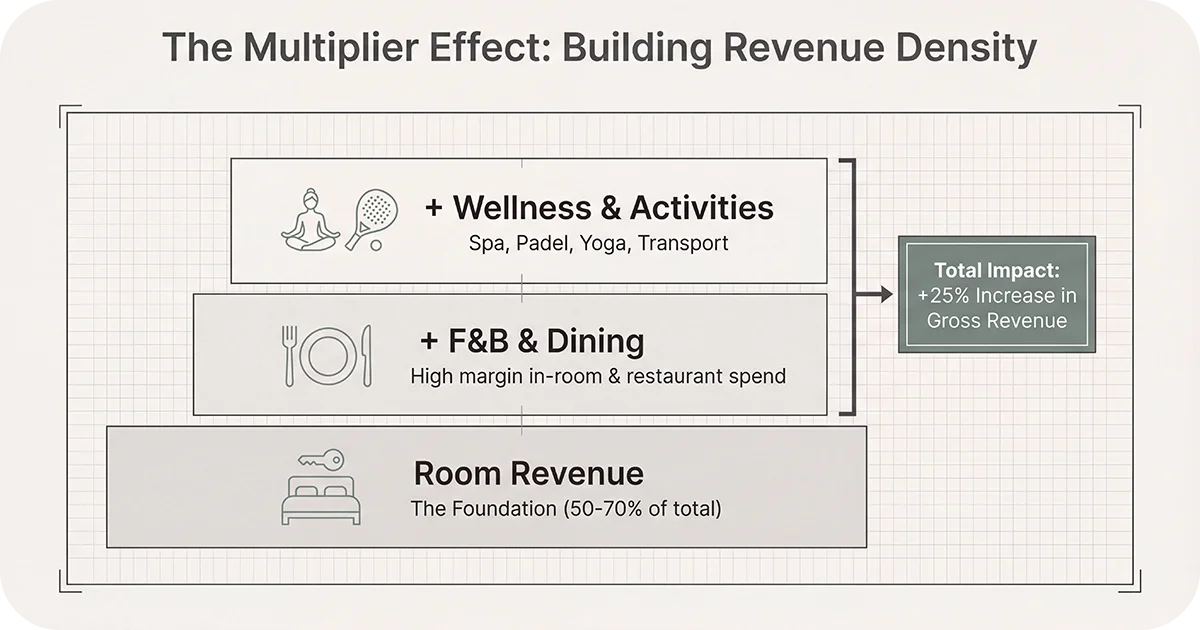
- The Multiplier Effect: Despite higher Operating Expenses (OpEx) of 35–50%, resorts generate superior returns via ancillary revenue (F&B, Spa, Coworking), which creates a “Revenue Density” that increases gross income by up to 25% compared to room-only models.
- Operational Science: Professional operators utilize AI-driven dynamic pricing and direct booking infrastructure to capture 12–18% more revenue and bypass high OTA commissions, maximizing yield beyond what passive ownership can achieve.
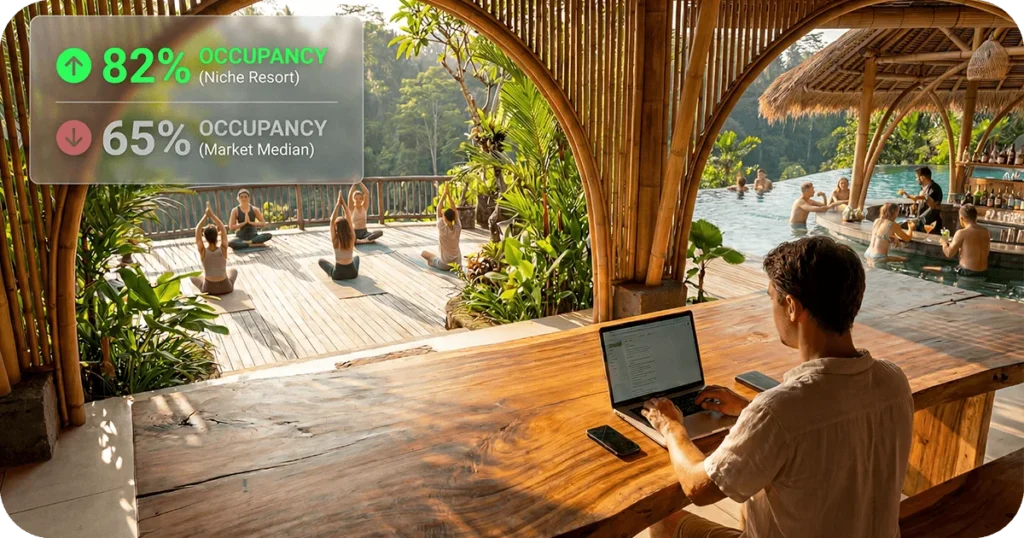
- Solving Seasonality: Integrated amenities buffer against the low season (Nov–Mar) dip by attracting the “bleisure” and digital nomad market, maintaining occupancy rates 15–25 percentage points higher than standalone villas.
- The Compliance Cliff: A critical regulatory update (Permenpar No. 6/2025) mandates full licensing (PT PMA, PBG, SLF) by March 31, 2026, threatening non-compliant properties with platform delisting and total revenue loss.
Written by: Rasmus Holst (Founder & CEO of Coco Development Group) | Reviewed by: COCO Chief Investment Officer (CIO)| Last updated: 17 April, 2026
Transparency: COCO Development Group builds and operates high-yield resorts in Bali (including the Azoria project). We don’t just advocate for the resort model – we bet our entire company strategy on it. This article documents the financial data and market shifts that compelled us to stop building standalone villas and pivot to integrated complexes. This content is for educational purposes and does not constitute financial advice.
Table of Contents
- Introduction
- The New Benchmark: Average Rental Yields in 2026
- The Multiplier Effect: Why Amenities Drive Yield
- The Science of Yield: Active Management vs. Passive Ownership
- The Seasonality Gap: Solving the “Empty Month” Problem
- Villa vs. Resort: The P&L Showdown
- Limitations, Alternatives & Professional Guidance
- Conclusion
- Frequently Asked Questions (FAQ)
- References & Official Sources
Introduction
The “easy money” era of Bali real estate is over. It is no longer 2019, and simply listing a 3-bedroom villa on Airbnb is not a guarantee of double-digit returns.
As the Bali property market matures, a clear divergence has emerged. On one side, the standalone villa market in saturated areas like Canggu is seeing yield compression due to rising competition and seasonal volatility. On the other side, integrated resort ecosystems are outperforming by leveraging what economists call the “Experience Premium.”
For the serious investor, the math has changed. It is no longer about who has the lowest costs, but who has the strongest revenue density.
This guide breaks down the financial reality of rental yield of property in Bali, comparing the P&L of a standalone villa against a managed resort unit, backed by 2024/2025 market data.
📈 Context: For a broader analysis of how these asset classes fit into the 2026 market cycle, read our full Bali Property Investment Report 2026.
The New Benchmark: Average Rental Yields in 2026
To accurately assess rental yield of property in Bali, investors must distinguish between “Marketing Yield” (often Gross figures) and “Net Yield” (what hits your bank account).
1. Standalone Villas (The “Commodity” Asset)
- Average Net Yield: 6% – 10%
- Typical Occupancy: 55% – 65% (Annual Average)
- The Reality: Standalone villas suffer from “Single Source Dependency.” 100% of your revenue comes from the room rate. If occupancy drops, your yield plummets. Furthermore, in areas like Seminyak, price wars are driving ADR (Average Daily Rate) down, compressing yields despite high tourist numbers.
2. Managed Resort Units (The “Lifestyle” Asset)
- Average Net Yield: 8% – 12% (Market Standard)
- Top-Tier Performance: 12% – 17% (Wellness/Sport Integrated)
- Typical Occupancy: 70% – 85%
- The Reality: While resorts are more expensive to run, they command a premium price. Research shows that properties with major wellness facilities achieve 34% higher Gross Operating Profit than those without. This “Wellness Premium” pushes the net yield higher, even after management fees.
The Multiplier Effect: Why Amenities Drive Yield
A common misconception is that resorts make more money by “cutting costs.” This is false.
In reality, managed resorts often have higher Operating Expenses (OpEx) as a percentage of revenue compared to private villas.
- Villa OpEx: 25-35% (Cleaning, Pool, Wifi).
- Resort OpEx: 35-50% (Full staff, 24/7 security, Marketing, Amenities).
So, how do resorts achieve higher net returns with higher costs? The answer is Revenue Density via Upsells.
The Power of Ancillary Revenue
A standalone villa guest pays for the bed and nothing else. A resort guest pays for the bed, then buys breakfast, books a massage, joins a Padel match, and works from the coworking space.
Ancillary Revenue Multipliers: Villa vs. Resort
The table below details how specific upsell streams contribute to the ‘Multiplier Effect’ that differentiates resorts from standalone villas.
🏆 Opportunity: See how sport facilities drive these upsells in our guide on Property Investment Opportunities in Bali – pending. [Pillar Hub 2 – Property Investment Opportunities in Bali: The Rise of Padel Resorts ]
- Villa Revenue Split: 100% Room.
- Resort Revenue Split: 50-70% Room / 30-50% Ancillary.
- Key Upsell Margins:
- Airport Transfers: $30-50 profit per trip (70% margin).
- Scooter Rentals: $15 net profit per day (40% margin).
- In-Villa Dining: High-margin F&B delivered to the room.
This ancillary spend creates a “Multiplier Effect.” A guest spending $200 at a resort is significantly more profitable than a guest spending $150 at a villa, effectively offsetting the higher operational costs. Data shows that strategic upsells can increase gross revenue by up to 25%.
The Science of Yield: Active Management vs. Passive Ownership
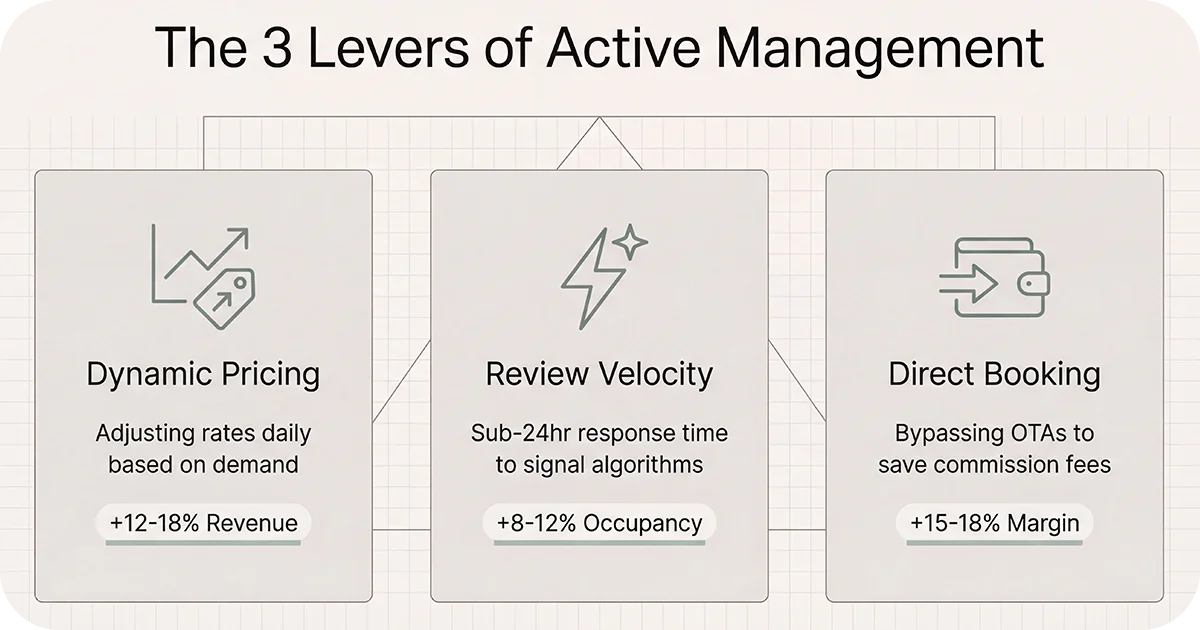
Beyond amenities, professional operators use sophisticated tools to squeeze every percentage point of yield out of a property. This “Active Management” is impossible for a passive villa owner to replicate without significant time investment.
Impact of Active Management Strategies
Professional operators utilize the following high-impact strategies to maximize yield beyond simple room rentals.
1. Dynamic Pricing (The “Airline” Model)
Most private villa owners set a “High Season” and “Low Season” rate and forget it.
- The Opportunity: Professional operators use AI-driven tools to adjust nightly rates daily based on demand, local events, and competitor vacancy.
- The Result: Moving from static to dynamic pricing typically captures 12-18% more revenue. It prevents you from selling too cheap in high demand and ensures occupancy during low demand.
2. Review Velocity & Conversion
Speed kills – in a good way.
- The Tactic: Responding to guest reviews within 24 hours signals “Active Host” status to algorithms like Airbnb.
- The Result: Properties with high review velocity and <24hr response times see an 8-12% boost in occupancy.
3. The Direct Booking Advantage
- The Problem: OTAs (Airbnb, Booking.com) take 15-18% commission.
- The Fix: Managed resorts build their own booking engines and brand loyalty. Converting just 15% of bookings to direct channels saves thousands in fees, which goes directly to the bottom line.
The Seasonality Gap: Solving the “Empty Month” Problem
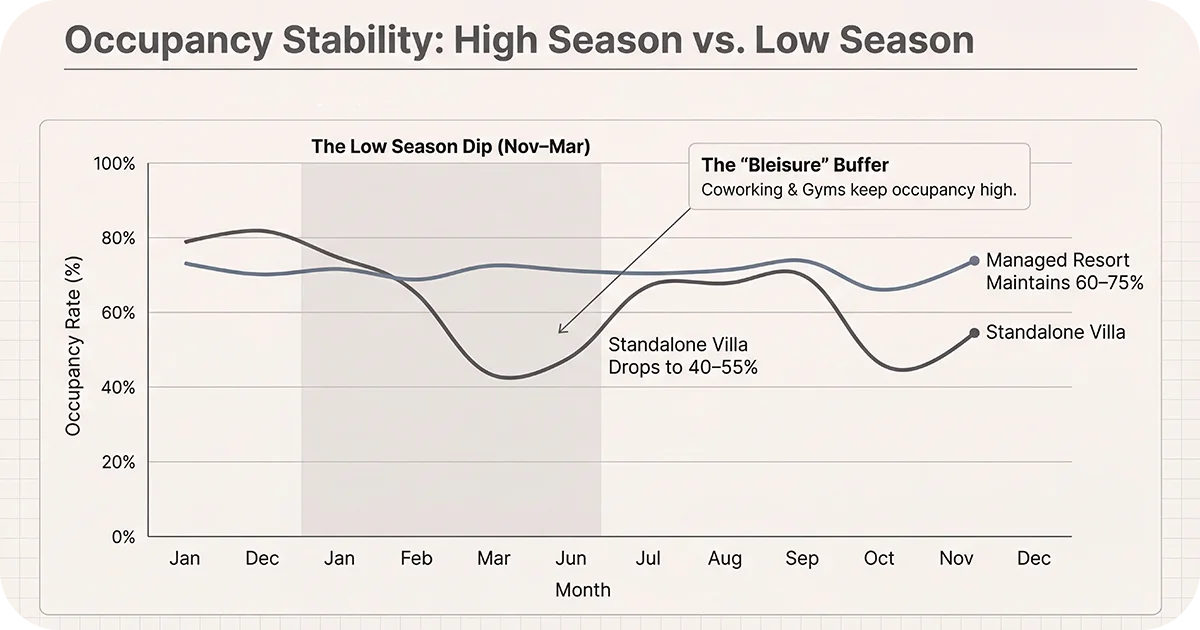
Yield is not made in August; it is maintained in November.
The greatest killer of rental yield of property in Bali is seasonality. During the “Low Season” (Nov–Mar), standalone villas often see occupancy dip to 40-55%. Managed complexes, however, use amenities to stabilize demand.
The “Remote Worker” Buffer
In 2026, the digital nomad and “bleisure” (business + leisure) market is a dominant force. These guests book for 1-3 months but require infrastructure: coworking spaces, gyms, and community.
- Low Season Occupancy (Villa): 40-55%
- Low Season Occupancy (Resort): 60-75%
The Gap: Managed complexes typically run 15-25 percentage points higher occupancy in low season compared to standalone villas. This consistency is what protects the 12%+ yield target.
Design for Demand: The “Tropical Modern” ROI
It is not just about having a pool; it is about “Instagrammability” and function.
- The Aesthetic: Old “Dark Wood” villas are underperforming. The market demands “Tropical Modern” – bright, airy, and photogenic.
- The Workspace: Installing ergonomic workspaces (good chair + monitor) pays for itself in 3-4 months by attracting long-stay nomads who refuse to book villas with just a dining table.
📍 Location Strategy: High yield requires high demand. See how we mitigate coastal risks in our guide on [Coastal Construction in Bali] – pending. [Pillar Hub 4]
Villa vs. Resort: The P&L Showdown
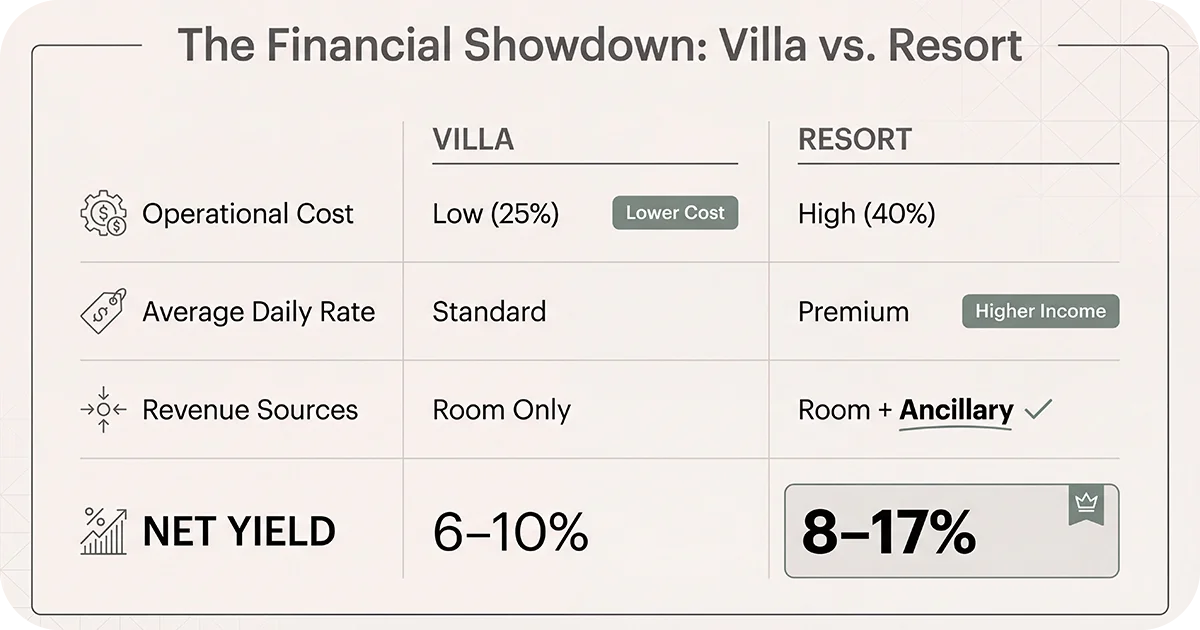
Let’s look at the financial models side-by-side. Note that while the Resort has higher fees and OpEx, the Net Result is superior due to the ADR premium and occupancy stability.
Note: Net Yield is defined as (Gross Revenue – OpEx – Fees – Taxes) / Total Investment. Tax liabilities vary by structure.
⚖️ Tax Check: These yields are pre-income tax. To calculate your final take-home after withholding tax, use our [Bali Property Tax Guide: PBB, BPHTB & VAT Explained]. – pending [Pillar 5]
Limitations, Alternatives & Professional Guidance
While the data favors the resort model, investors must be aware of the specific “Failure Modes” that can erode returns.
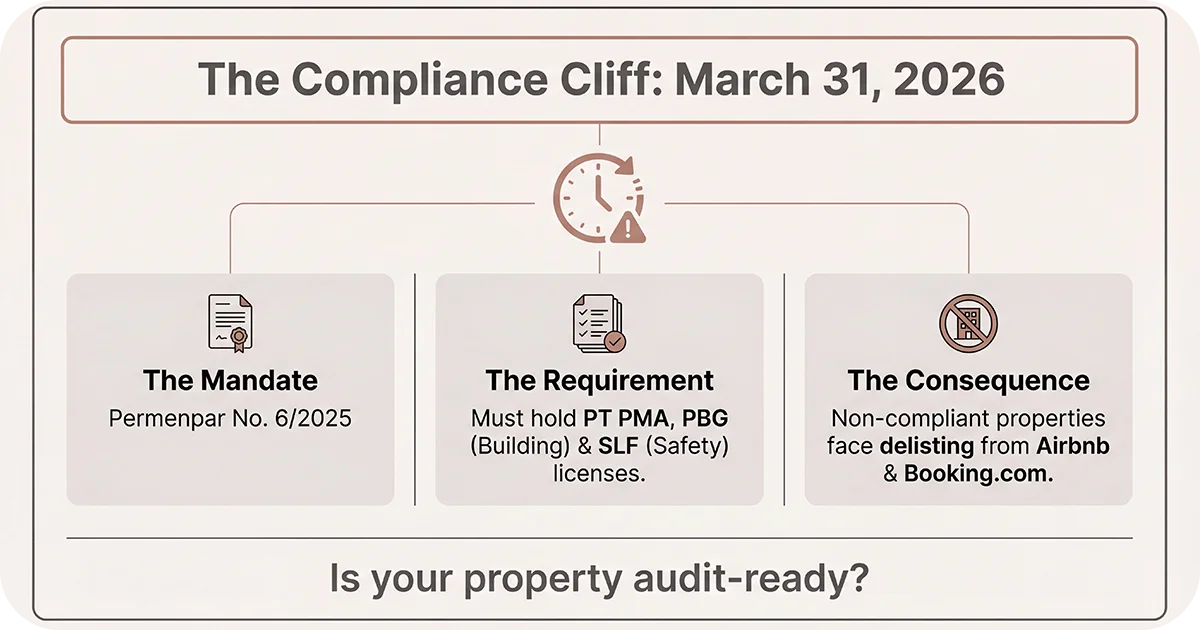
⚠️ URGENT MARKET UPDATE: The March 2026 Compliance Cliff
Investors must be aware of the new Indonesian government mandate (Permenpar No. 6/2025) enforcing strict licensing compliance by March 31, 2026.
Investment Risk & Compliance Checklist
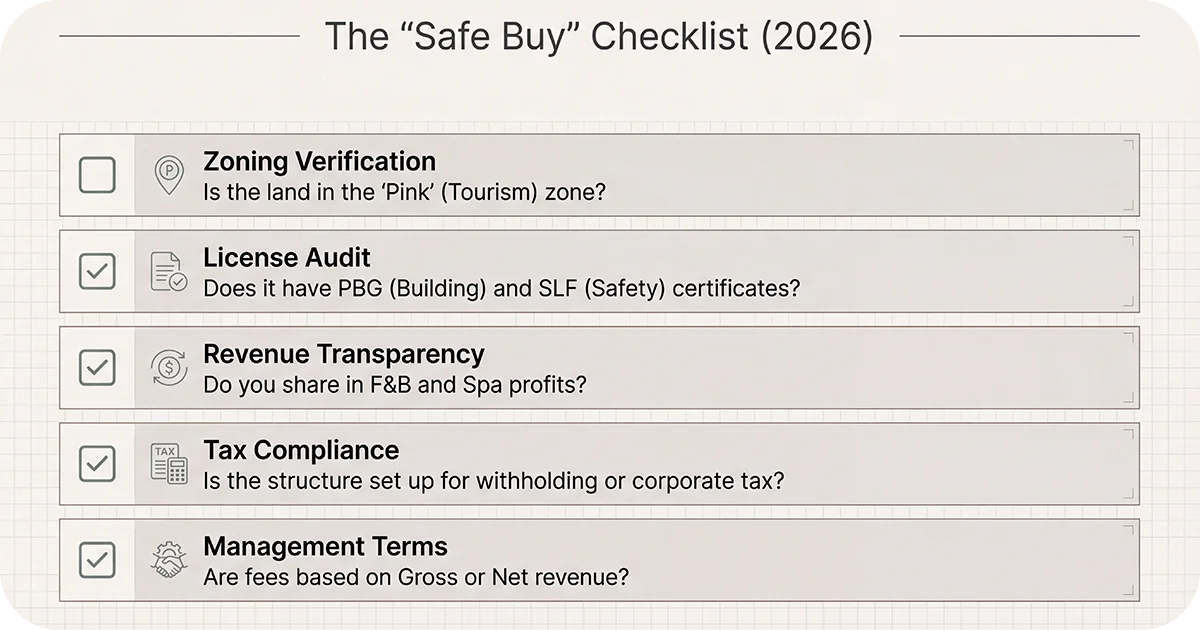
Investors should audit potential properties against the following compliance and risk checklist to ensure viability past the March 2026 deadline.
- The Risk: Properties operating without a proper PT PMA, PBG (Building Permit), and SLF (Safety Certificate) face delisting from platforms like Airbnb and Booking.com.
- The Impact: Standalone villa owners operating in the “grey zone” risk total loss of revenue. Managed resorts (like Azoria) are fully licensed, protecting your asset from this regulatory crackdown.
The Risks: Where Resort Yields Fail
- Revenue Leakage (The Greedy Operator): Some operators keep 100% of the ancillary profit (F&B, Spa) and only share room revenue with investors. If you do not participate in the ancillary “pot,” you lose the yield multiplier.
- High HOA Fees: Beware of “Luxury” complexes with astronomical monthly maintenance fees that eat into your net profit.
- Scale Without Quality: The collapse of brands like Selina proves that rapid expansion without operational excellence destroys value. A brand name alone does not fill rooms; management quality does.
Alternatives
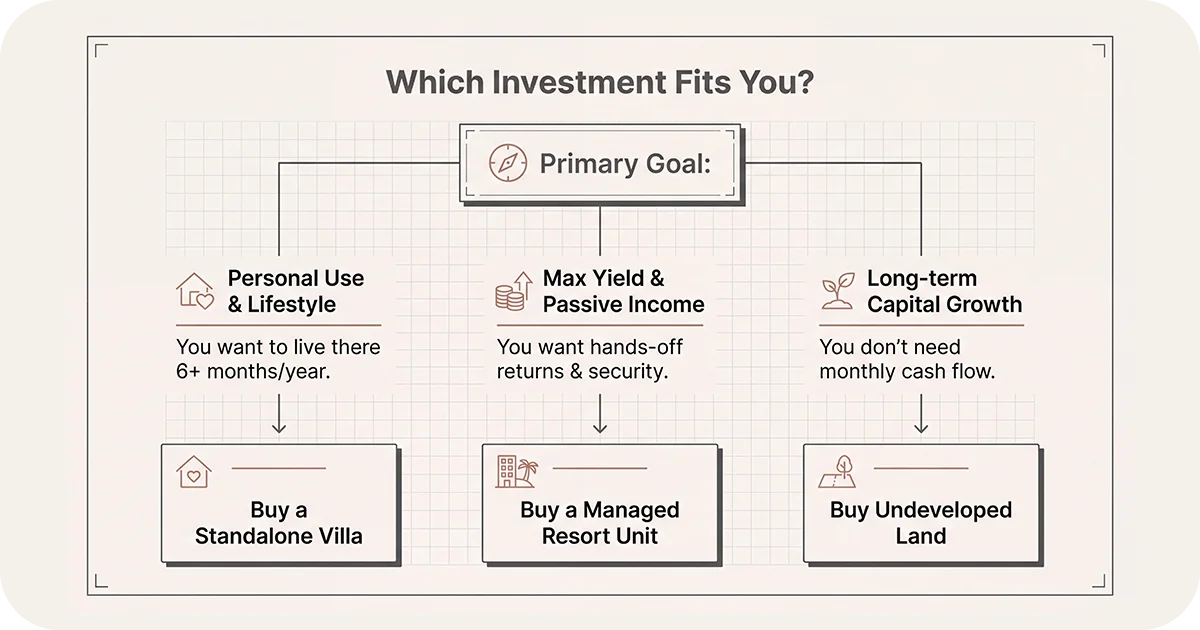
- Land Banking: If you prefer capital appreciation over cash flow, buying land in developing zones (like Nunggalan) offers zero yield but high resale potential.
- Commercial Zoning: Building a dedicated restaurant or gym can yield 20%+, but carries significantly higher operational risk than residential property.
Professional Guidance
- Verify the Split: Ensure your management contract is transparent. Are you paid on Gross or Net? Do you share in F&B revenue?
- Check the Zoning: 40+ villas were demolished in Bingin in July 2025 for zoning violations. Ensure your resort is in a “Pink” (Tourism) zone.
- Don’t Buy for “Ego”: Buying a massive private villa feels good, but buying a high-yield resort unit pays better. Separate your emotion from your investment.
⚖️ Structuring the Deal? Ensure you understand the ownership vehicle in our guide on [PT PMA Setup in Bali] – pending. [Pillar 5]
📞 Still unsure which asset class fits your portfolio? Stop guessing. Schedule a Free Strategy Consultation directly with our founder, Rasmus Holst. No sales pitch – just honest market data and guidance on whether a private villa or a resort unit aligns better with your financial goals.
Lets Meet
Conclusion
The data for 2026 is clear: the rental yield of property in Bali is increasingly driven by the “Experience Economy.”
While standalone villas remain a valid lifestyle choice, they are losing the yield battle to integrated resorts. The combination of higher ADR, ancillary revenue participation, and low-season occupancy stability makes the managed resort model the superior vehicle for passive income.
Investors who prioritize operational efficiency, compliance safety, and wellness infrastructure over square footage will see the strongest returns in the coming decade.
Ready to see the math?
Review the projected performance and ancillary revenue models of our latest resort development in Uluwatu.
👉 View Our Exclusive & High Yield Property in Bali for Sale
Frequently Asked Questions (FAQ)
A realistic net rental yield for a standalone villa is 6-10%. For a professionally managed resort unit in a prime location (like Uluwatu), investors should target 8-12%, with top-performing wellness assets reaching 15-17%. Be wary of developers promising "Guaranteed 20% ROI" - this is rarely sustainable.
Resorts offer full-service experiences (24/7 reception, security, buggy service, F&B staff). This costs more to run (35-50% of revenue) than a simple villa (25-35%). However, this service level allows resorts to charge much higher nightly rates, resulting in a higher net profit despite the costs.
Yes, but with limits. Most high-yield investment resorts offer owners 21 to 60 days of personal use per year. This restriction ensures the unit is available for rental inventory during peak times to maximize returns for all investors.
Yes. In wellness-focused properties, ancillary revenue (spa, food, coworking) can make up 30-50% of the total income. If your investment model allows you to participate in this revenue stream, it provides a massive buffer against low occupancy periods.
Yes. You cannot legally evade tax.If you own via a PT PMA, you pay corporate tax (often 0.5% turnover tax for the first 3 years under the MSME incentive). If you own personally, there is a withholding tax on rental income. Always consult a tax professional.
References & Official Sources
Global Wellness Institute (2025). “Build Well to Live Well: Wellness Real Estate Report”. (Confirming 10-25% price premiums for wellness properties). https://globalwellnessinstitute.org/press-room/press-releases/build-well-to-live-well-2025/
Indonesian Ministry of Tourism (2025). “Permenpar No. 6/2025”. (The official regulation enforcing the March 31, 2026 licensing deadline). https://jdih.kemenpar.go.id/en/peraturan/1422
Horwath HTL (2025). “Bali Hotel & Branded Residences Report”. (Data confirming hotel occupancy rates of 75%+ vs. private villa volatility).https://c9hotelworks.com/wp-content/uploads/2025/04/Bali-Hotel-Branded-Residences-Report-March-2025.pdf
PriceLabs (2025). “Revenue Management Case Studies”. (Source confirming the 12-30% revenue uplift from dynamic pricing implementation). https://hello.pricelabs.co/customer-story/
Legal Indonesia (2026). “Airbnb in Bali 2026: Licensing & Taxes”. (Legal breakdown of the March 31, 2026 compliance deadline and platform delisting risks). https://legalindonesia.id/airbnb-bali-licensing-taxes-2026/
CoStar (2024). “Selina Hospitality Insolvency Filing”. (Market evidence regarding the risks of rapid expansion without operational excellence). https://www.costar.com/article/1120765817/selina-hospitalitys-board-says-it-has-no-reasonable-prospects-to-avoid-insolvency
Bali Business Consulting (2025). “Bingin Beach Demolitions & Zoning”. (Verification of the 40+ villa demolitions in July 2025 due to zoning violations). https://balibusinessconsulting.com/bingin-beach-end-game/
Preno (2025). “OTA Commission Rates Guide”. (Confirming the 15-18% commission fees for platforms like Booking.com and Airbnb). https://prenohq.com/blog/ota-commission-rates-expedia-booking-com-more/
Pajak.go.id (2018). “PP No. 23/2018”. (Official tax regulation regarding the 0.5% Final Income Tax for MSMEs). https://www.pajak.go.id/en/siaran-pers/pemerintah-turunkan-tarif-pph-final-umkm-jadi-05

Rasmus Holst is a serial entrepreneur and Co-Founder of COCO Development Group, where he helps drive innovation and growth through strategic business development. He is also the Co-Founder of Estate of Bali and Regnskabshelten.dk, Denmark’s fastest-growing accounting firm, which grew to 35 employees and generated $2.5M in turnover in 2023. Rasmus is passionate about building businesses that create long-term value and impact.