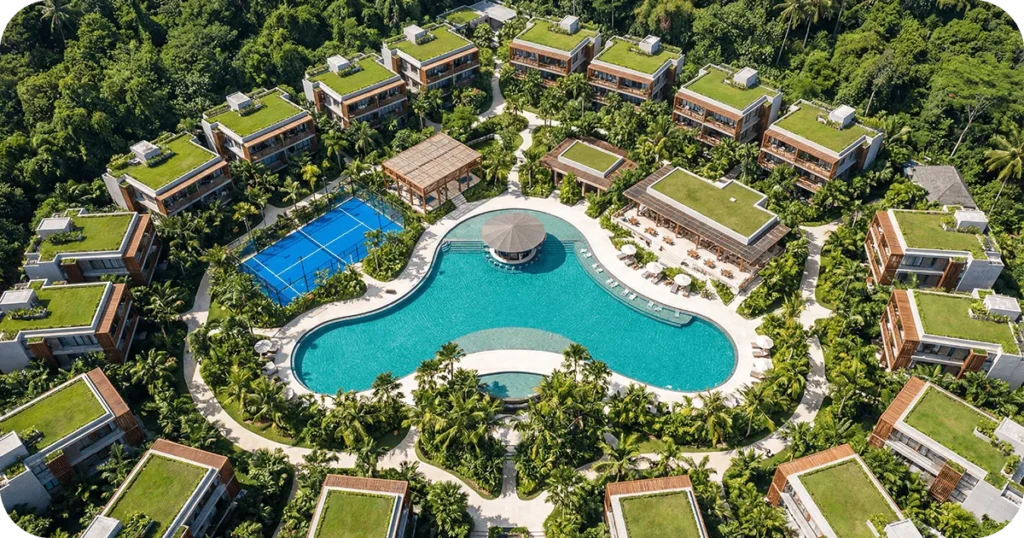
🎯 Summary of Content
To maximize yields when searching for property investment tips for Bali, your broader Bali property investment strategy must shift its focus from gross revenue to Net Operating Income (NOI). The most profitable strategies require moving past the island’s 84,428 active short-term rental listings by targeting ultra-proximity to the beach without crossing the “arterial divide,” investing in lifestyle ecosystems to extend guest stays, and aggressively cutting Cost Per Occupied Night (CPON). Utilizing an integrated in-house management team eliminates the standard 15-20% third-party fee leakage, while radius underwriting ensures you buy into micro-markets capable of beating the island’s low 46% average occupancy.
- The Market Reality: With over 84,000 active short-term rentals in Bali averaging just 46% occupancy, the era of building basic standalone villas for easy returns is over. Success now requires treating the property as an institutional hospitality asset focused strictly on Net Operating Income (NOI).
- The Location Moat: True pricing power requires ultra-proximity to premium beaches without crossing major traffic veins (the “Arterial Divide”). Eliminating this traffic friction protects review scores and guarantees occupancy resilience.
- The Ecosystem Advantage: Standalone properties struggle with high turnover costs. Integrating lifestyle amenities (like conceptual Padel resorts and wellness spas) secures 5-star reviews and extends guest Length of Stay (LOS), drastically widening profit margins.
- Radius Underwriting: Savvy investors avoid localized “supply cliffs” by analyzing comparable properties within a strict 500–800m radius, ensuring the chosen micro-market can mathematically support target occupancies of 60–70%.
- Operational Cost Control: Traditional third-party management leaks 15–20% of gross revenue while hiding maintenance markups. Utilizing an integrated, in-house property management team eradicates this fee leakage and aggressively lowers the Cost Per Occupied Night (CPON).
- The Stabilized Exit: Maximum Internal Rate of Return (IRR) is achieved by buying off-plan in fully compliant (NIB-verified) destinations, allowing investors to capture an intrinsic 25% capital appreciation once the asset’s operations are stabilized post-handover.
Written by: Rasmus Holst (Founder & CEO of Coco Development Group) | Reviewed by: COCO Chief Investment Officer (CIO) | Last updated: 17 April, 2026
Transparency Note: COCO Development Group develops and manages Bali real estate. Since our business model relies on selling and operating such properties, we have a direct financial bias in promoting integrated resort investments. This article is strictly for educational purposes, not financial or legal advice. Always conduct independent research and consult licensed professionals, including a certified notary (PPAT), legal counsel, and tax advisors, before making any investment decisions.
Table of Contents
- Introduction
- Tip 1: Target Ultra-Proximity to the Beach (The “Traffic Friction” Rule)
- Tip 2: Invest in Ecosystems, Not Just Concrete (The Amenity Premium)
- Tip 3: Target High-Demand Micro-Markets with Radius Underwriting
- Tip 4: Demand Integrated, In-House Property Management
- Tip 5: Leverage Off-Plan “Destination” Builds for Capital Appreciation
- Limitations, Alternatives & Professional Guidance
- Conclusion
- Frequently Asked Questions (FAQ)
- References & Official Sources
Introduction
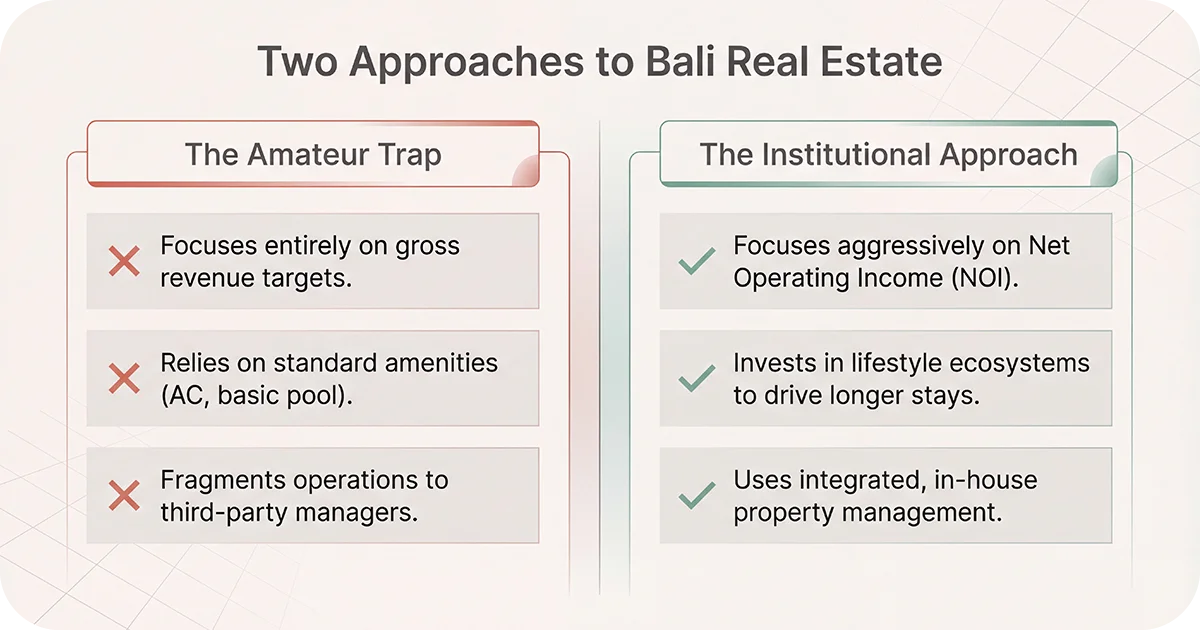
The difference between a Bali property that barely covers its maintenance costs and one that generates hands-off passive income comes down to operational discipline. Gross yield in Bali is a lie; true profitability is measured in Net Operating Income (NOI). To hit high-yield targets, you must engineer your asset selection to beat market averages while systematically stripping out the “silent killers” of operational leakage.
From our experience developing integrated lifestyle resorts across Bali’s premium corridors, we know that true passive income requires treating your property as a high-functioning hospitality asset. Here are the five definitive, data-backed strategies to increase your net yield and ensure long-term profitability.
Tip 1: Target Ultra-Proximity to the Beach (The “Traffic Friction” Rule)
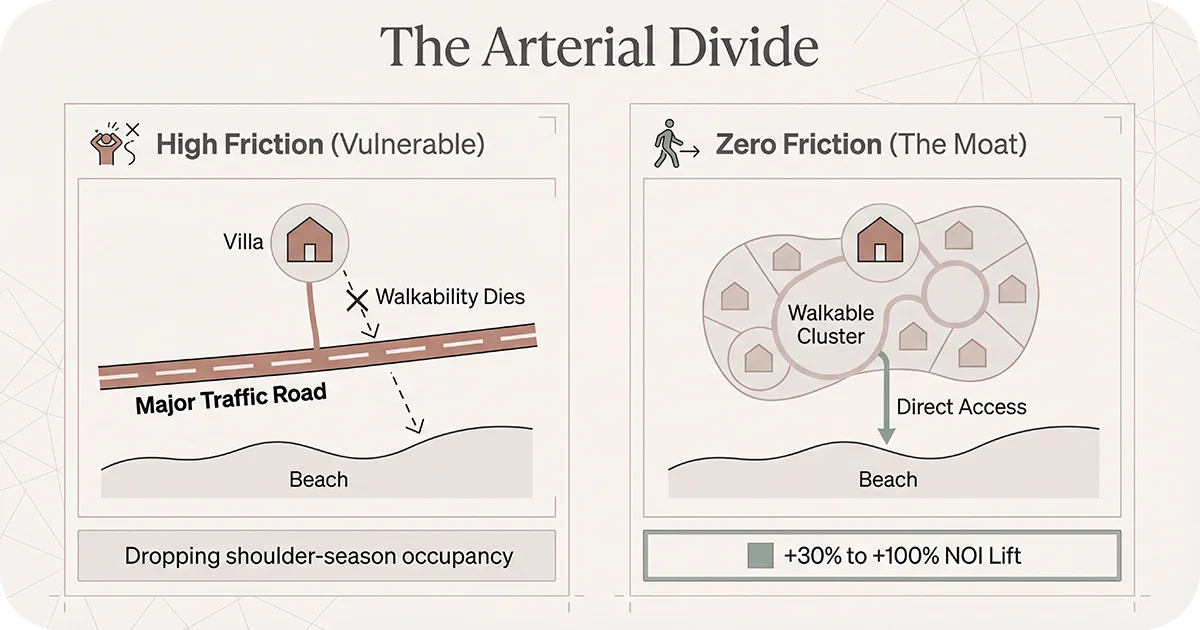
The most reliable way to increase your risk-adjusted returns is to buy into a pocket where demand is structurally dense. “Near the beach” is no longer a sufficient metric; you must evaluate “Traffic Friction” and avoid what we call the Arterial Divide.
Bali’s infrastructure is under immense pressure. Institutional hotel operators explicitly flag worsening traffic as a major hurdle in high-growth submarkets. If your guests have to cross a major arterial road, such as Raya Canggu or the Uluwatu bypass, to reach the coastline or get a coffee, walkability dies and shoulder-season occupancy plummets.
Proximity to premium beaches within a highly walkable, undivided cluster is the ultimate moat. Picking a demand-dense micro-location drives occupancy resilience and pricing power, delivering an estimated +30% to +100% NOI lift compared to a mediocre pocket with the exact same villa specifications.
Tip 2: Invest in Ecosystems, Not Just Concrete (The Amenity Premium)
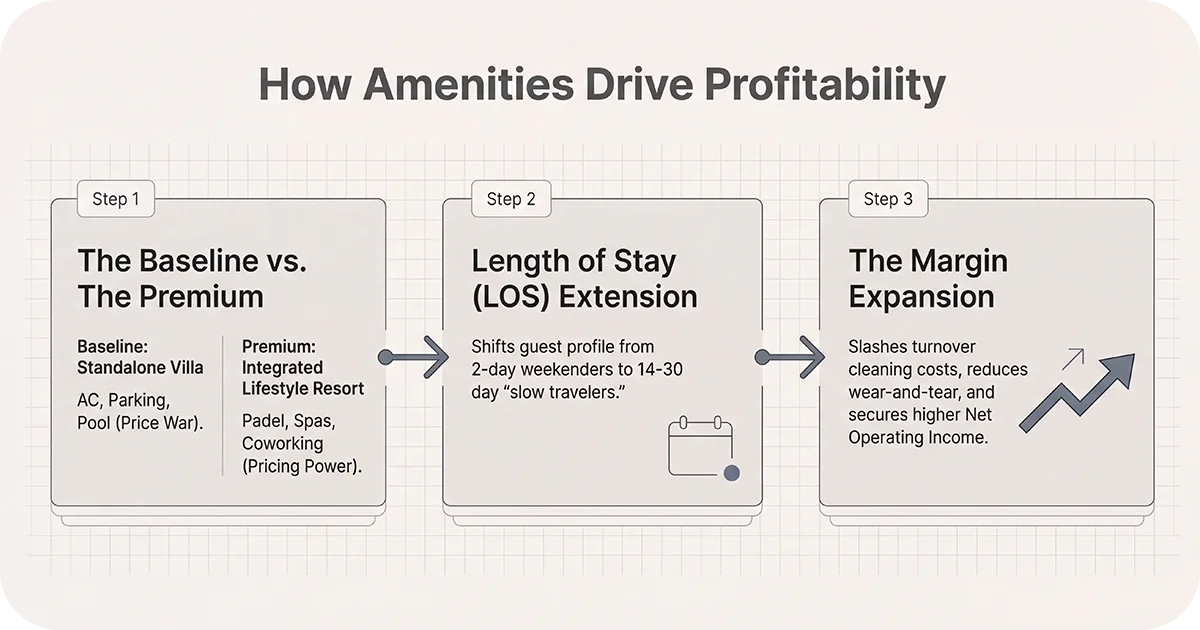
In today’s highly competitive market, standard amenities do not provide pricing power. Across Bali’s STR market, the baseline is already set:
- 96% of listings have air conditioning
- 88% offer parking
- 83% have a pool
If you only offer these basics, you will be forced to compete entirely on price. To command premium nightly rates, you must invest in High-ROI differentiators. The strict underwriting rule for capex is to target upgrades that provide a <36-month payback.
Rather than aesthetic fluff, invest in conceptual Padel resorts, workspace-grade setups, and wellness spas. Beyond securing 5-star reviews, which research proves can increase occupancy by about a fifth (20%) in relative terms, ecosystems trigger a massive financial advantage: Length of Stay (LOS) Extension.
Standalone concrete villas primarily attract weekenders, resulting in high turnover cleaning costs, increased wear-and-tear, and frequent booking gaps. Integrated lifestyle ecosystems attract the 14-to-30-day “slow travel” demographic, drastically slashing turnover costs and widening your NOI margin. This operational advantage is why integrated resorts consistently outperform standalone villas.
Tip 3: Target High-Demand Micro-Markets with Radius Underwriting
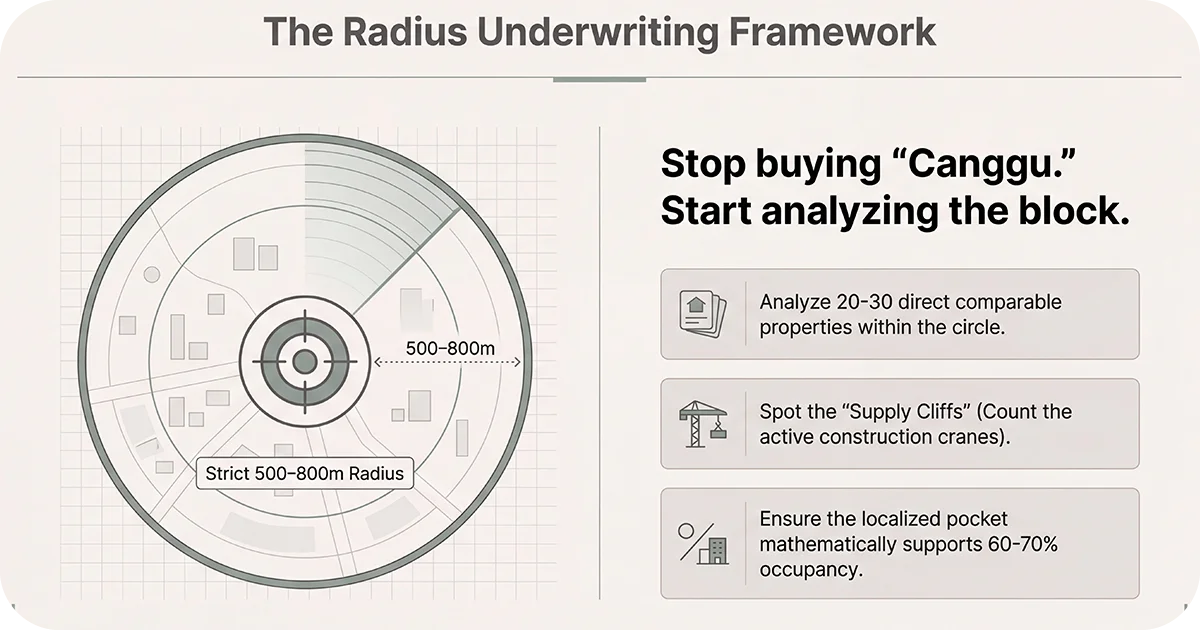
Never underwrite an investment based on a broad geographic headline like “Canggu” or “Uluwatu.” To protect your yield, pull 20-30 comparable properties within a strict 500-800m radius of your target site.
Here is how different micro-pockets perform based on market data:
When analyzing this radius, you must actively spot Supply Cliffs by counting the cranes. If you see multiple unmanaged, standalone villa projects being built within your 500m radius, you must underwrite for lower ADR growth because a localized price war is coming.
Operating at the island’s 46% average occupancy will destroy your returns. Here is the exact sensitivity math for a $250,000 all-in property investment, assuming conservative variable costs (42% of revenue) and fixed costs ($13,500/year):
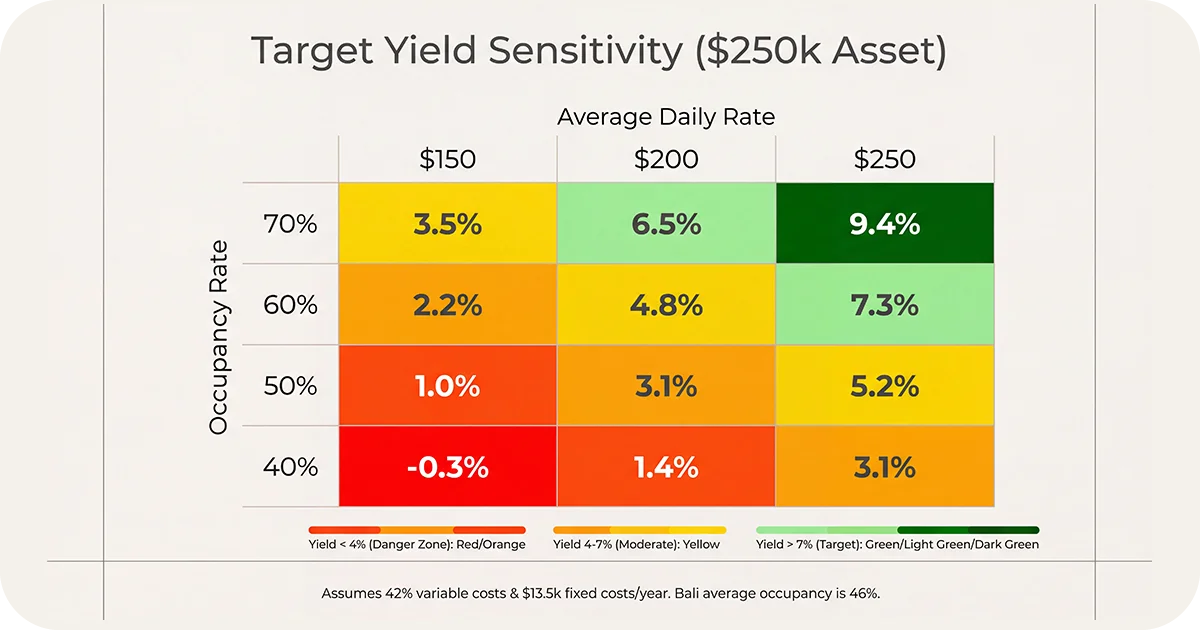
Interpretation: To clear an institutional net yield threshold, you must bypass oversupplied standalone pockets and target protected resort micro-locations capable of supporting 60-70% occupancy at a $250+ ADR.
🏗️ Want to validate the build quality of your investment? Ensure you understand the regulations and costs in our complete guide on Bali Villa Construction
Tip 4: Demand Integrated, In-House Property Management
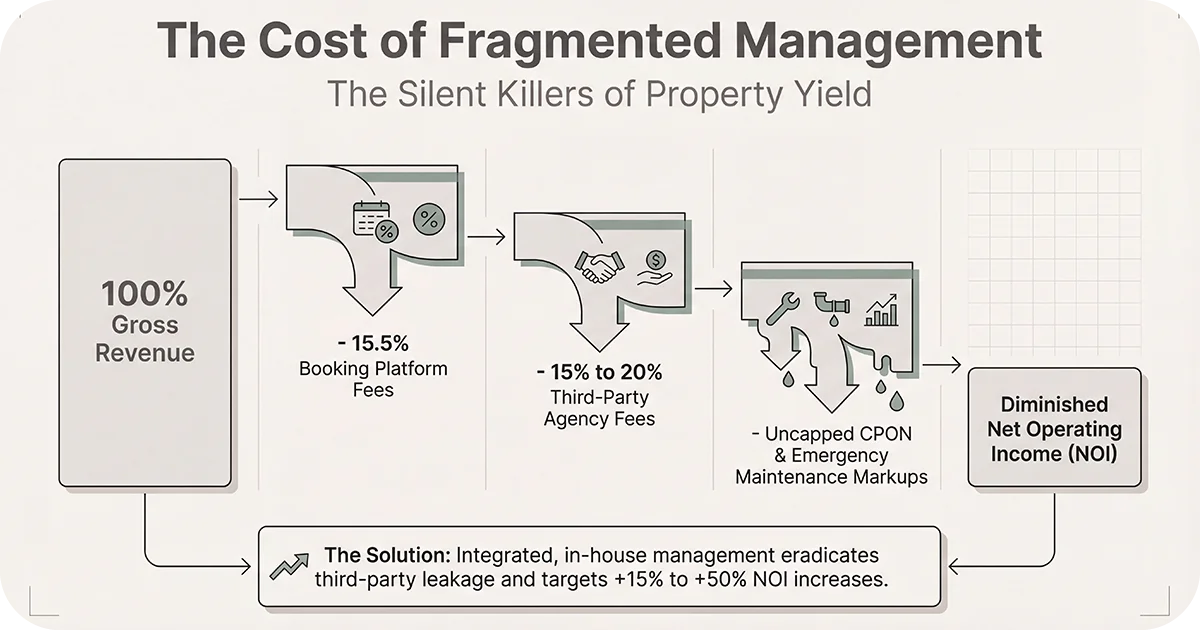
Fragmented management is the silent killer of property yield. Buying a standalone villa and handing it to a third-party management agency systematically leaks NOI.
Look at how quickly your gross revenue vanishes under a traditional, non-integrated model:
- ~15.5% Airbnb host-only fee structure
- 15% to 20% Standard third-party management fee
This ignores the most dangerous leak: Cost Per Occupied Night (CPON). Third-party managers focus purely on gross revenue. They wait for an AC unit to break, hire a third-party vendor, and pass an emergency markup directly to you.
To protect your cash flow, utilize a hands-off investment model backed by a developer’s integrated, in-house management team. In-house teams drive down CPON through preventative maintenance, executing on these strict operational KPIs to increase your NOI by an expected +15% to +50%:
- Strict Revenue Management: Implementing dynamic pricing and seasonal minimum-stay tuning to increase NOI by +10% to +35%.
- Downtime Eradication: Targeting <5 nights/year lost to maintenance.
- Review Protection: Targeting a ≥4.7 overall rating and keeping response times under 10 minutes to protect platform conversion rates.
Tip 5: Leverage Off-Plan “Destination” Builds for Capital Appreciation
To maximize your Internal Rate of Return (IRR), you must factor in capital appreciation. With a current pipeline of 43 new hotels bringing 5,357 rooms into areas like Canggu and Jimbaran-Uluwatu, standard independent villas will struggle to hold their resale value against institutional competition.
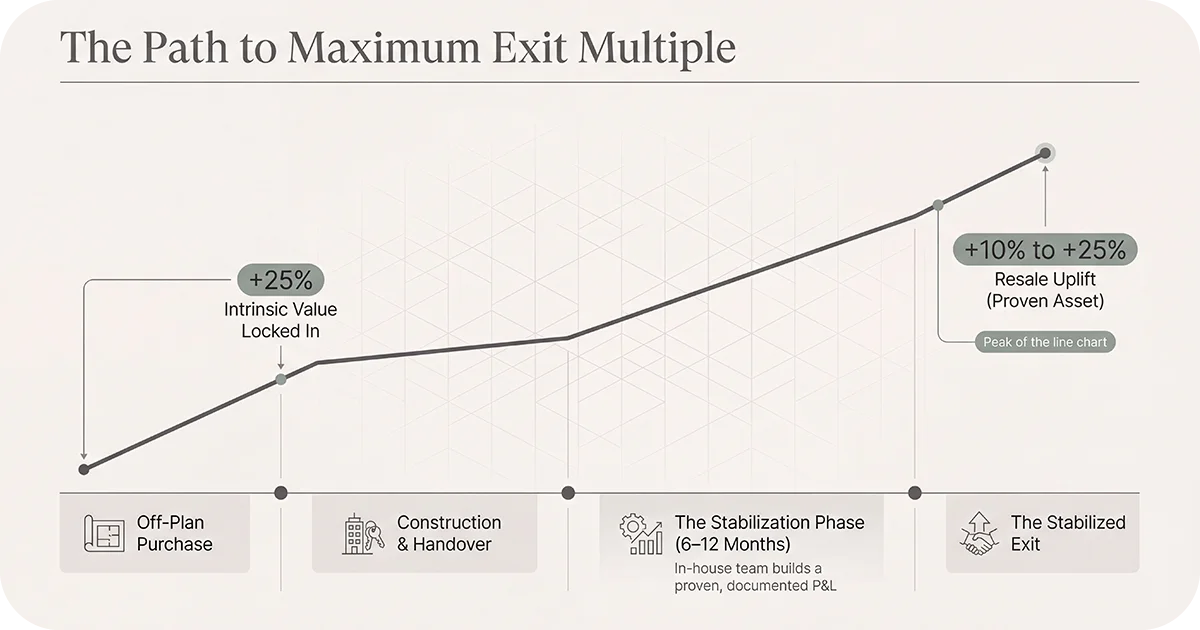
The most strategic move is a value-add approach: buying off-plan within a fully compliant, conceptual destination. Locking in pre-construction pricing within Azoria Living’s portfolio historically generates an intrinsic value increase of 25% upon handover.
However, capturing that 25% equity bump requires the “Stabilized Exit Rule.” You cannot flip a hospitality asset the day the paint dries and expect top dollar. You must let your in-house management team stabilize the NOI for 6 to 12 months post-handover. Selling a property with a proven, documented P&L and verified NIB (Business Identification Number) compliance guarantees maximum exit liquidity and expands your exit multiple by an estimated +10% to +25% resale uplift versus non-compliant, unproven assets.
🏗️ Need to choose a reliable partner? Learn how to conduct safe due diligence in our 2026 guide to finding a top property developer in Bali
Limitations, Alternatives & Professional Guidance
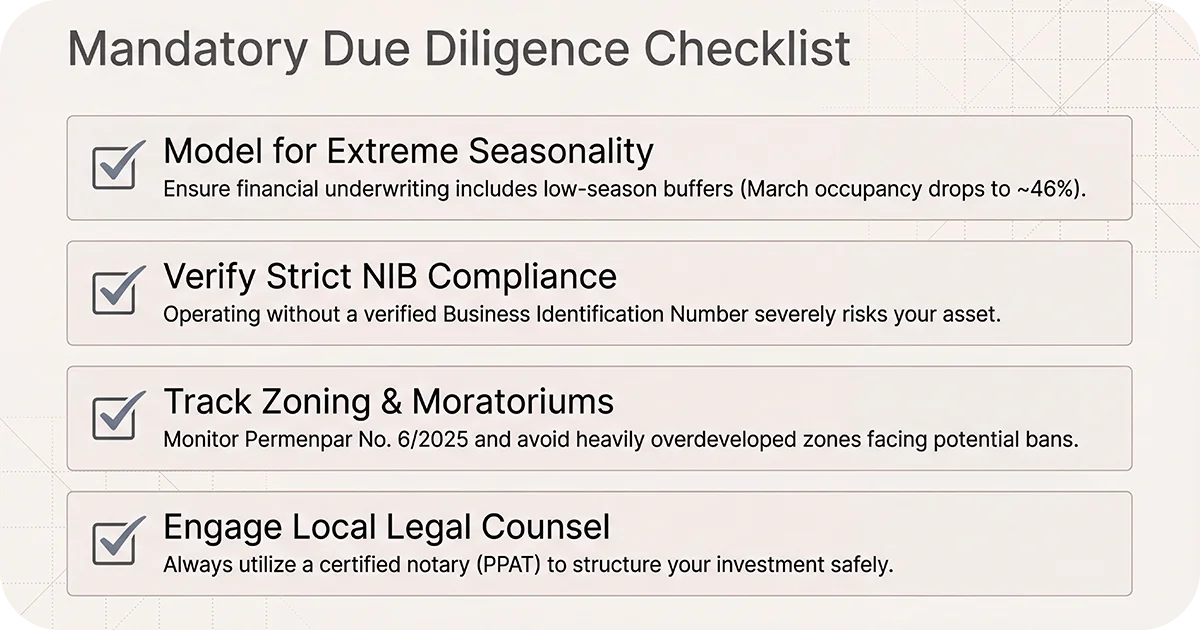
While targeting high-yield lifestyle resorts offers exceptional upside, real estate in emerging markets carries inherent operational risks. Market seasonality is powerful; official data shows star-hotel occupancy dropping from a peak of 69.54% in August down to 46.61% in March. Therefore, your financial underwriting must always include conservative low-season buffers.
Additionally, the regulatory trajectory in Indonesia requires close monitoring. Official regulation metadata (such as Permenpar No. 6/2025) indicates tightening compliance, and government authorities have discussed moratoriums on construction in overdeveloped zones to combat supply surges. Regardless of your chosen model, you must ensure strict regulatory adherence and engage professional legal counsel or a notary (PPAT) to structure your investment safely.
⚖️ Need to check the safety of your investment? Navigate the legal setup securely with our complete Bali Investor Guide.
📞 Ready to stop competing with 84,000 average listings and start generating true passive income? Schedule a Free Portfolio Consultation directly with our founder, Rasmus Holst. We’ll look at the hard NOI data, cut through the market fluff, and show you exactly how an integrated off-plan resort can hit your 12-22% yield targets.
Lets Meet
Conclusion
Generating top-tier yields in Bali requires a fundamental shift in perspective. You are not just buying real estate; you are acquiring a high-performance hospitality asset. By applying these property investment tips for Bali, utilizing radius underwriting to avoid supply cliffs, demanding integrated management to hit strict CPON metrics, investing in lifestyle ecosystems to extend guest stays, and capturing off-plan equity, you systematically mitigate your downside risk. Focus on the data, partner with a visionary developer, and let a fully integrated ecosystem generate your passive returns.
🌴 Ready to secure your passive income? Property in Bali for sale located just 1 minute from Suluban Beach.
Frequently Asked Questions (FAQ)
A highly optimized, professionally managed lifestyle resort in a premium micro-location can target annual returns of 12-22%. However, properties operating on the broad market average of 46% occupancy and $144.6 ADR generally yield much lower net returns once 15-20% management fees and CPON leaks are deducted.
Standard third-party property management fees in Bali generally range from 15% to 20% of your gross rental revenue. This does not include the ~15.5% Airbnb host-only fee or underlying maintenance markups, which is why integrated, in-house management is crucial for protecting net yield.
Yes, significantly. Bali experiences distinct seasonality. Official star-hotel occupancy data indicates swings from a low of 46.61% in March to a peak of 69.54% in August. Offering integrated ecosystem amenities (like coworking and wellness centers) helps extend the Length of Stay (LOS) and sustain occupancy during slower months.
Buying off-plan allows you to secure property at a lower, pre-construction price point. In high-demand conceptual complexes that are fully compliant with required NIB regulations, investors typically capture significant capital appreciation, often averaging 25% once the project is completed and the NOI is stabilized.
References & Official Sources
- Horwath HTL (2024). “Indonesia Hotel & STR Market Context”. (Provides baseline data of 6,333,360 international arrivals in 2024, tracks 5,357 new hotel rooms, and explicitly warns of worsening traffic friction in key submarkets). https://horwathhtl.com/wp-content/uploads/2025/04/HHTLC9_Bali-Hotel-Branded-Resi-Report-1.pdf
- AirDNA (2024). “Bali Market Data & Supply Analytics”. (Reports 84,428 active short-term rental listings with an average 46% occupancy and $144.6 ADR, plus baseline amenity saturation). https://www.airdna.co/vacation-rental-data/app/id/default/bali/overview
- Badan Pusat Statistik / BPS (2025). “Hotel Industry and Tourism Seasonality Patterns”. (Shows official hotel occupancy swings from 46.61% in March down-season to 69.54% in the August peak). https://bali.bps.go.id/en/pressrelease/2025/10/01/717985/tourism-overview-of-bali-province–august-2025.html
- Cardiff University / Peer-Reviewed Study on STR Platforms (2023). “The Impact of Review Sentiments on Occupancy”. (Demonstrates that outstanding reviews can increase occupancy by roughly a fifth in relative terms). https://orca.cardiff.ac.uk/id/eprint/166787/1/sahadev-et-al-2023-the-impact-of-review-sentiments-on-occupancy-evidence-for-signalling-theory-from-peer-to-peer.pdf
- Airbnb Official Resource Center (2024). “Host Fee Structures & Indonesia Compliance”. (Details the ~15.5% host-only fee structure and the strict requirement of an NIB for operations). https://www.airbnb.com/help/article/185718
- Reuters (2024). “Bali Construction Moratorium Discussions”. (Reports on government discussions regarding construction moratoriums in overdeveloped areas). https://www.reuters.com/world/asia-pacific/indonesias-bali-wants-ban-building-hotels-villas-media-say-2024-09-09/
- Peraturan / Indonesia Regulatory Database (2025). “Permenpar No. 6/2025”. (Signals ongoing regulatory and policy trajectory changes affecting the tourism sector). https://peraturan.go.id/id/permenpar-no-6-tahun-2025

Rasmus Holst is a serial entrepreneur and Co-Founder of COCO Development Group, where he helps drive innovation and growth through strategic business development. He is also the Co-Founder of Estate of Bali and Regnskabshelten.dk, Denmark’s fastest-growing accounting firm, which grew to 35 employees and generated $2.5M in turnover in 2023. Rasmus is passionate about building businesses that create long-term value and impact.