🎯 Summary of Content
Can you buy investment property in Bali apartments for high returns? Yes. As detailed in our comprehensive Bali Property Investment Report, managed resort units are currently outperforming standalone villas in net yield (12–17% vs. 7–9%) due to lower entry costs (starting under €100k) and shared maintenance expenses. By pooling costs for SPA, pools, gyms, and security, investors achieve “resort-level” occupancy without the “private villa” headache.
- The Market Pivot: Rising land prices and changing tourist preferences have shifted the “smart money” from high-maintenance private villas to capital-efficient resort apartments (under €100k).
- The Financial Advantage: Apartments outperform standalone villas in net yield (projected 12–17% vs. 7–9%) by leveraging lower entry costs and shared operating expenses (economies of scale).
- The “Amenity War”: Modern travelers (wellness tourists & nomads) prioritize community facilities like gyms and saunas, giving resorts a decisive advantage in Airbnb search algorithms. For a deeper dive into how amenities drive bookings, read our analysis on is airbnb in bali a good property investment
- Seasonality Defense: Apartments with indoor amenities mitigate the “low season” risk, maintaining 82-93% occupancy rate.
- Operational Reality: The harsh tropical climate makes maintenance a “hidden profit killer” for private villas, whereas managed apartments distribute these costs to offer a truly passive investment.
- Strategic Ownership: Investors utilize Leasehold (Hak Sewa) or PT PMA structures to secure long-term rights, ensuring compliance with Indonesian agrarian law while optimizing for future liquidity.
Written by: Rasmus Holst (Founder & CEO of Coco Development Group) | Reviewed by: Coco Senior Investment Analyst | Last updated: 17 April, 2026
ℹ️ Transparency: COCO Development Group develops resort properties in Bali. We champion this model because we believe in its superior performance, but we also benefit financially if you invest. Consequently, this article contains inherent bias and is for educational purposes only, not financial or legal advice. We strictly recommend independent due diligence and consulting a certified Indonesian notary (PPAT), tax advisor, and legal counsel.
Table of Contents
- Introduction
- The New Logic: Why Smart Money is Moving to Apartments
- The ROI Mathematics: Apartment vs. Standalone Villa
- The “Amenity War”: Why Community Resorts Win Occupancy
- The Hidden Profit Killer: Maintenance & Operations
- Maintenance Reality: Standalone Villa vs. Managed Apartment
- Limitations, Alternatives & Professional Guidance
- Conclusion
- Frequently Asked Questions (FAQ)
- References & Official Sources
Introduction
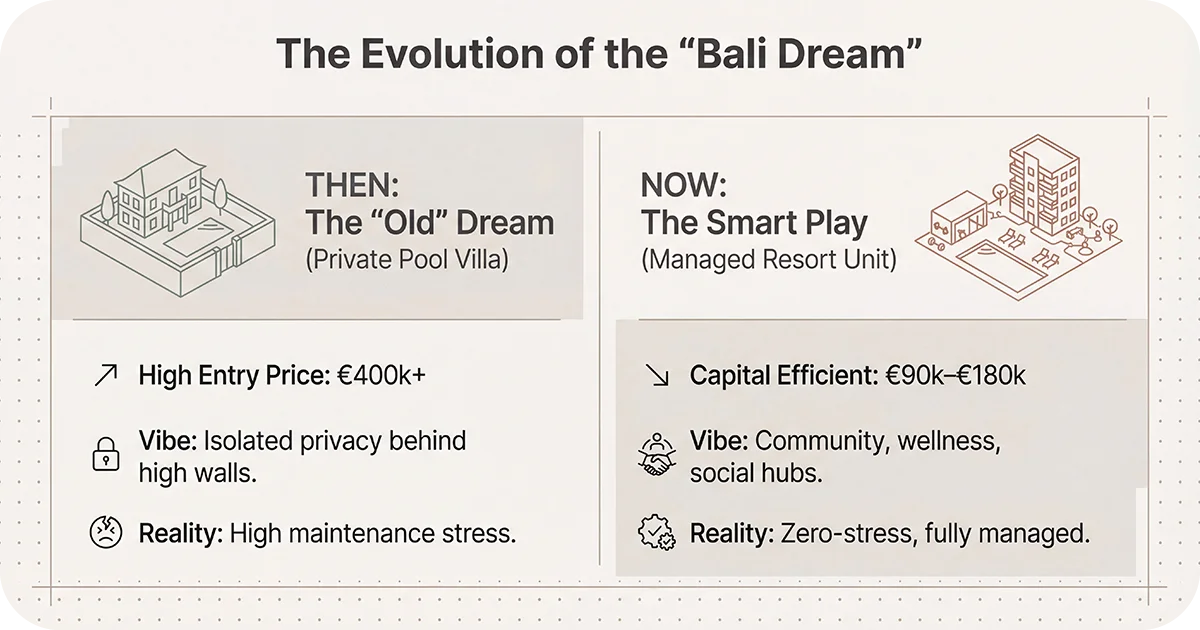
Investing in Bali apartments has emerged as one of the smartest capital plays for 2026. For years, the “Bali Dream” was synonymous with a private pool villa. However, rising land prices and a shift in tourist behavior toward “community living” have flipped the script.
Today, savvy investors are pivoting away from overpriced €400,000 villas. Instead, they are consolidating capital into high-yield, fully managed resort units that offer better amenities, higher occupancy, and—crucially—zero maintenance stress.
If you are looking to buy investment property in Bali apartments, this guide breaks down the math, the management, and why “going small” often means winning big.
The New Logic: Why Smart Money is Moving to Apartments
In 2020, you could build a villa in Canggu for $150,000. In 2026, land prices alone often exceed that. This has created a “barbell” market:
- Ultra-Luxury Villas ($500k+): High entry, high risk, requires full-time staff.
- Resort Apartments ($90k–$180k): Low entry, shared costs, high liquidity.
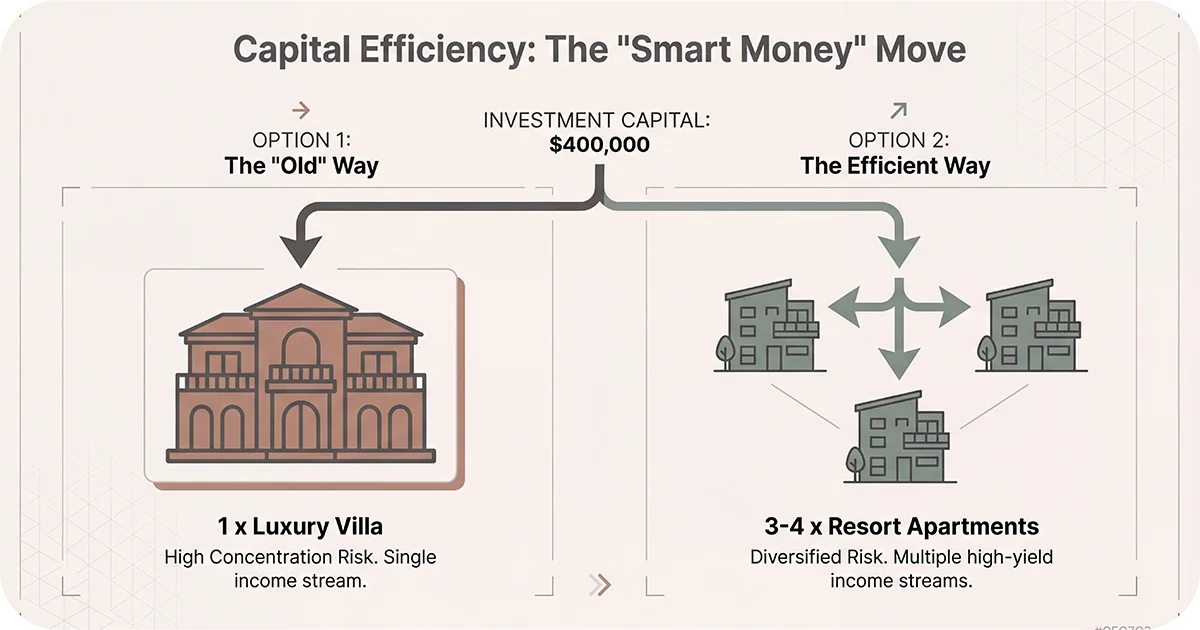
Investors looking to buy investment property in Bali apartments are capitalizing on Capital Efficiency. Instead of sinking $400,000 into one asset (a villa), you can diversify that same capital into 2-4 apartment units. This spreads your vacancy risk and maximizes your exposure to high-yield resort tourism.
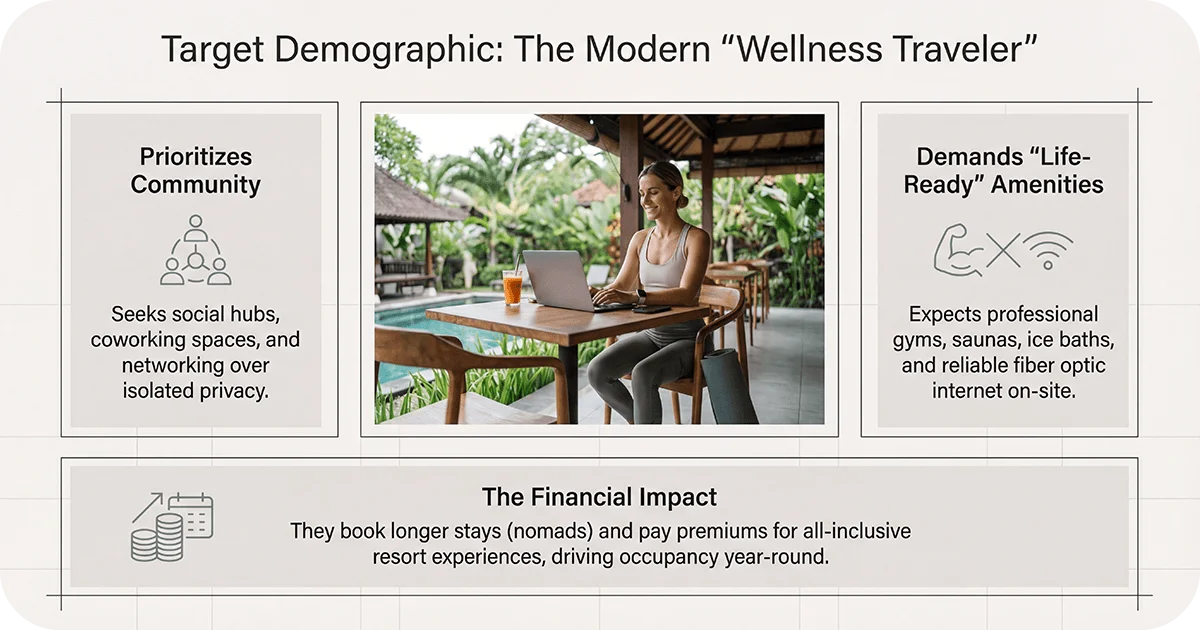
Furthermore, the target demographic has changed. Digital nomads and “wellness tourists” (the fastest-growing segment in Bali) prioritize community (coworking, gyms, saunas, social hubs) over privacy (a lonely villa behind high walls).
💡 Key Insight: A standalone villa competes with thousands of other private villas. A resort apartment competes with hotels—but at a much more attractive price point for the guest.
The ROI Mathematics: Apartment vs. Standalone Villa
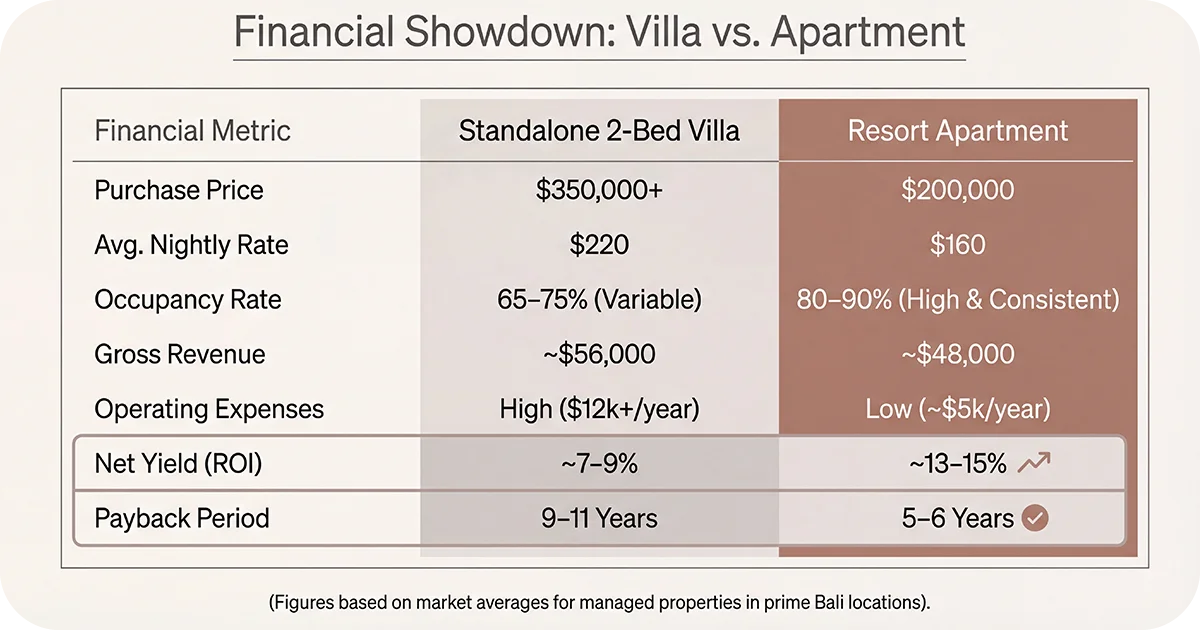
The argument for apartments isn’t just about lifestyle; it is about pure math. Lower purchase prices combined with higher occupancy rates drive superior Net Yields. See our full data breakdown on rental yield of property in Bali.
Here is a typical comparison for a prime location (e.g., Uluwatu or Bingin) in 2026:
(Figures based on market averages for managed properties in Bali). [^1] [^2]
The Leverage Effect:
Because the entry price is so low (under €100k), many investors find they can purchase a unit cash, eliminating interest repayments. Alternatively, buying two units allows you to live in one and rent the other, effectively subsidizing your lifestyle in Bali.
Shoulder Season Resilience
The biggest risk for any Bali investor is the “low season” (January–March). During these rainy months, standalone villas often sit empty. However, data from managed complexes shows that apartments with indoor amenities (coworking, gym, spa) maintain 82–93% occupancy even during off-peak times.
This resilience is structural: guests choose resorts because the “experience” (sauna, gym, cafe) exists regardless of the weather. A standalone villa offers nothing when it rains.
The “Amenity War”: Why Community Resorts Win Occupancy
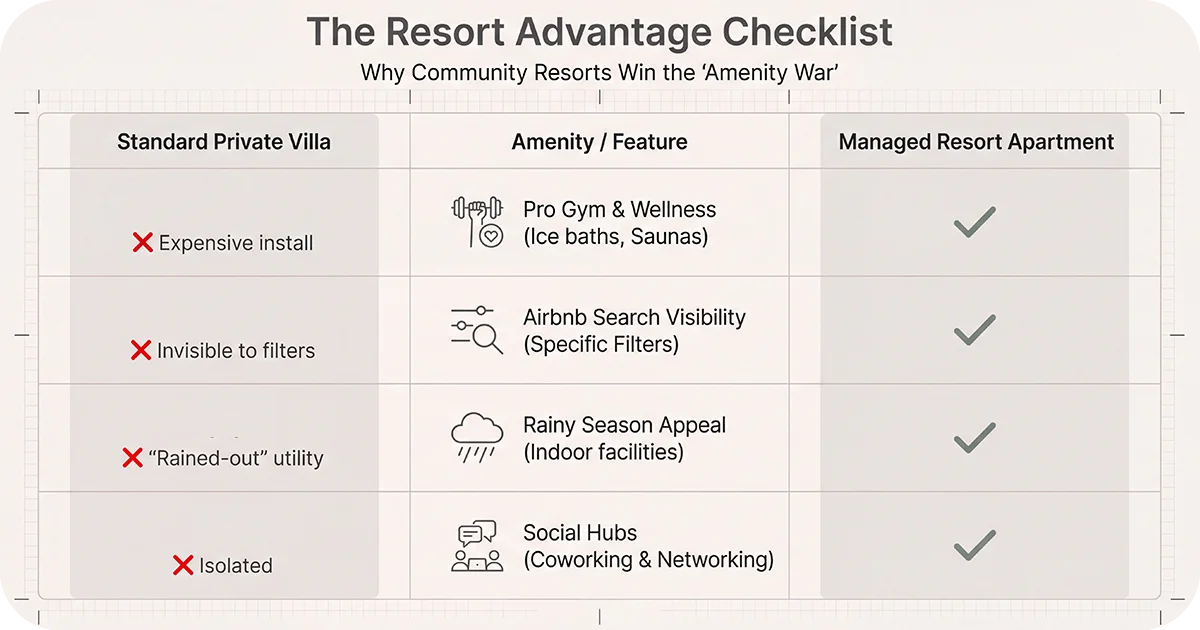
When a tourist searches on Airbnb or Booking.com, they filter by amenities. This is where the standalone villa struggles to compete.
To install a professional gym, ice bath, sauna, and coworking space in a private villa would cost upwards of $50,000 and require significant land. In a community apartment complex, these amenities are standard.
The Airbnb Algorithm Advantage
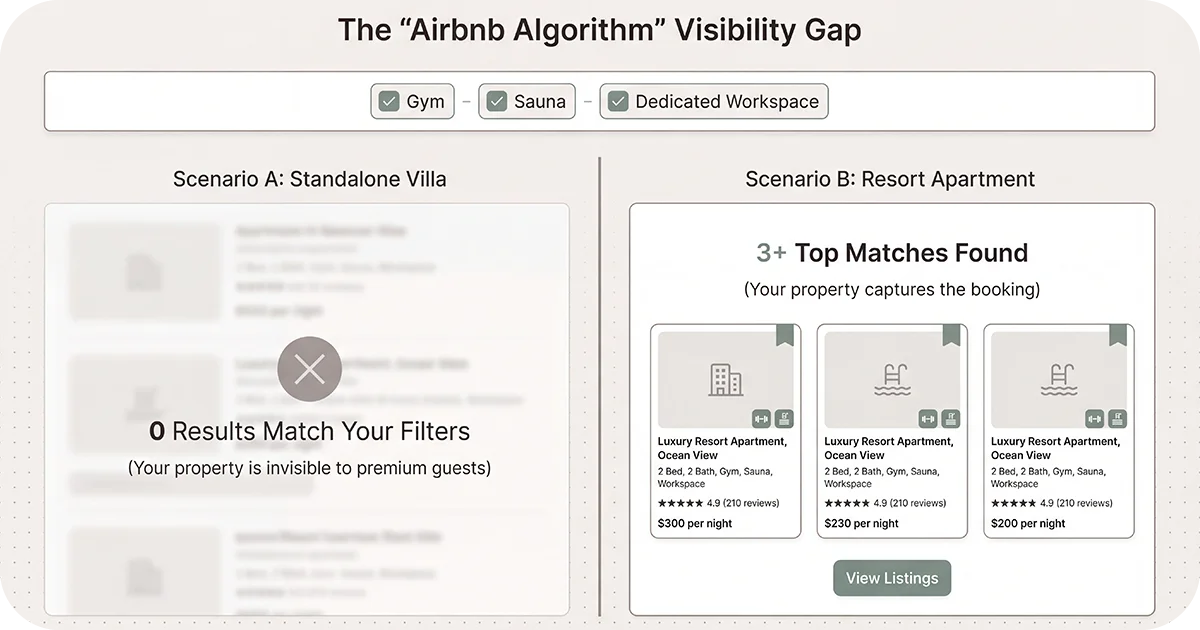
This is a technical reality that few investors consider. When a user filters for “Gym,” “Sauna,” or “24/7 Check-in” on Airbnb, standalone villas without these specific features disappear from the search results entirely.
- The Result: Your villa becomes invisible to the highest-spending demographic (wellness travelers and digital nomads).
- The Fix: A resort apartment inherently “ticks all the boxes” in the algorithm, ensuring your property appears in 3x more searches than a basic private villa.
The “Experience-Rich” Advantage
Travelers today seek experiences, not just beds. An apartment in a resort complex offers:
- Wellness: On-site ice baths, SPA, saunas, and yoga decks.
- Sport: Padel courts (a major draw in 2026) and lap pools.
- Dining: In-house restaurants or cafes.
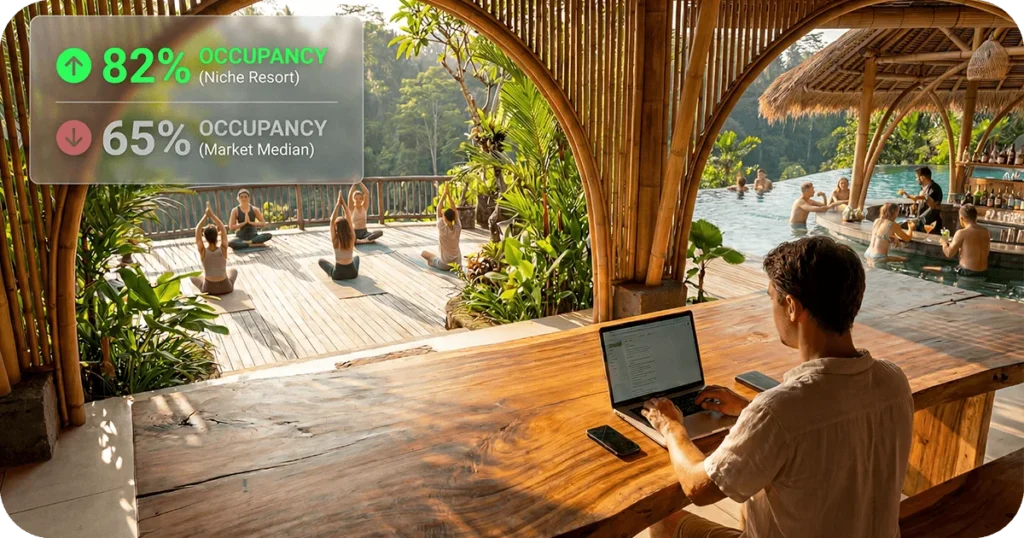
Why this matters for ROI: These amenities reduce “seasonality.” Even in the rainy season, a digital nomad will book a resort apartment because the gym, coworking, and sauna are indoors and accessible. A private villa with a rained-out pool loses its appeal. Data shows amenity-rich developments maintain 82–93% occupancy during peaks, far above the market average of 65–80%.
The “Amenity War”: Impact on Occupancy & Search Visibility
The Hidden Profit Killer: Maintenance & Operations
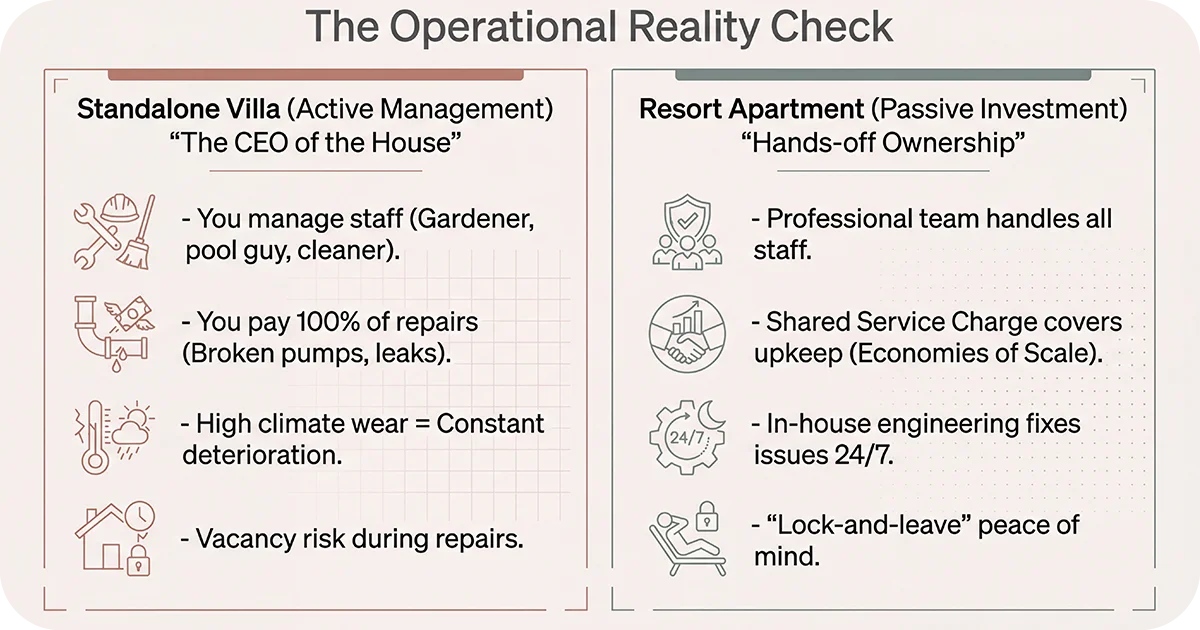
The most underestimated factor in Bali real estate is the tropical climate. It is harsh. Humidity, salt air, and rapid plant growth mean a property starts deteriorating the moment it is finished.
The Villa Burden (Active Management)
If you own a standalone villa, you are the CEO of that house. You are responsible for:
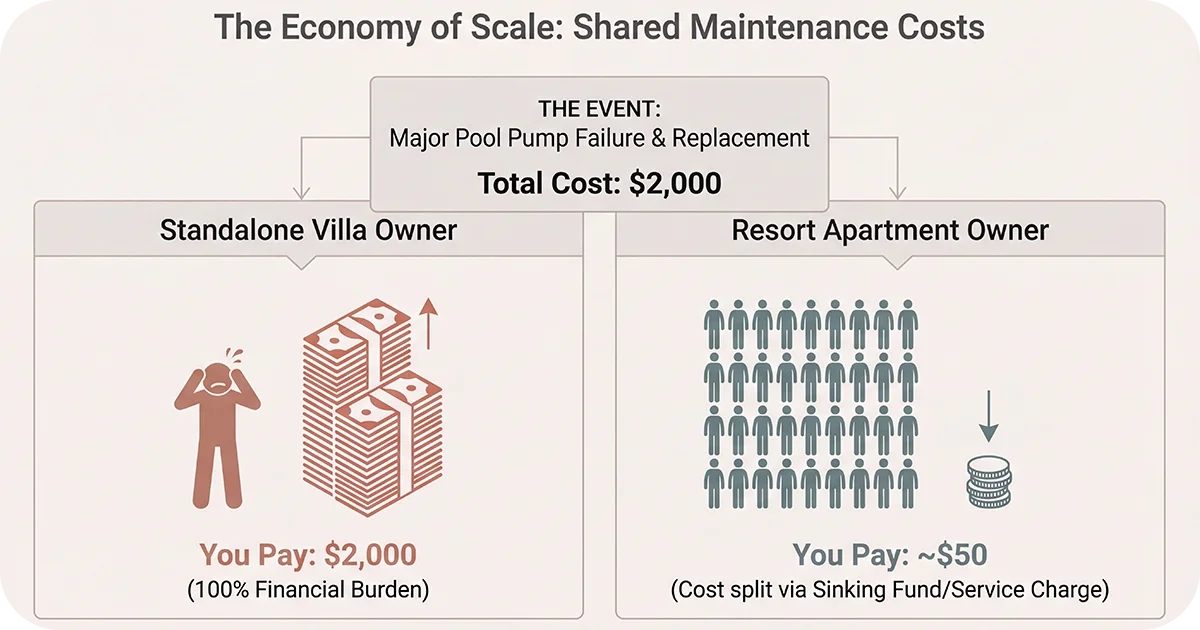
- Pool pump failures ($500+).
- Roof leaks during monsoon season.
- Staff salaries (Housekeeper, Gardener, Pool Guy = ~$4,000/year).
- Pest control and fumigation.
Total estimated maintenance for a villa: $3,000–$7,200 per year, and that doesn’t include your time or management fees (usually 15-20%).
🏗️ Worried about maintenance costs? Poor build quality destroys ROI. Understand the real price of upkeep in our guide to Bali Villa Construction.
The Apartment Solution (Passive Income)
When you buy investment property in Bali apartments, you pay a Sinking Fund or Service Charge (similar to an HOA fee).
- Economy of Scale: The cost of security, pool maintenance, and landscaping is split between 40+ owners.
- Professional Oversight: You don’t get a WhatsApp message at 2 AM saying the AC is broken. The in-house engineering team fixes it.
- Lock-and-Leave: You can leave Bali for 6 months. When you return, the pool is blue, and the AC works. A villa left alone for 6 months often requires a full renovation.
This structure turns a real estate asset into true Passive Income, rather than a second job.
Maintenance Reality: Standalone Villa vs. Managed Apartment
Limitations, Alternatives & Professional Guidance
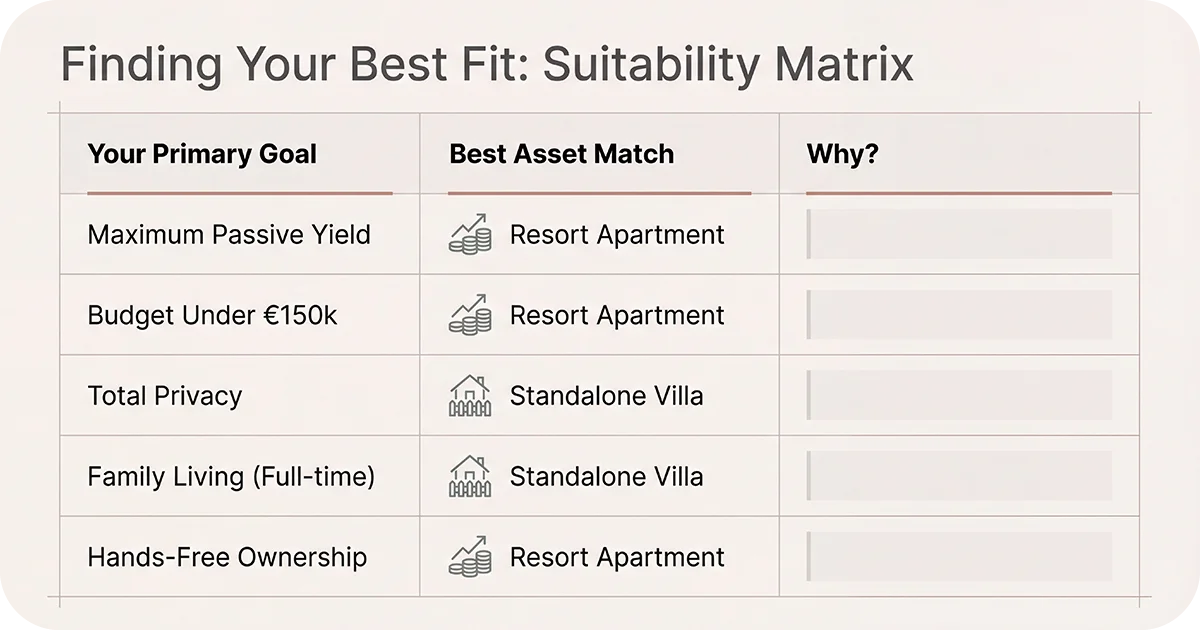
While apartments offer superior yields and ease of management, they are not for everyone. You must understand the trade-offs to ensure this asset class fits your goals.
Is This Investment Right For You? (Suitability Matrix)
1. Privacy vs. Community
Apartments are communal. You share the pool, the gym, and the walls. If your goal is total seclusion or hosting loud private parties, a standalone villa is the better option.
- Alternative: If privacy is paramount, look for “Cluster Villas” where you get a private pool but still pay into a shared management system.
2. Customization Limits
In a managed resort, you generally cannot paint your front door pink or renovate the kitchen on a whim. Uniformity ensures the “hotel standard” is maintained, which protects the rental rate for all investors.
3. Ownership Titles (Leasehold vs. Freehold)
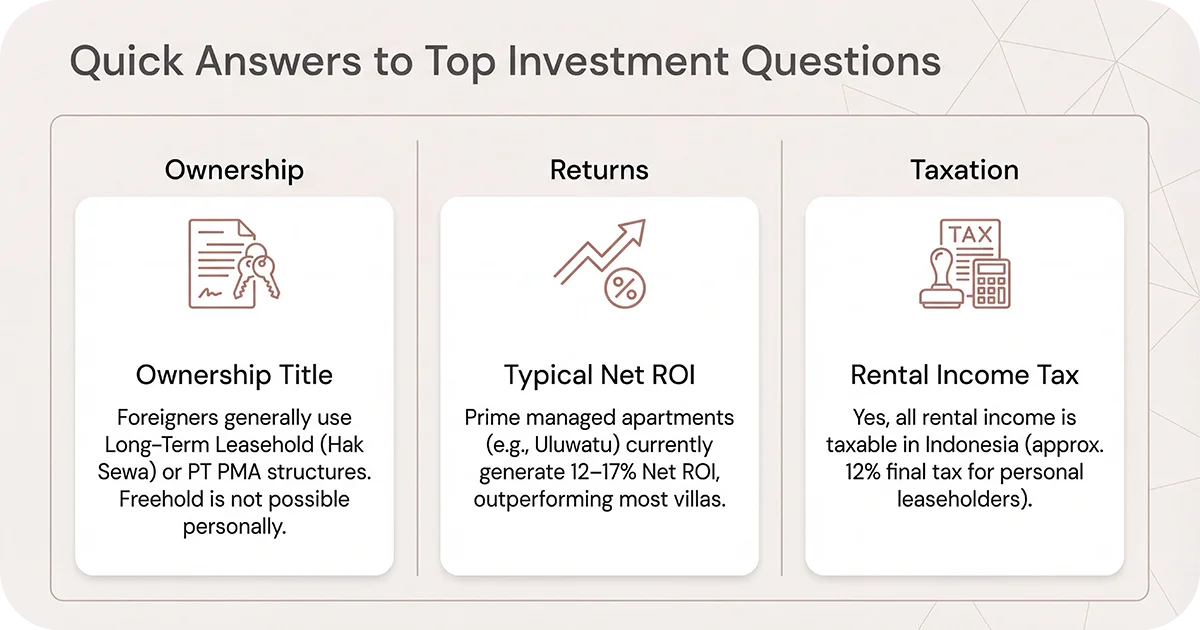
Most apartments and commercial investment properties in Bali are sold under Leasehold (Hak Sewa) or via a PT PMA (Foreign Company) structure. Foreigners strictly cannot own Freehold (Hak Milik) land in their personal name.
- Guidance: Ensure the lease is long (25+ years) and includes a guaranteed extension clause (in accordance with Agrarian Law No. 5 of 1960).
⚖️ Confused by ownership titles? Ensure you understand what you actually own. Read our essential Bali Investor Guide.
4. Space Considerations
Apartments are compact (typically 35–80 sqm). They are optimized for rental turnover, not for raising a family of five.
- Recommendation: If you plan to live in Bali full-time with a large family, this investment is better used as an income generator to pay for your separate family villa rental.
📞 Still debating between privacy and profit?
Stop guessing. Schedule a Free Strategy Consultation directly with our founder, Rasmus Holst. Get honest, data-backed guidance on whether a standalone villa or a managed resort unit better aligns with your personal lifestyle needs and financial targets.
Lets Meet
Conclusion
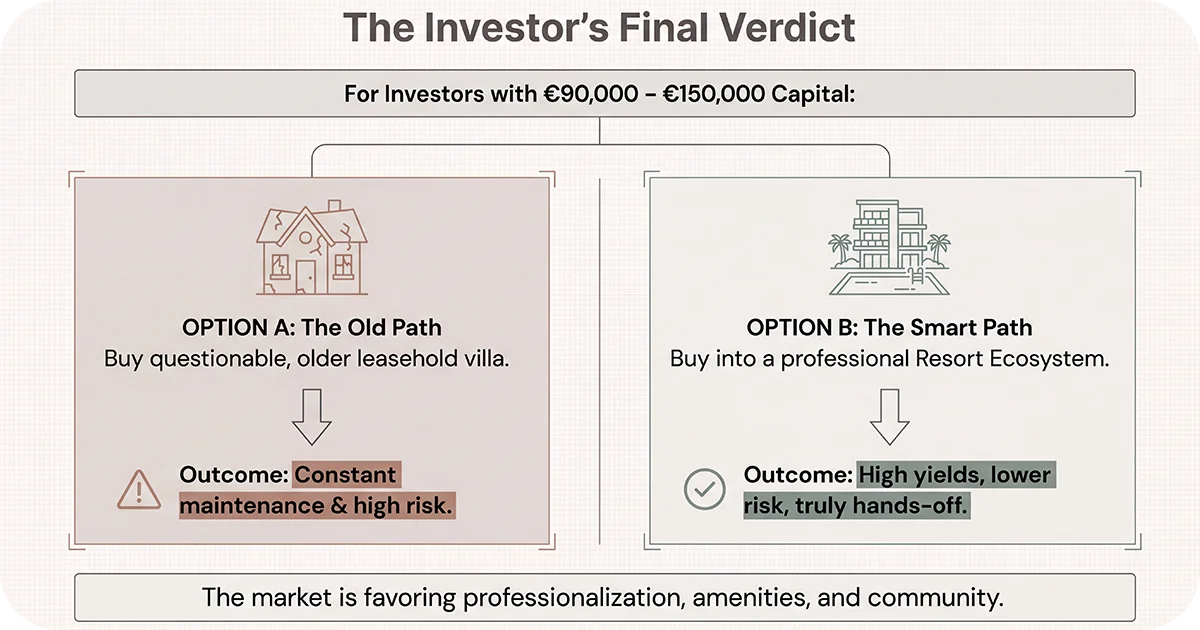
The era of the “wild west” villa build is fading. As Bali matures into a world-class destination, the market is favoring professionalization, amenities, and community.
For the investor with €90,000 to €150,000, the choice is clear:
- Buy a questionable, older leasehold villa that requires constant maintenance.
- Or, buy investment property in Bali apartments within a resort ecosystem.
The latter offers higher yields, lower risk, and a truly hands-off experience. You get the benefits of a luxury hotel business—gyms, spas, high occupancy—without the headache of cleaning the pool yourself.
🌴 Ready to see the math? Explore our high-yield, fully managed units at Azoria and secure your foothold in Uluwatu: Property in Bali for sale
Frequently Asked Questions (FAQ)
References & Official Sources
On Legal Framework, Ownership & Taxation:
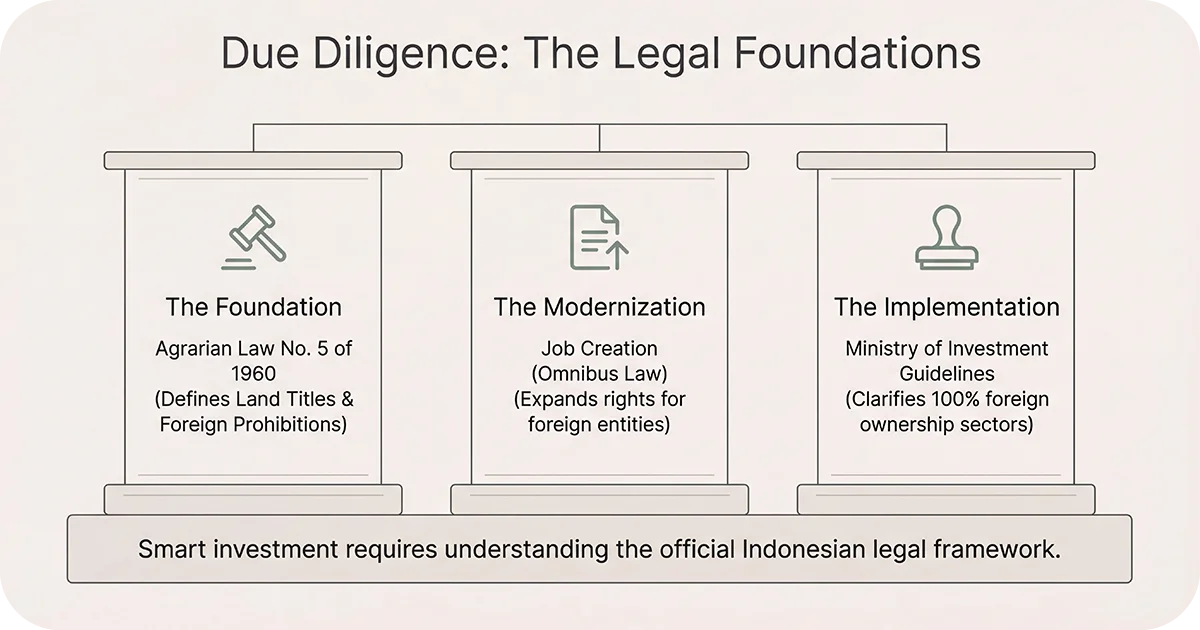
- Republic of Indonesia (1960). “Agrarian Law No. 5 of 1960 (Basic Agrarian Law)”. (The primary legal text defining Foreign Ownership prohibitions and Land Title classifications including Hak Pakai). https://faolex.fao.org/docs/pdf/ins3920.pdf
- Government of Indonesia (2020). “Law No. 11 of 2020: Job Creation (Omnibus Law) – Foreign Ownership Provisions”. (https://investmentpolicy.unctad.org/investment-policy-monitor/measures/3701/new-regulation-expands-strata-title-rights-for-foreign-citizens-and-legal-entities)
- Ministry of Investment/BKPM (2025). “Positive Investment List & Foreign Ownership Guidelines”. (Regulations confirming 100% foreign ownership eligibility for PT PMA in tourism sectors). https://www.investindonesia.go.id/en/why-invest/positive-investment-list
- Ministry of Finance Regulation (PMK) No. 131 of 2024. “Adjustment of Value Added Tax (VAT) Rate”. (Official confirmation of the 12% VAT rate effective from 2025, which investors must factor into their construction and acquisition costs. Supports “Section 6: Tax Liabilities”). https://www.pajak.go.id/id/artikel/pmk-1312024-tarif-ppn-sebelas-dua-belas

About the Author:
Rasmus Holst is a serial entrepreneur and Co-Founder of COCO Development Group, where he helps drive innovation and growth through strategic business development. He is also the Co-Founder of Estate of Bali and Regnskabshelten.dk, Denmark’s fastest-growing accounting firm, which grew to 35 employees and generated $2.5M in turnover in 2023.
Rasmus is passionate about building businesses that create long-term value and impact.