🎯 Summary of Content:
Can foreigners buy property in Bali? Yes. Foreigners can legally own property using Hak Pakai (Right to Use) or Hak Sewa (Leasehold) titles.
- Legal Ownership Structures: Foreigners cannot hold direct freehold (Hak Milik) but can legally secure property via Leasehold (Hak Sewa), Right to Use (Hak Pakai), or the “Gold Standard” Foreign-Owned Company (PT PMA) for full commercial rights.
- Zoning Verification (KKPR): Investors must confirm Spatial Planning zones before buying; Pink (Tourism) and Red (Commercial) zones permit short-term rentals, whereas Green (Agricultural) zones strictly prohibit permanent structures.
- The Nominee Trap: Using a local Indonesian citizen as a “nominee” to buy freehold land is illegal and highly risky, often leading to total asset loss during unforeseen personal events like the nominee’s divorce.
- 2026 Compliance & Visas: Modern regulations seamlessly link property investment to legal residency pathways (Second Home vs. Golden Visa) and require strict tax settlements, including a 5% Acquisition Tax and the updated 12% VAT.
- Strategic Approach: Safe investment requires acting like an institution rather than a tourist by strictly avoiding legal grey areas, verifying permits (PBG), and utilizing an independent certified Notary (PPAT) for end-to-end due diligence.
Written by: Rasmus Holst, Founder & CEO of Coco Development Group. Reviewed by: Head of Legal & Acquisitions at COCO Development Group. Last updated: 12 March 2026.
ℹ️ Transparency & Disclaimer: This guide is published by COCO Development Group, a developer of high-yield resorts in Bali. While our business is selling property, this article is written to protect foreign investors from common legal pitfalls like the ‘Nominee’ trap. All legal references are based on the 2026 Omnibus Law. Note: We are real estate developers, not a law firm. This content is for educational purposes and should not replace official legal counsel from a certified notary.
Table of Contents
Introduction
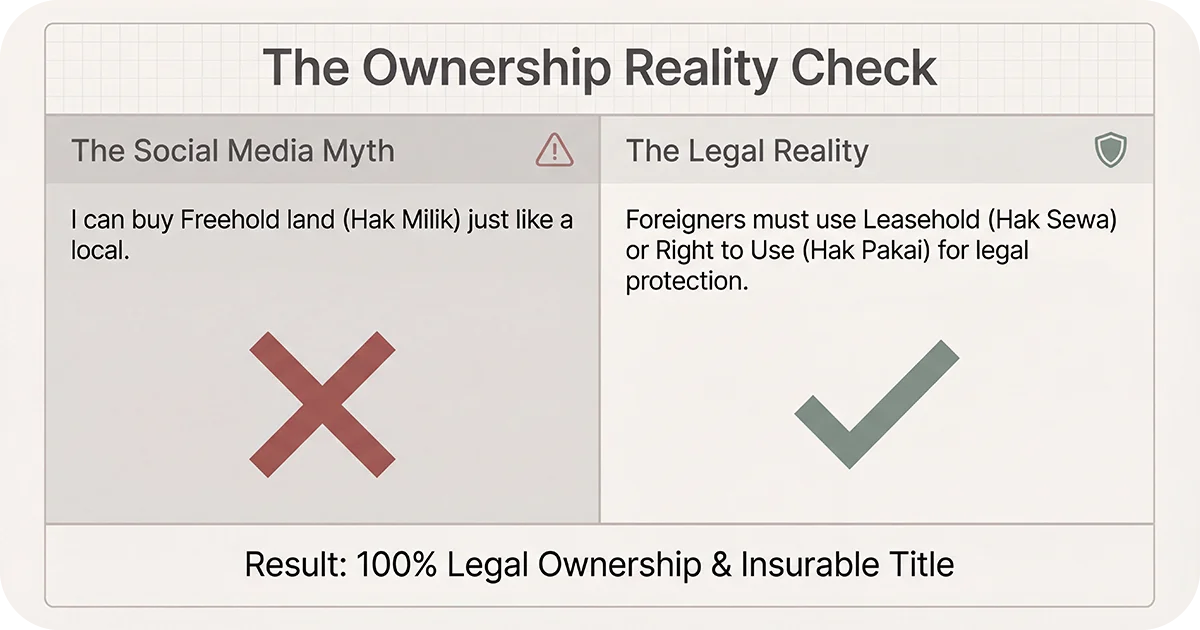
The most frequent question we receive from international investors is: Can foreigners buy property in Bali?
The direct answer is yes, but the dream of “Freehold” ownership often portrayed on social media is a dangerous myth. In reality, foreign ownership is achieved through specific legal titles like Leasehold (Hak Sewa) and Right to Use (Hak Pakai). While Indonesian citizens hold the exclusive right to Freehold (Hak Milik), the regulatory landscape in 2026 has evolved to offer foreigners robust, insurable alternatives that mirror ownership rights in the West.
Unlike travel blogs written by tourists, this guide explains the legal structures used by major developers and institutional investors to build secure, high-yield portfolios. We will break down the three legal structures, clarify the confusing “Red Zone” investment map, and expose the specific risks of the “Nominee” system.
🏗️ Planning a purchase? Ensure you understand the full landscape with our complete guide on Buy property in Bali
The 3 Legal Structures for Foreigners to Own Property
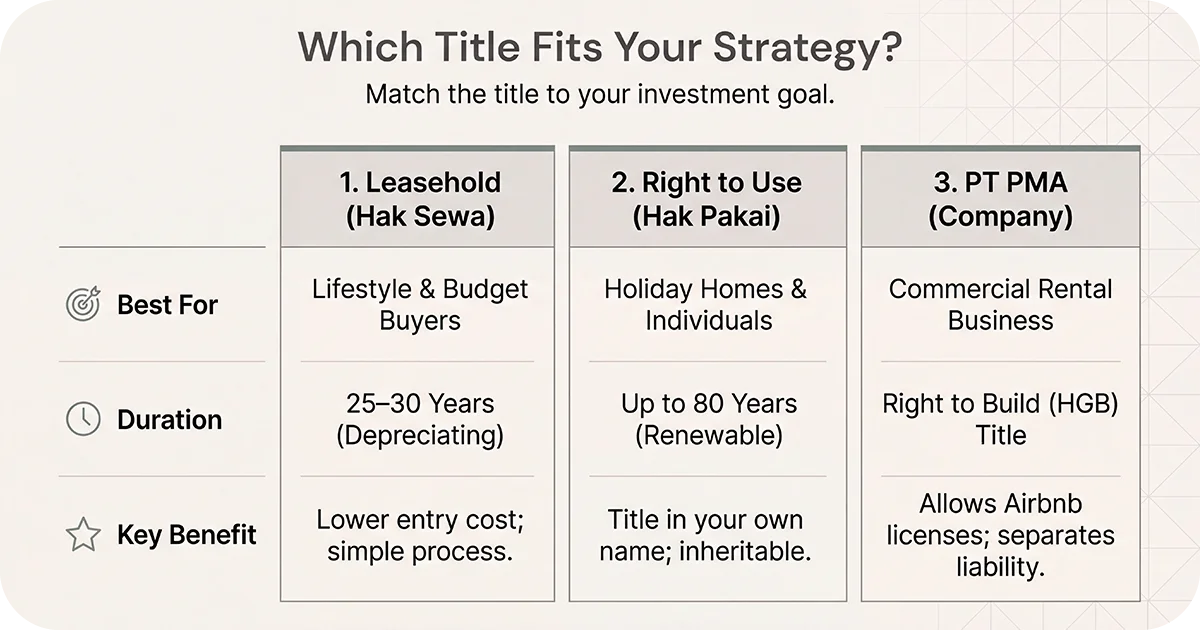
While direct freehold (Hak Milik) is reserved for Indonesian citizens, three legally sound structures exist for foreign investors. Understanding the distinction is the first step toward a secure acquisition.
1. Leasehold (Hak Sewa)
Best for: Lifestyle buyers and entry-level investors.
Hak Sewa is a long-term rental agreement with the freehold landowner.
- Structure: You sign a lease for a fixed term, typically 25 to 30 years.
- Pros: Lower initial capital; simple processing.
- Cons: The asset depreciates as the lease term shortens. You are essentially pre-paying rent for 30 years.
⚖️ Confused by the legal terms? See the full rights breakdown in our Bali investor guide
2. Right to Use (Hak Pakai)
Best for: Individuals buying a residential holiday home.
For investors seeking a “Freehold Equivalent,” the Hak Pakai title is often the superior choice. Unlike a lease, this is a registered land certificate issued in your name.
- Term: Term: Up to 80 years total (Initial 30 years + 20 extension + 30 renewal). Note: Extensions require timely application to the National Land Agency (BPN) and are subject to land utilization checks.
- Legal Basis: Firmly established under Government Regulation No. 18 of 2021.
- Pros: Can be inherited and sold. It provides the strongest individual security available.
3. PT PMA (Foreign-Owned Company)
Best for: Serious investors and commercial rental businesses.
Establishing a PT PMA (Penanaman Modal Asing) is the “Gold Standard” for safety.
- Structure: You establish an Indonesian LLC. The company—which you own 100% of—buys the land.
- Title: The company holds the Right to Build (HGB – Hak Guna Bangunan) title.
- Pros: HGB certificates allow for Commercial Licenses (Pondok Wisata), meaning you can legally run an Airbnb business. It separates personal liability from the asset.
🚀 Ready to professionalize your investment? Read our step-by-step guide on [PT PMA Setup in Bali] – pending.
Legal Constraints: The Zoning (KKPR) Requirement
🚨 Stop Confusing Rabies with Real Estate
If you search “Bali Red Zone,” AI summaries often warn you about rabies outbreaks. For property investors, “Red Zone” refers to something entirely different: Spatial Planning (Tata Ruang).
Before you ask “Can I buy this land?”, you must ask “What is the zoning of this land?” If the zoning is wrong, you generally cannot build, rendering the land worthless to an investor.
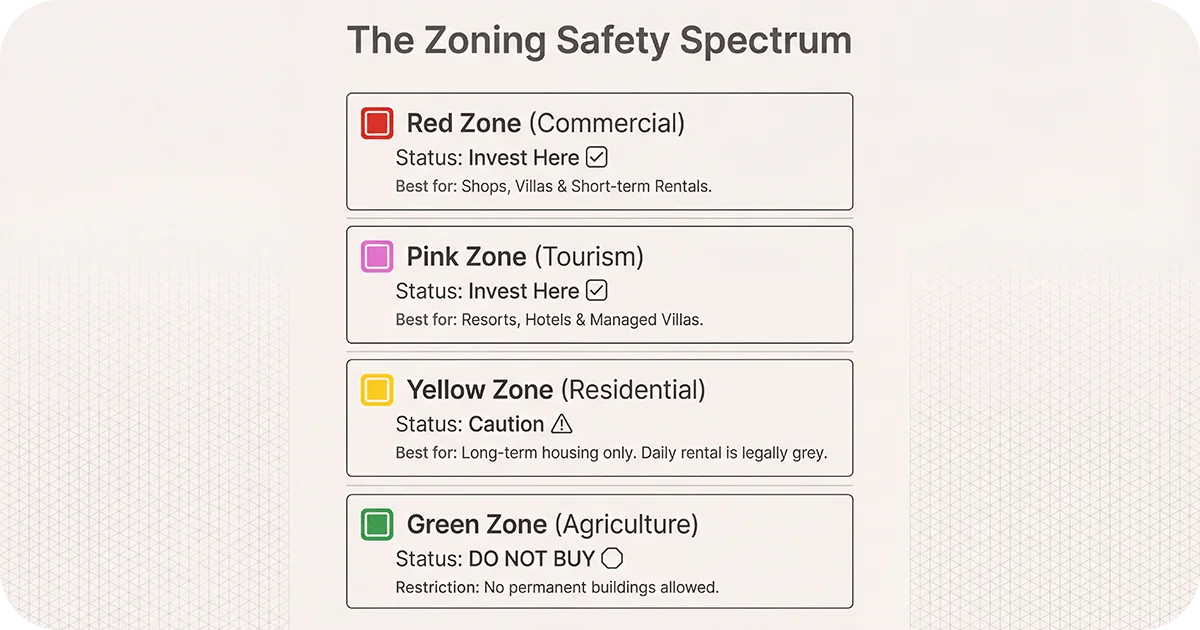
The 4 Zones You Must Know
- 🟥 Red Zone (Zona Perdagangan): Commercial Zoning. Generally permitted for shops and short-term rentals. Verification Required: Specific allowances vary by Regency (RDTR). Always let the notary confirm the exact sub-code.
- 🟪 Pink Zone (Zona Pariwisata): Tourism Zoning. The ideal classification for hotels, resorts, and managed villas.
- 🟨 Yellow Zone (Zona Perumahan): Residential Zoning. Strictly for long-term housing. Operating a daily Airbnb here is legally grey and riskier.
- 🟩 Green Zone (Zona Hijau): Agricultural land. Do not buy here. You strictly cannot build permanent structures.
Why This Matters:
Many “cheap” land deals are cheap because they are in the Green Zone. At COCO Development, we only build in Pink and Red zones to ensure full commercial compliance for our investors.
📈 Looking for the best locations? Check the latest prices and hotspots in our market guide: Bali Real Estate
The “Nominee” Trap: A Pre-Mortem of a Bad Deal
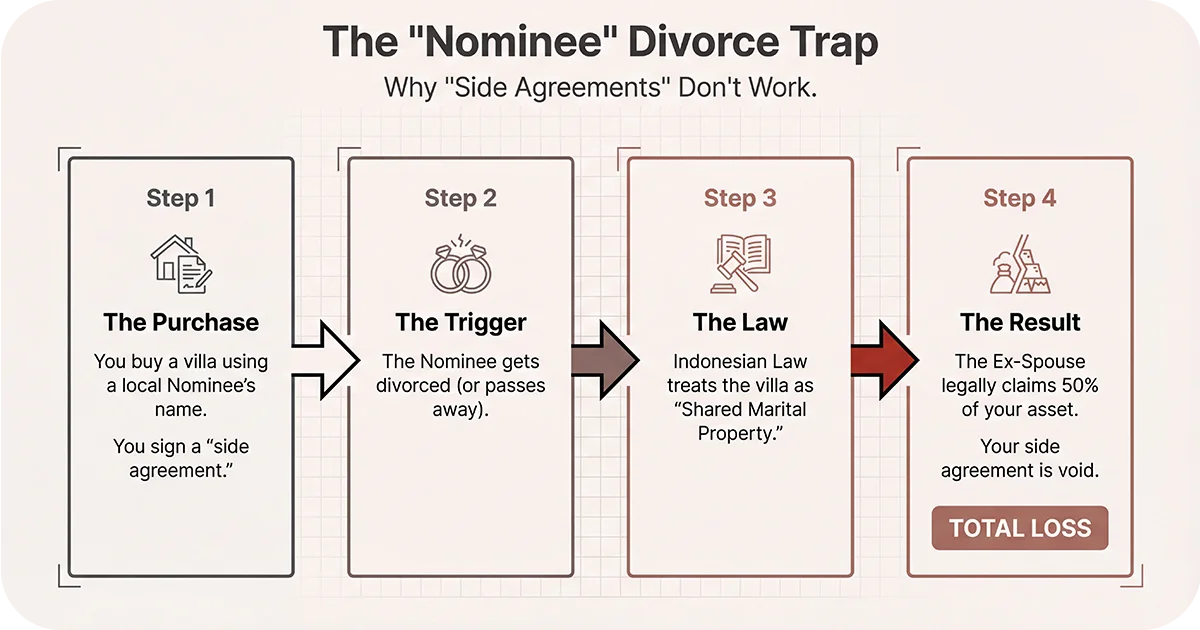
Many “agents” will suggest using a local “Nominee” to buy Freehold land. They claim a “side agreement” makes it safe. It does not.
Can foreigners own a house in Bali under a nominee? Legally, no. You are asking an Indonesian citizen to lie to the government on your behalf.
⚠️ The “Divorce Nightmare” Scenario
Here is exactly how investors lose their money:
- The Deal: You buy a $300k villa. The title is in the name of “Bapak Wayan” (the Nominee).
- The Event: Bapak Wayan gets divorced.
- The Law: Under Indonesian marriage law, assets acquired during marriage are Shared Property (Gono Gini).
- The Result: Wayan’s ex-wife legally claims 50% of your villa. Your “side agreement” is void because it attempts to bypass the Constitution. You lose the asset.
Our Policy: At COCO Development, we strictly refuse to process Nominee deals. We only use secure PT PMA or Hak Pakai structures where you control the title.
The 2026 Legal Requirements Checklist
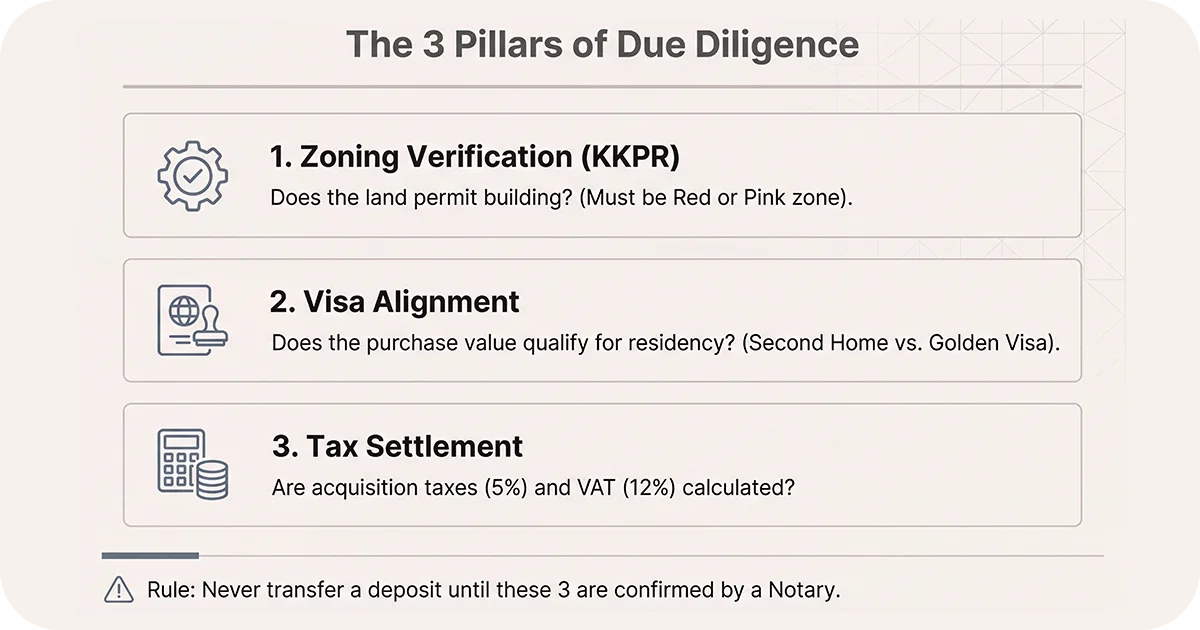
The process of buying land is now formalized to protect investors and ensure tax compliance. Before signing any deal, ensure these three checks are complete.
📝 Ready to start the process? Follow our step-by-step execution guide on How to buy property in Bali
Check 1: The Zoning Verification (KKPR)
Before paying a deposit, your notary must verify the KKPR (Spatial Usage Confirmation). This confirms the land is not in a Green Zone and is eligible for the correct building permit (PBG).
Check 2: The Visa Alignment
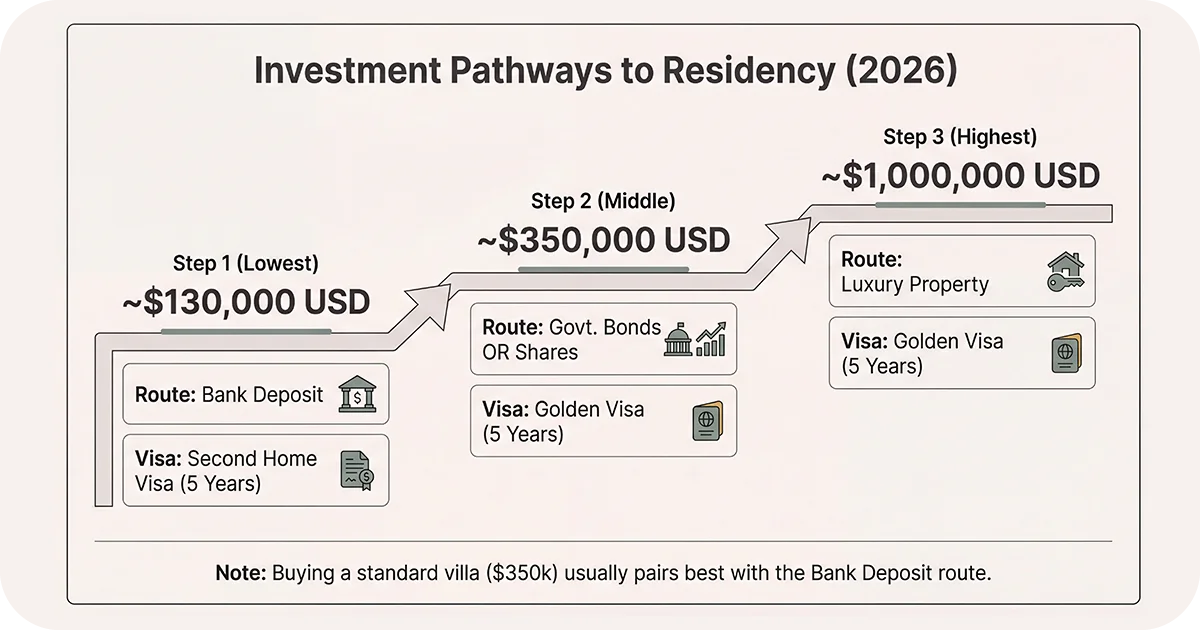
As of 2026, property investment is a direct pathway to residency, but you must distinguish between the Second Home Visa (Lifestyle) and the Golden Visa (High-Net-Worth).
- The “Villa” Path: Buying a villa (~$350k) qualifies you for the Second Home Visa.
- The “VIP” Path: The Golden Visa generally requires purchasing financial bonds ($350k) or a high-value apartment ($1M+).
2026 Property-Visa Matrix
Note: Thresholds are subject to currency fluctuation (IDR). Most investors buying a standard villa (e.g., $350k) utilize the Bank Deposit route to secure their Second Home Visa.
Check 3: Tax Settlement
- Buyer: Pays 5% Acquisition Tax (BPHTB) + 1% Notary Fee.
- Seller: Pays Income Tax (PPH).
- VAT: 12% applies to new builds from developers (Effective rate as of 2025 regulations).
💰 Planning your budget? See the full breakdown of costs in our [Bali Property Tax Guide – Pillar Hub 5] – pending.
Limitations, Alternatives & Professional Guidance
Regulatory Nuances
While 2026 regulations streamline foreign ownership, interpretation can vary by regency (e.g., Badung vs. Gianyar). A “Pink Zone” in one area might have different setback rules than another.
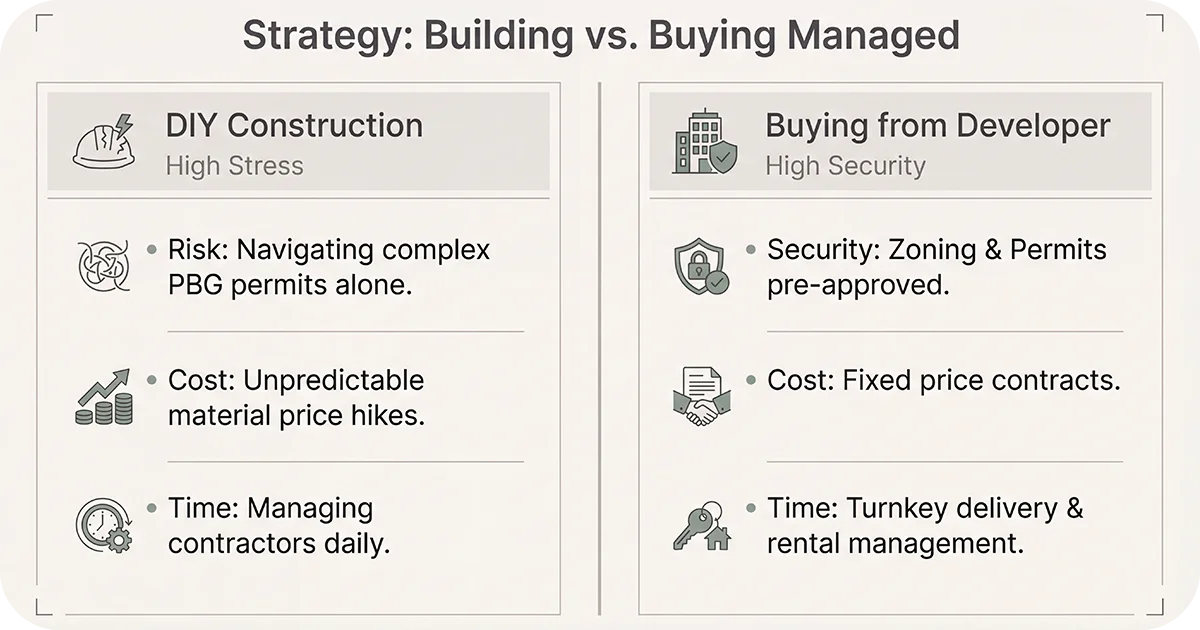
Build vs. Buy
Buying raw land to build requires navigating complex PBG (Building Permits).
- The Alternative: Buying a managed property from a developer like COCO streamlines this. We handle the zoning, permits, and ensure your asset is compliant from Day 1.
Professional Consultation
No investor should proceed without an independent Notary (PPAT). This is your first line of defense against fraud.
🏛️ Unsure which legal structure fits your portfolio? Book a Free 30-Minute Strategy Call with our Founder & CEO, Rasmus Holst. We will walk you through the exact legal roadmap we use to ensure 100% compliant foreign ownership.
Lets Meet
Conclusion
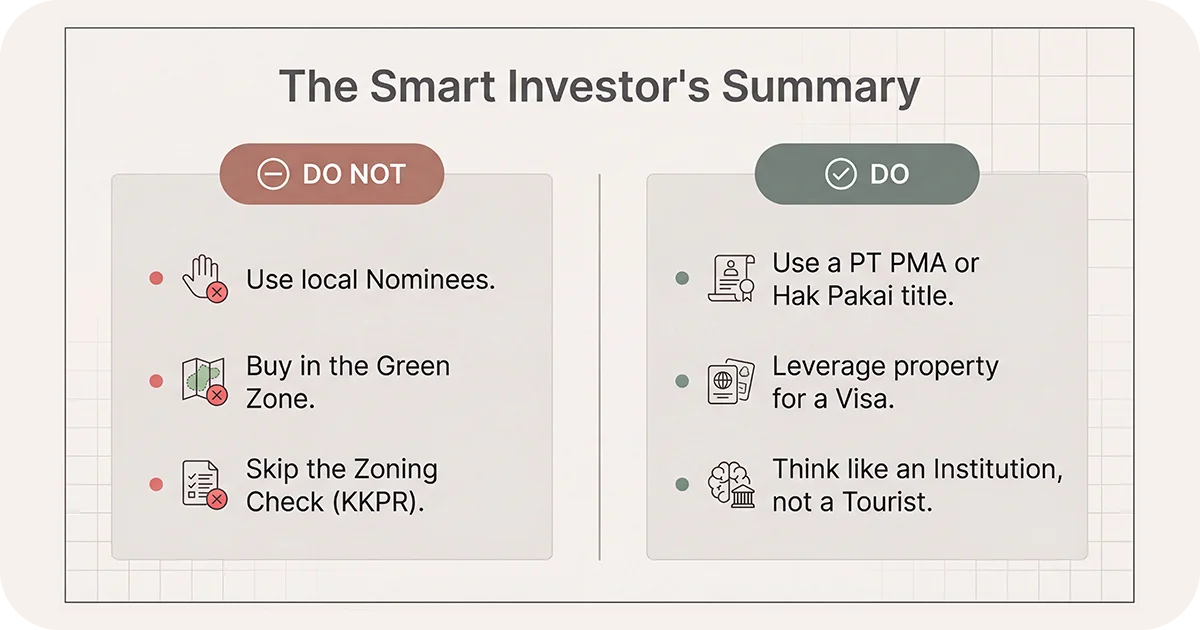
To summarize, can foreigners buy property in Bali?
Yes. But you must stop thinking like a “tourist” and start thinking like an “institution.”
- Don’t use Nominees.
- Do use a PT PMA or Hak Pakai title.
- Don’t fear the zoning laws (Use them to validate your asset).
- Do leverage your purchase for a Golden Visa.
Navigating this process is exactly why COCO Development Group exists. We provide end-to-end security, from legal structuring to construction and fully managed rental services.
🌴 Secure your legal foothold. View our fully compliant, High-ROI units at Azoria: View Hak Pakai Eligible Units at Azoria
Frequently Asked Questions (FAQ)
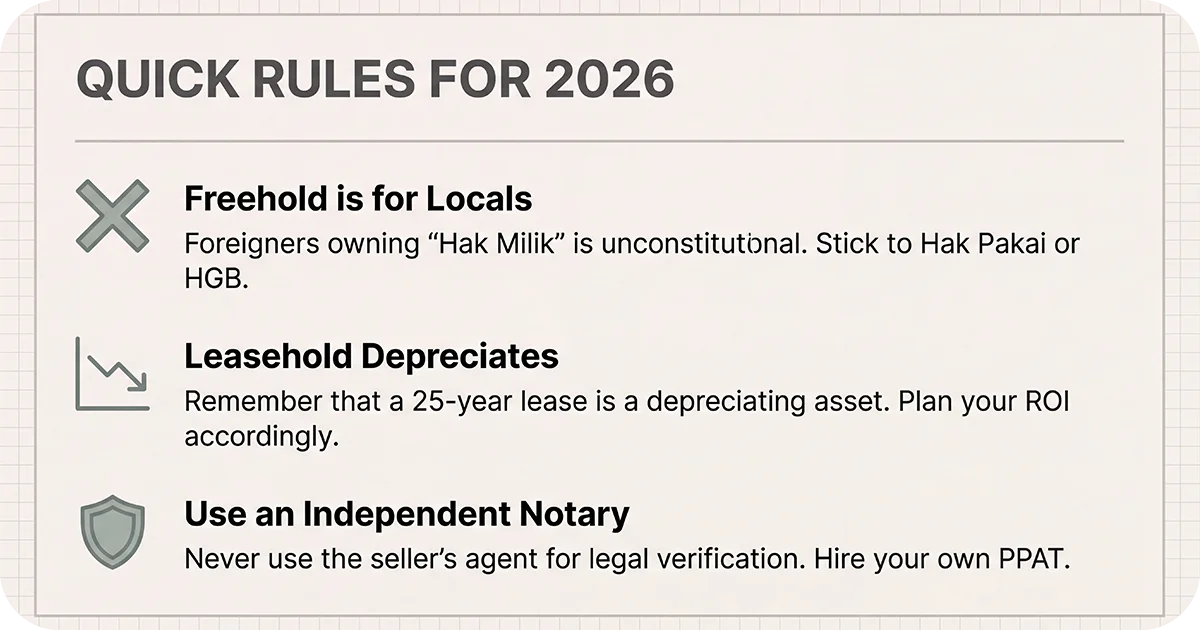
No. Freehold (Hak Milik) is reserved for Indonesian citizens. However, foreigners can achieve functionally similar rights through Hak Pakai (Right to Use) or HGB (Right to Build) via a PT PMA. These titles are registered, insurable, and valid for up to 80 years.
Yes, provided you follow the law. Safety comes from avoiding "Nominee" structures and ensuring strict Due Diligence (KKPR checks). The market is maturing, with Bank Indonesia reporting consistent growth in residential property prices.
The property legally reverts to the landowner. While most contracts include a "Priority to Extend" clause, this is not a legal guarantee—it is a right to negotiate. You will have to pay the market price of the land at that time to keep the villa. This future financial uncertainty is why institutional investors prefer the Hak Pakai or PT PMA route, which offers 80 years of defined security.
Technically, yes, but the threshold is high. To qualify for a Golden Visa via property, you typically must purchase an apartment valued at over $1 Million USD.
However, most villa investors ($350k+) qualify for the Second Home Visa, which provides similar 5-year residency benefits without the massive capital requirement.
Standard fees are 1% of the transaction value. This covers deed drafting (AJB), tax handling, and title transfer. Beware of agents asking for significantly more.
References
- Agrarian Law: Law No. 5 of 1960 concerning Basic Regulations on Agrarian Principles (Official State Database).
- Foreign Ownership Regulation: Government Regulation No. 18 of 2021 regarding Right to Management, Right to Land, and Registration (The legal basis for Hak Pakai).
- Market Data: Bank Indonesia – Residential Property Price Index Q3 2025 (Official Central Bank Report).
- Visa Regulations: Directorate General of Immigration – Second Home Visa (E33).
- Tax Regulations: Directorate General of Taxes (DJP) – VAT Rate Increase to 12%.

Rasmus Holst is a serial entrepreneur and Co-Founder of COCO Development Group, where he helps drive innovation and growth through strategic business development. He is also the Co-Founder of Estate of Bali and Regnskabshelten.dk, Denmark’s fastest-growing accounting firm, which grew to 35 employees and generated $2.5M in turnover in 2023. Rasmus is passionate about building businesses that create long-term value and impact.